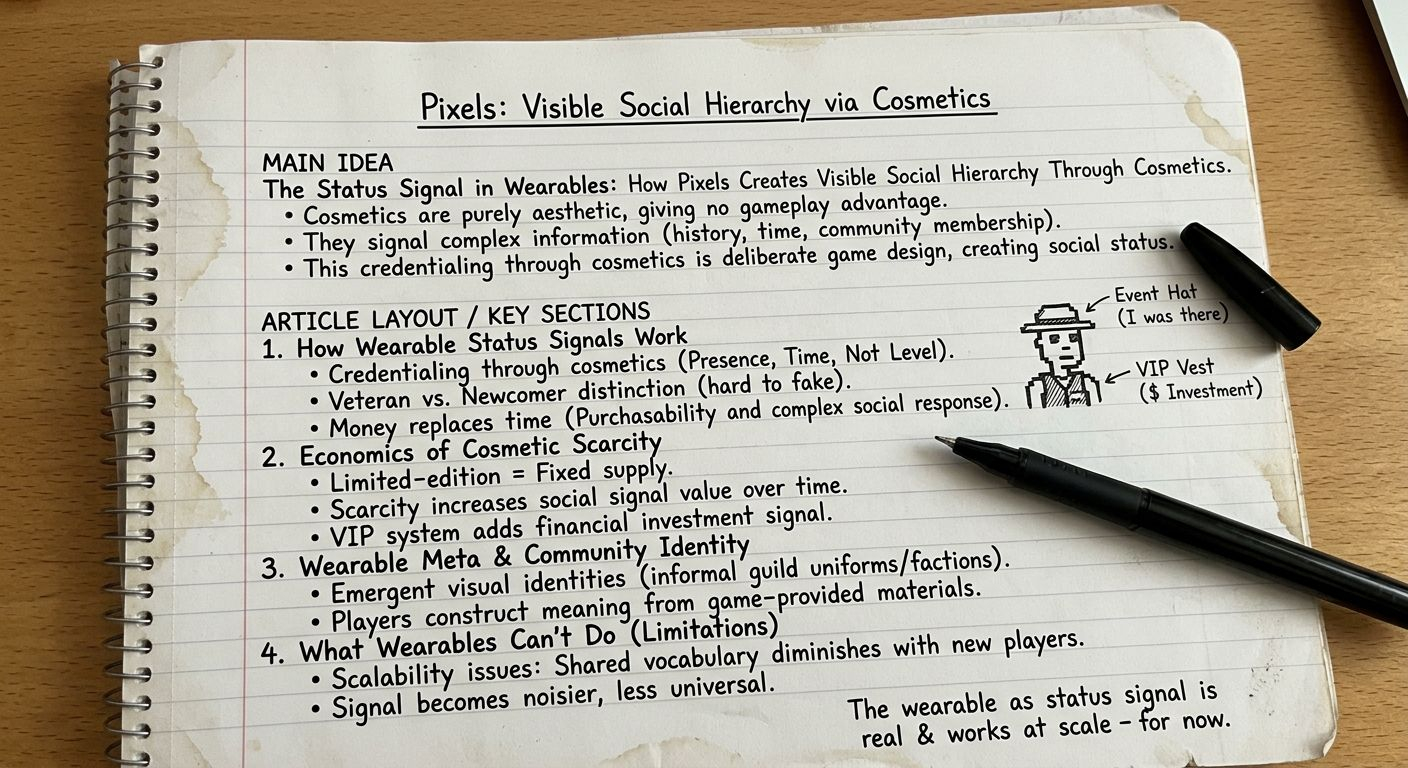
I want to talk about something that operates beneath the surface of how Pixels players interact with each other and that I think the game has engineered more deliberately than it appears.
When you encounter another player in Terra Villa, you see their avatar. The avatar is wearing things: wearables, cosmetic items that don't provide gameplay mechanics advantages but that are visible to everyone in the shared space. The game documentation is clear that cosmetics give no competitive edge. They're purely aesthetic.
They are not, however, purely information-neutral. What you're wearing in Pixels communicates something to every player who can read the vocabulary, and that vocabulary is complex, evolving, and deeply tied to community membership and temporal history.
How Wearable Status Signals Work
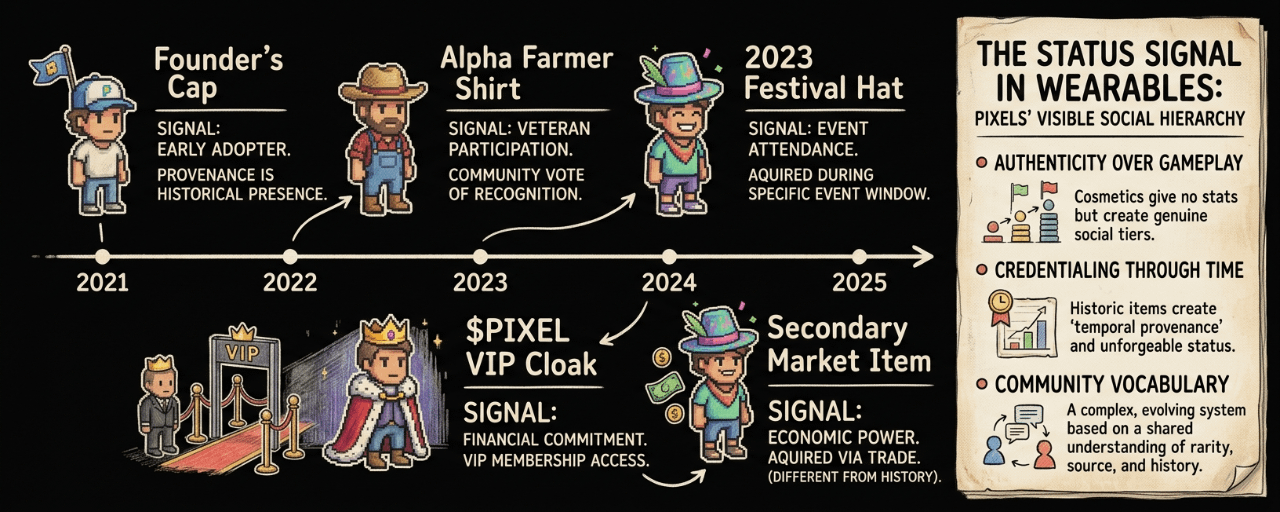
A wearable that was available only during a specific past event cannot be replicated. If the Winter Festival wearable was released once, in a specific window, to players who participated in that event, then seeing that wearable on another player's avatar tells you something unambiguous: that player was there. They were active during that period. They are not a new account. They are not someone who showed up during the bull run and left.
This is credentialing through cosmetics. The wearable doesn't say "I am Level 50 in farming." It says something harder to fake and in some ways more meaningful: "I have been here for long enough to have been present when this existed."
In a community where the veteran-newcomer distinction is one of the primary social categories, this is powerful information. It's the equivalent of a guild badge that you didn't choose, because you can't retroactively acquire presence at a past event.
The secondary market exists for most wearables: you can buy them from players who have them. This introduces money as a substitute for time, which is a specific kind of social complexity. A wealthy newcomer can acquire a veteran's cosmetic without the veteran's history. The wearable that was a credential becomes purchasable.
The community response to this is interesting and largely unsaid. There's a quiet distinction between players who earned a cosmetic through presence and players who purchased it on the secondary market. Not a formal distinction. Not enforced. But real, and perceptible in how people respond to specific wearables in community conversation.
The Economics of Cosmetic Scarcity
Pixels has built something that luxury goods industries understand deeply: genuine scarcity creates durable value, and durable value creates social signal that money can partially but not fully reproduce.
A limited-edition wearable from a past event has a fixed supply. The total number in existence cannot increase. As the game grows and more new players join, the proportion of players who have that wearable decreases, which means the social signal it carries increases. The early holder of a now-scarce cosmetic is in a position that gets relatively more valuable over time without any additional action.
This is the economics of provenance applied to a 16-bit farming game. The wearable isn't worth what it is because of what it does. It's worth what it is because of what it represents: participation in something specific, at a specific time, that is now closed.
$PIXEL plays into this through the VIP system. VIP membership in Pixels provides access to exclusive areas, including, at various points, exclusive wearable drops and item access. The VIP tent in Terra Villa, purchasable with $PIXEL, is itself a visible marker: a player who has invested real tokens into their account is signaling something about their commitment level that a purely free player cannot match.
The VIP signal is different from the event signal. It says: I am invested financially. The event wearable says: I was here historically. Both are forms of community currency. They're not equivalent and the community doesn't treat them as equivalent.
The Wearable Meta and Community Identity
Something I've watched develop over my time in Pixels is an informal wearable meta: specific combinations and aesthetic choices that signal particular community identities or affiliations.
Guild members sometimes coordinate aesthetic choices. Players associated with specific community factions develop visual identities. The social recognition that comes from being visually identifiable to your community members has real social value in a shared world where you're encountering people constantly.
This is behavior the game doesn't engineer directly. There's no guild uniform system, no formal coordination mechanism for avatar aesthetics. It emerges from players who find social value in visual group identity and act on that finding.
What the game does engineer is the material: a supply of varied cosmetics with different histories and values, distributed through events and marketplace and VIP access, that gives players enough material to construct meaningful visual identities. The construction happens on the player side. The material is the game's provision.
What Wearables Can't Do
There's a limit to what cosmetic signaling can sustain. Social hierarchies built on visible status symbols are real but fragile: they depend on the community sharing a reading of the symbols, on the symbols having stable meaning, on new members learning the vocabulary fast enough to participate meaningfully in the signaling system.
As Pixels grows and the new player cohort becomes a larger proportion of the community, the shared vocabulary around wearable significance becomes less universal. A veteran's event wearable from 2023 is legible to another 2023-era player and opaque to someone who joined in 2025. The signal exists but the audience for it shrinks as the community's temporal composition changes.
The game hasn't fully addressed this. There's no formal system for marking item provenance in-game. The wiki tracks event histories but that knowledge requires deliberate research. The signal that was clear in a smaller community becomes noisier in a larger one.
The wearable as status signal is real and it works at current community scale. Whether it scales with the community to larger audiences, or whether the signal degrades into noise as the reading community fragments, is one of the less obvious challenges the Pixels aesthetic economy will face as the game grows.
What I know is that the first thing I notice when I encounter an interesting-looking avatar in Terra Villa is what they're wearing and whether I recognize it. I'm reading the signal even when I can't fully decode it. That's the evidence that the system is working.