
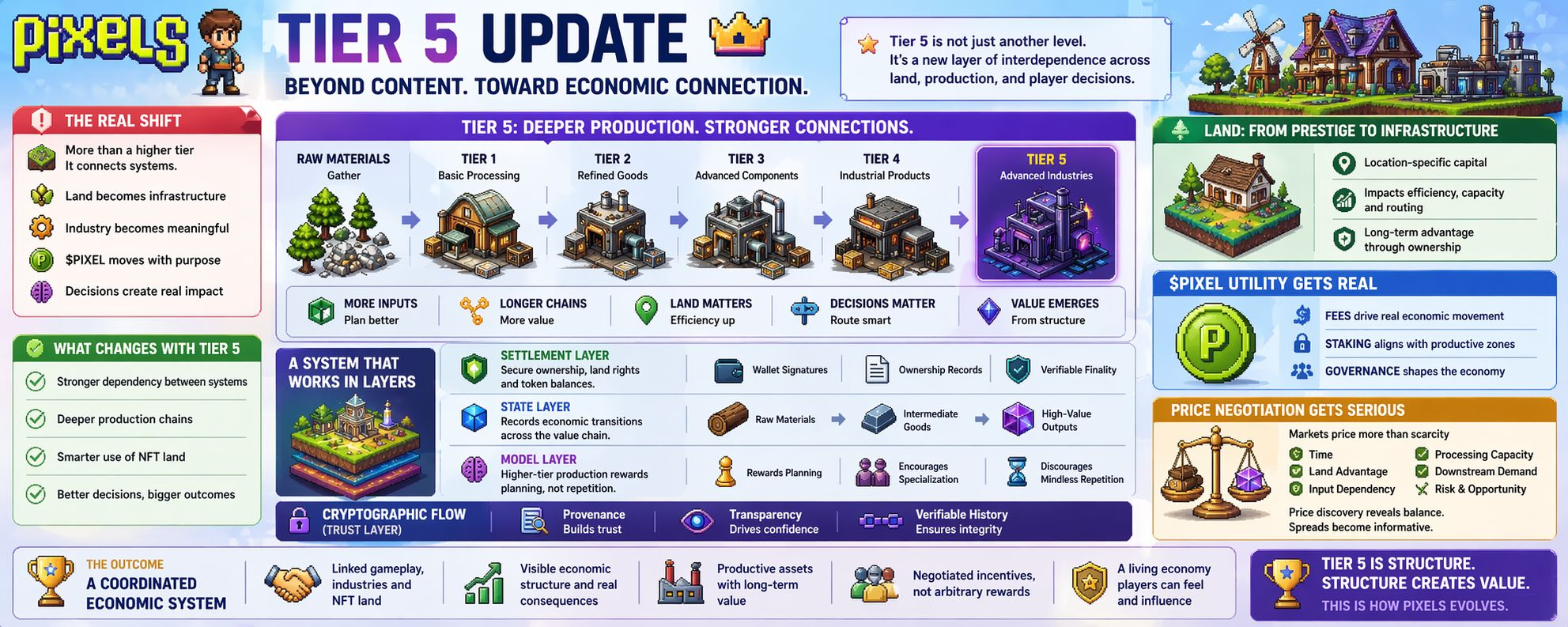

What caught my attention with this Pixels update is not the Tier 5 label by itself, but the way it changes what everyday play is supposed to mean.
I have seen plenty of game economies add a higher tier and call it progress when the real result is only a longer grind.
Here the more interesting question is whether a new tier can make land, production, and player decision-making feel structurally connected. That is the part I keep coming back to.
The main friction in these systems is usually not a lack of content. It is a lack of economic consequence.
Players gather, craft, and upgrade, but the loop often stays flat because each action looks busy without changing the structure underneath. Land becomes cosmetic prestige, industry becomes a checklist, and the token sits beside the game instead of inside its logic.
It feels less like adding one more level to a game and more like adding a new floor to a factory that forces the elevators, storage rooms, and workers to move in sync.
That is why this update matters to me. A higher tier only becomes meaningful when it increases dependency between systems.
If advanced industries require more deliberate inputs, tighter production chains, and stronger use of NFT land, then the network starts shifting away from isolated actions and toward linked economic behavior.
The value is not that players can do more. The value is that they have to think harder about where production should happen and what kind of output is actually worth pushing through the chain.
In practical terms, the problem this can address is fragmentation. A lot of lighter game economies suffer from scattered incentives.
Farming exists in one lane, crafting in another, land utility somewhere else, and token demand is expected to appear automatically just because all the parts sit in the same ecosystem.
That rarely works. Tier 5 gives the network a chance to connect those lanes. When production depth increases, land stops being a badge and starts behaving more like infrastructure.
When infrastructure matters, routing matters. When routing matters, pricing becomes less arbitrary.
For that to hold, the system has to work in layers.
At the settlement layer, the important thing is dependable finality around asset ownership, land rights, and token balances. At the state layer, the update matters because it expands the number of meaningful transitions the economy can record: raw materials into intermediate goods, then into higher-value outputs.
At the model layer, the design challenge is making sure higher-tier production is not just numerically expensive, but structurally selective. It should reward planning, not only repetition.
The cryptographic flow is easy to ignore, but it is part of the trust model. Wallet signatures define custody. Ownership records define who can use, trade, or benefit from digital land and assets.
The application layer can move quickly, but settlement still needs a verifiable trail whenever scarce items, land-linked advantages, or tokenized rewards are involved.
The more complex the industrial loop becomes, the more important provenance becomes.
I also think the land angle becomes serious here. In a shallow economy, NFT land can look like a premium wrapper around ordinary gameplay. In a deeper one, land starts acting as location-specific capital.
That changes the conversation. Ownership is no longer just about status or access, but about production efficiency, allocation decisions, and long-term planning.
The utility of $PIXEL becomes more credible in that environment. Fees begin to make sense when they are attached to real movement across the economy rather than abstract participation.
Staking becomes more defensible when it reflects commitment to productive zones or aligned growth instead of passive waiting. Governance becomes more interesting when players and asset holders are not voting over vague promises, but over the parameters that shape a live production system.
The price negotiation piece is where I think the update becomes serious. Once more production stages exist, pricing can no longer rely on simple scarcity stories.
The market has to negotiate time, land advantage, input dependency, processing capacity, and expected downstream demand. That creates spreads between raw resources and finished goods that are more informative than a basic farm-and-sell loop. Price discovery starts revealing whether the system is balanced.
What I like about this direction is that it does not need dramatic claims to matter. It only needs internal logic.
If Tier 5 pushes the network toward stronger interdependence between gameplay, industries, and NFT land, then the update is doing something more valuable than adding content. It is making economic structure visible.
And once structure becomes visible, the game starts feeling less like a loose reward loop and more like a coordinated system with productive assets, negotiated incentives, and consequences that can actually be felt over time.
