
Let me start with something that feels increasingly hard to ignore…
The more I observe official updates around Pixels, the less it looks like a traditional game. What’s emerging instead is a network of interconnected systems, quietly expanding beneath the surface.
As we move closer to 2026, Pixels no longer feels like a single, cohesive experience. It’s becoming a layered ecosystem. And while that sounds polished from the outside, the internal structure is far more complex—and not nearly as clean. That tension is where things get interesting.
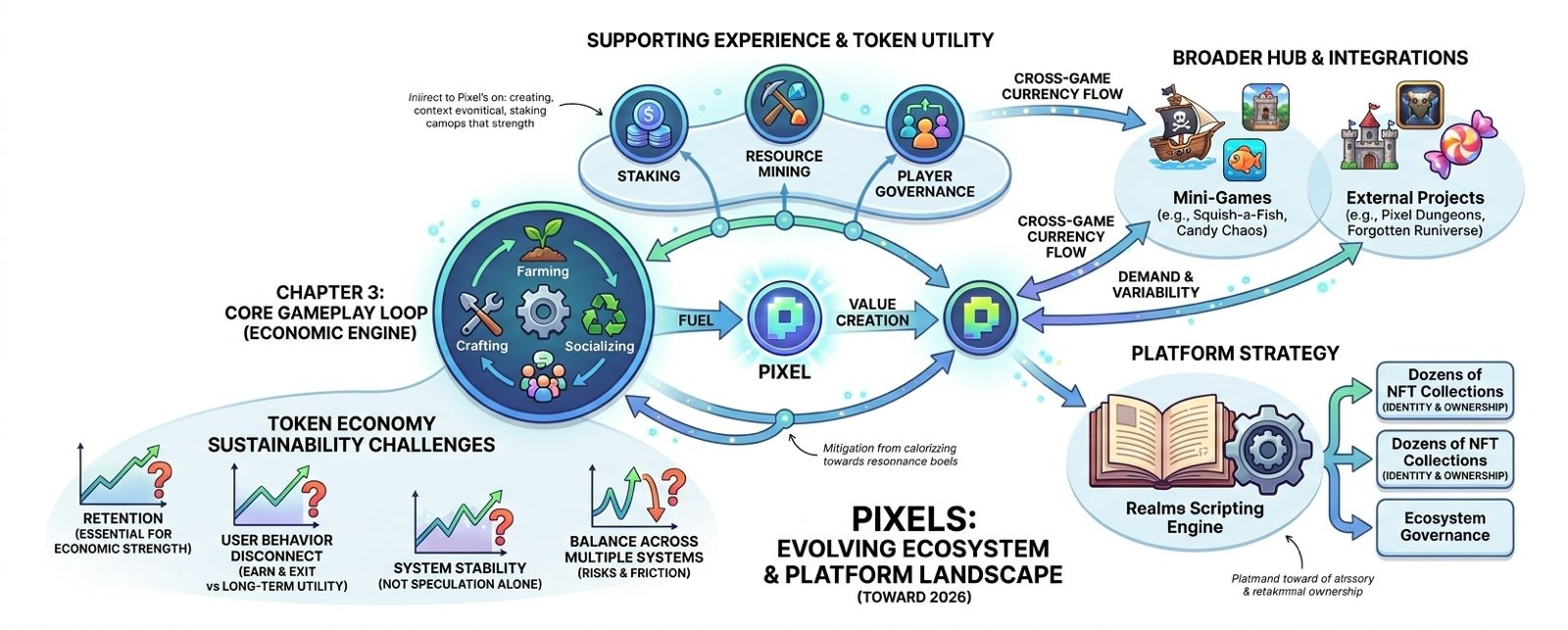
At the center of everything, Chapter 3 still acts as the core. Farming, crafting, and social interaction are presented as simple loops, but underneath, they function as economic engines. What appears to be a soft casual game is, in reality, a system designed to sustain a token-driven economy. Players produce, trade, and recycle value in a loop that extends beyond gameplay itself.
If you look at it structurally, Pixels is no longer just one game—it’s supported by multiple experiences tied together through staking and token utility. On top of that, it’s evolving into a broader hub, integrating mini-games and external projects.
That leads to the obvious question: how stable is this system?
There isn’t a clear answer. Economies like this don’t survive on speculation alone—they require consistent, meaningful utility. Pixels is moving in that direction, but it hasn’t fully arrived. Being ranked among top Web3 games is a positive signal, but rankings in this space are notoriously unstable. Visibility doesn’t guarantee durability.
The real shift is happening at the ecosystem level. Pixels is extending beyond its own boundaries, pushing its token into other games. That’s where the model begins to change—not just improving gameplay, but strengthening the broader cycle of value.
Projects like Pixel Dungeons and Forgotten Runiverse highlight this direction. Different genres, different player behaviors, yet tied to the same token flow. The ambition is clear: to position PIXEL as a cross-game currency.
But that’s where complexity increases. Different game economies don’t behave the same way. Demand in one environment can weaken another. Maintaining balance across multiple systems becomes a delicate act—and a risky one. Expansion adds opportunity, but it also introduces friction.
Then there are the mini-games—Squish-a-Fish, Candy Chaos. At first glance, they feel almost trivial. But they serve a deeper purpose. These are retention tools, designed to keep users engaged in short, repeatable loops.
It’s a familiar pattern: one quick session turns into nearly an hour.
And in Web3 gaming, retention isn’t optional—it’s essential. Without it, the entire token economy begins to weaken.
Zooming out further, Pixels seems to be positioning itself as more than just a game. The Realms scripting engine and NFT integrations point toward a platform strategy. Supporting dozens of NFT collections isn’t just cosmetic—it’s an attempt to build identity and ownership across the ecosystem.
This marks a shift from “game” to “platform.”
But becoming a platform comes with its own challenges. It requires managing not just gameplay, but governance, incentives, and economic balance. This is where many projects struggle to scale.
At the center of it all is the token itself.
PIXEL is clearly moving toward utility, trying to become more than just a reward mechanism. But user behavior hasn’t fully caught up. Many participants still approach it with an “earn and exit” mindset. That disconnect is one of the biggest challenges ahead. A long-term economy can’t be sustained if short-term extraction dominates.
What stands out most is that Pixels feels like it’s in transition.
On one side, it’s a growing, interconnected system—games, integrations, NFTs, all expanding together. On the other, it’s still an experiment, not yet a fully stable economy. Both realities exist at the same time.
Some moments, it feels like the foundation of a new gaming model.
Other times, it raises the question—has it become too complex for its own good?
In the end, Pixels isn’t a finished product. It’s an evolving system.
And systems like this don’t succeed based on design alone—they depend on time, balance, and how users choose to engage with them.
Right now, it sits somewhere in between.
Not driven by hype, not defined by failure—just slowly unfolding.