

I caught myself opening the PIXEL chart again tonight—not out of conviction, just habit. Like rereading a conversation I already understand, but still scanning for a different ending.
That’s the strange gravity of projects like Pixels. They don’t pull you in because they’re clearly winning… they pull you in because they might. They live in that uncomfortable space between potential and déjà vu.
On the surface, nothing about Pixels is groundbreaking. It’s farming, exploration, social loops—familiar mechanics stitched together on Ronin. In a space addicted to reinvention—AI overlays, modular stacks, restaking spirals—there’s something almost refreshing about that simplicity.
But in Web3, simplicity is rarely simple. It’s usually a mask over a system that’s constantly under economic stress.
And the market has already delivered its verdict, at least partially. A drop from over $1 to fractions of a cent isn’t just volatility—it’s a full reset. The kind that forces you to ask whether demand was ever real, or just perfectly timed attention.
What makes it harder to dismiss is that Pixels actually has users. Not vanity metrics—real activity, real players showing up. That alone puts it ahead of most Web3 games that quietly fade without anyone noticing.
But I’ve learned not to trust user numbers at face value here.
In Web3, a “player” is often just an economic participant wearing a different label. And the moment incentives weaken, behavior shifts. Not dramatically at first—just enough. Then suddenly, all at once.
I’ve seen this cycle enough times that it feels predictable:
First comes growth—easy onboarding, smooth UX, cheap transactions.
Then liquidity—tokens start moving, narratives build, everyone feels “early.”
Then pressure—more users, more rewards, more extraction.
And finally… fatigue.
That quiet phase where things don’t collapse—they just slow down, stretch thin, and start getting tested.
That’s where Pixels feels like it is right now.
Not dead. Not thriving. Just… under pressure.
What’s interesting is that it hasn’t disappeared. It’s still active, still generating volume, still finding pockets of attention. That usually means there’s something real underneath—or at least something sticky enough to keep the cycle going.
Maybe both.
But the core problem hasn’t gone anywhere. It never does.
Web3 gaming is still trying to answer the same question it’s been asking for years:
how do you build an economy where players don’t eventually take out more than they put in?
Because if they do, the system drains itself. Slowly, then suddenly.
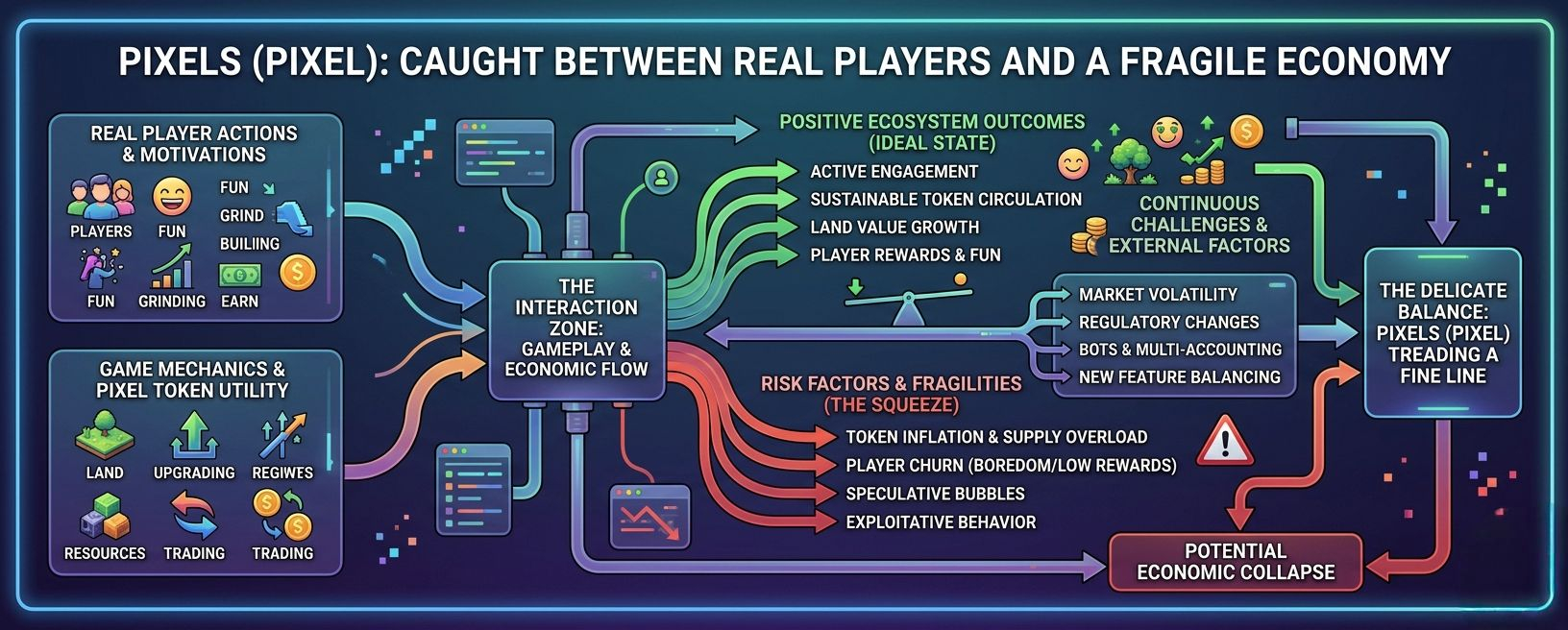
Pixels tries to counter that with social layers—guilds, progression, ownership loops. The idea is to make people stay because they want to, not because they’re extracting value.
But that balance is fragile.
Players don’t think in tokenomics—they feel friction.
If rewards drop, they notice.
If progression slows, they feel it.
If price bleeds, it changes behavior whether they admit it or not.
And that’s the part most people underestimate:
even if the game is genuinely fun, the existence of a token changes everything.
It shifts incentives. It reframes decisions. It turns play into strategy.
And once that happens, the game is no longer just competing with other games—it’s competing with the entire market.
That’s when things get messy.
Because now people aren’t asking if it’s enjoyable—they’re asking if it’s undervalued. And those are very different questions.
Still… I can’t fully write it off.
Pixels shipped. It scaled. It didn’t break under pressure. That alone puts it ahead of most experiments in this space.
But it’s also carrying the weight of a system that hasn’t been solved yet.
And maybe that’s why I keep coming back to it—not because I’m convinced, but because I’m not.
Because somewhere between the farming loops and the price chart, there’s still an open question.
And in this market, the projects that keep you questioning are usually the ones worth watching… even if it’s just late at night, out of habit.
