
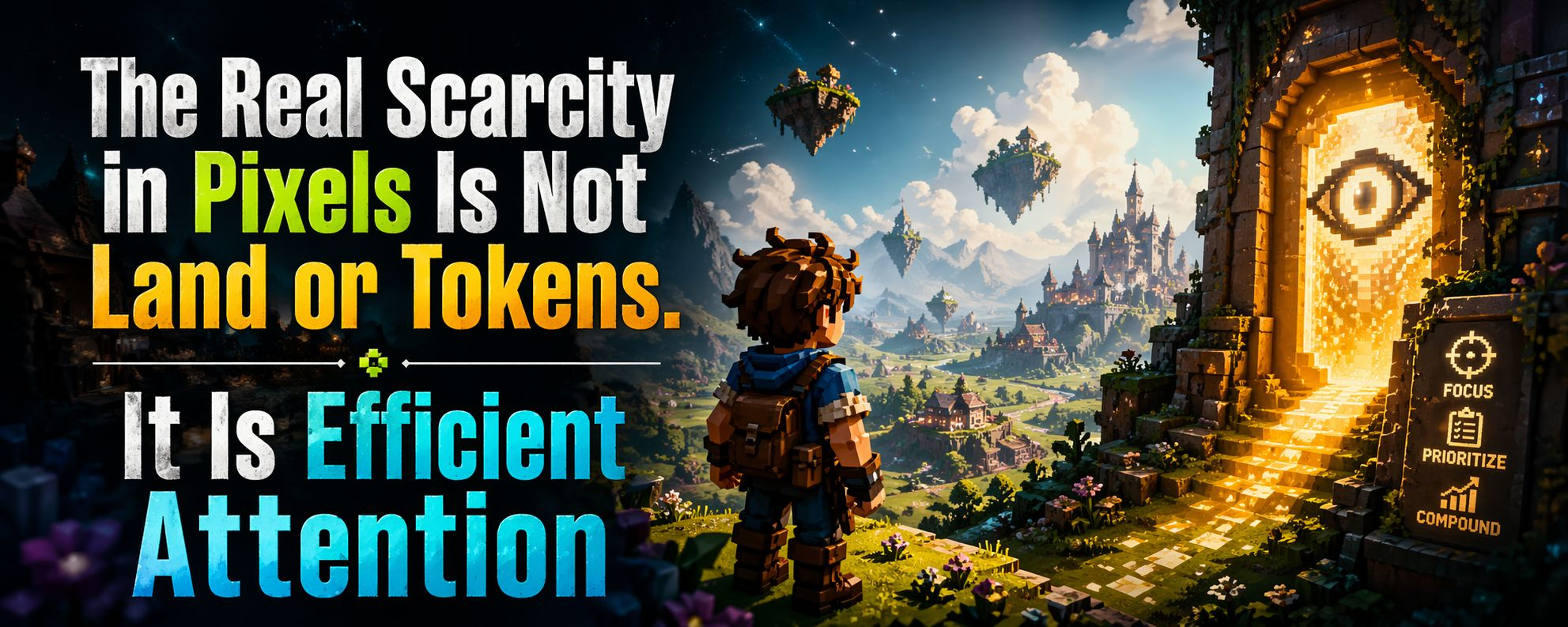

The longer I watch Pixels, the less I think it is a story about digital property.
That is the default way people read it, and I understand why. Land is visible. Tokens are measurable. Those are the cleanest things to point at, so they become the center of the conversation. People ask who owns what, who has more PIXEL, who has better infrastructure, who is positioned to extract more value. On paper, that feels like the right framework. But the more I look at how players actually move through the game, the less convincing that framework becomes.
What keeps standing out to me is something less glamorous.
The players who compound best are not always the ones with the most assets. They are usually the ones who waste the least attention.
That, to me, is where Pixels becomes interesting. Beneath the farming loop, beneath the token narrative, beneath the land thesis, this is increasingly a game about attention allocation. Not attention in the social media sense. Not attention as hype. I mean attention as an economic input. The ability to identify what matters now, ignore what only looks exciting, and keep your time focused long enough for the decision to actually pay off.
I think that is the real scarcity in Pixels.
The reason I feel strongly about this is that Pixels no longer behaves like a simple farming game with a token layer attached. It behaves more like a live system that constantly asks players to re-rank their priorities. You log in to do one thing and within minutes the game gives you five more possibilities. Tasks. crafting. market routes. progression tracks. event participation. social coordination. premium advantages. land-linked efficiency. reputation-linked benefits. collective goals. None of these are meaningless on their own. The problem is that together they create a crowded decision environment where the player who chases everything often ends up building very little.
That is why I do not think the key divide in Pixels is rich players versus poor players, or landowners versus non-landowners. The sharper divide is between players who can filter and players who cannot.
Some people see more systems and conclude that the game is becoming more generous because it offers more ways to engage. I see more systems and conclude that the game is becoming more selective, because every new loop increases the cost of misplaced attention. The game does not only test whether you have resources. It tests whether you can resist noise. That is a much harder skill, and in my view, a much more durable one.
This is also why I have become less convinced by the usual argument that land is the ultimate edge in Pixels. Land matters, obviously. I am not pretending it does not. Better infrastructure, better productivity, better optionality, and smoother access to certain loops are all real advantages. But I think people sometimes speak about land as if it creates value automatically. It does not. Land amplifies judgment. If your time is poorly allocated, land just helps you become more efficient at the wrong thing.
The same applies to PIXEL itself. The token matters because it helps organize access, progression, and participation across the system. But holding the token is not the same as understanding the game. I have seen enough onchain economies to know that people often confuse financial exposure with strategic clarity. Pixels keeps reminding me that these are separate abilities. The player who understands where effort is actually being rewarded can outperform the player who simply holds more chips.
That is why I keep coming back to attention.
I think Pixels is quietly evolving into a game where the main challenge is not just earning. It is deciding. Deciding where to spend the next half hour. Deciding which loop is still underexploited and which one has already become crowded. Deciding when a new feature is a real edge and when it is just a temporary distraction wearing the costume of opportunity. In most crypto games, people talk about alpha as if it only lives in markets. In Pixels, a lot of alpha lives in behavior.
That is what I find fresh about it.
Many Web3 games fail because they become too legible. Once the optimal route becomes obvious, the whole world starts flattening into routine. People stop playing and start executing. The economy may still function for a while, but the spirit of the game dies because everyone is staring at the same spreadsheet. Pixels has resisted that outcome better than most because it keeps introducing just enough movement to prevent a stable social consensus around one perfect strategy.
Some people experience that as friction. I experience it as the point.
The game stays alive because it keeps forcing a question that simpler economies stop asking: what deserves my focus right now? That question is much more human than people admit. It is not really about math. It is about self-control. It is about resisting the urge to overreact. It is about staying with a good process even when a shinier one appears. That is why the strongest players in Pixels often look less like speculators and more like editors. Their real skill is not accumulation. Their real skill is subtraction.
They know what to ignore.
That, to me, is the hidden sophistication of the project. Pixels may look cheerful and accessible on the surface, but underneath it is building a world where selective attention behaves like productive capital. If you can direct it well, even modest assets become meaningful. If you cannot, even strong positioning starts to leak value. The game is not only rewarding effort. It is rewarding clarity under conditions of distraction.
Recent design choices make that clearer, not weaker. The more the game expands into coordinated competition, layered incentives, and shared objectives, the less success depends on simple ownership alone. It starts depending on timing, interpretation, and group focus. This is especially important because social systems do not just multiply action. They multiply confusion too. A crowded environment creates more chances to misread what matters. In that kind of setting, efficient attention becomes a real edge, not a poetic phrase.
There is a danger here, of course. A game can become so dependent on constant vigilance that it starts to feel like labor. That is the line Pixels has to manage carefully. If every advantage requires nonstop monitoring, then the system eventually rewards obsession more than intelligence. I do think that risk is real. But I also think that tension is exactly what makes Pixels more worth studying than the average Web3 game. It is trying to balance two things that usually break apart: accessibility at the front door and complexity inside the house.
That is hard to do. Most games choose one. They are either simple enough to onboard people and shallow enough to bore them, or complex enough to keep experts interested and hostile enough to scare everyone else away. Pixels is trying to build a middle path, and I think that effort changes how we should analyze it.
For me, the biggest mistake is to look at Pixels and only ask what is scarce at the asset layer. That is the most obvious question, but not the most revealing one. The more useful question is what becomes scarce once the economy is live, social, and full of competing incentives. My answer is attention, but not generic attention. Disciplined attention. Efficient attention. The kind that can sort signal from clutter and keep moving without panicking every time the environment shifts.
That is why I do not think Pixels is ultimately about owning the best plot or stacking the most tokens. Those things matter, but they are not the deepest edge. The deepest edge belongs to the player who can remain mentally organized in a system designed to fragment focus.
And honestly, that is why the game feels more modern to me than many of its peers.
Most digital economies obsess over scarcity in objects. Pixels is starting to reveal scarcity in cognition. It is showing that in a live onchain world, the rarest advantage may not be what you possess, but what you can consistently pay attention to while everyone else keeps getting pulled away.
That is the part I find hardest to ignore. In Pixels, the players who pull ahead are not always the ones with the biggest inventory. More often, they are the ones with the cleanest mind.