
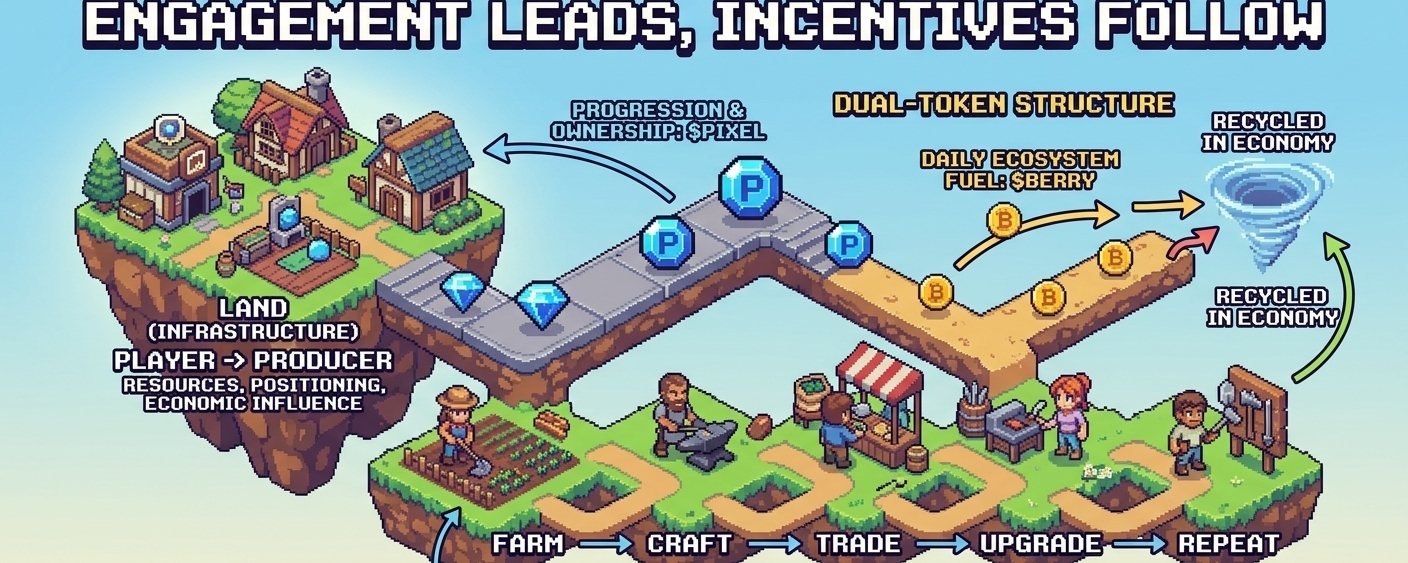
Most GameFi projects tried to solve the wrong problem. They obsessed over tokenomics — emissions schedules, burn mechanics, reward loops — as if a better spreadsheet would magically create a better game. We saw how that played out during the Axie Infinity boom era: explosive growth, followed by equally fast collapse. Not because the math failed… but because the experience did.
$PIXEL takes a noticeably different approach, and you can feel it the moment you actually spend time inside the game.
Pixels doesn’t begin with the token. It begins with the loop.
Farm → craft → trade → upgrade → repeat.
Simple on the surface. But here’s the difference — it doesn’t feel like a grind engineered for extraction. It feels like progression. The kind that slowly pulls you in without needing to constantly “pay” you to stay. And that’s where most GameFi designs historically broke: they relied on incentives to replace engagement. Pixels flips that — engagement comes first, incentives follow.
The dual-token structure is where this philosophy becomes tangible.
$BERRY operates as the day-to-day fuel. It’s earned through regular gameplay, spent just as quickly, and constantly recycled within the ecosystem. It absorbs the pressure of routine activity — meaning players aren’t forced to interact with the main token every time they make a move.
$PIXEL, on the other hand, sits at a higher layer. It’s tied to progression, ownership, and decisions that actually matter. That separation isn’t just clever design — it’s protection. It prevents the core token from being diluted by daily emissions, a mistake that quietly killed most first-generation GameFi economies.
Then there’s land — arguably the most misunderstood piece of the entire model.
In Pixels, land isn’t just an NFT badge. It’s infrastructure. It transforms a player from a participant into a producer. Once you own land, your role shifts — you’re no longer just consuming the loop, you’re contributing to it. Resources, positioning, and economic influence start to compound. And unlike previous cycles where NFTs were mostly speculative, here they’re integrated directly into the game’s productive layer.
That’s the real shift $PIXEL introduces.
It doesn’t try to financialize gameplay from the outside. It builds a system where gameplay naturally generates economic value — and then layers tokens on top of that foundation. Subtle, but powerful. Because when the game holds on its own, the economy doesn’t need to constantly defend itself.
We’ve seen GameFi try to buy attention before. It never lasts.
Pixels is betting on something much harder to build — but far more durable if it works:
A game people would actually play… even if the token didn’t exist.
