

Most Web3 games never really felt like games. They felt like systems dressed up as games, with the real machinery sitting underneath in plain view. You could usually tell what mattered most within a few minutes. Rewards came first. The token came first. The world itself was often an afterthought, something built not to hold attention on its own but to give the economy a setting. People arrived, of course, but many of them arrived for the same reason traders gather anywhere else: there was something to extract. Once that reason weakened, so did the illusion of attachment.
That is why Pixels feels different.
Not because it has solved anything permanently. Not because it is beyond criticism. And not because it has escaped the same pressure that eventually exposes most tokenized games. It feels different because it seems to understand a quieter truth that much of Web3 gaming ignored for too long: people do not form lasting attachment to economies. They form attachment to routines, to spaces, to repetition, to the small feeling that a place has started to fit somewhere inside their life.
That difference sounds subtle, but it changes everything.
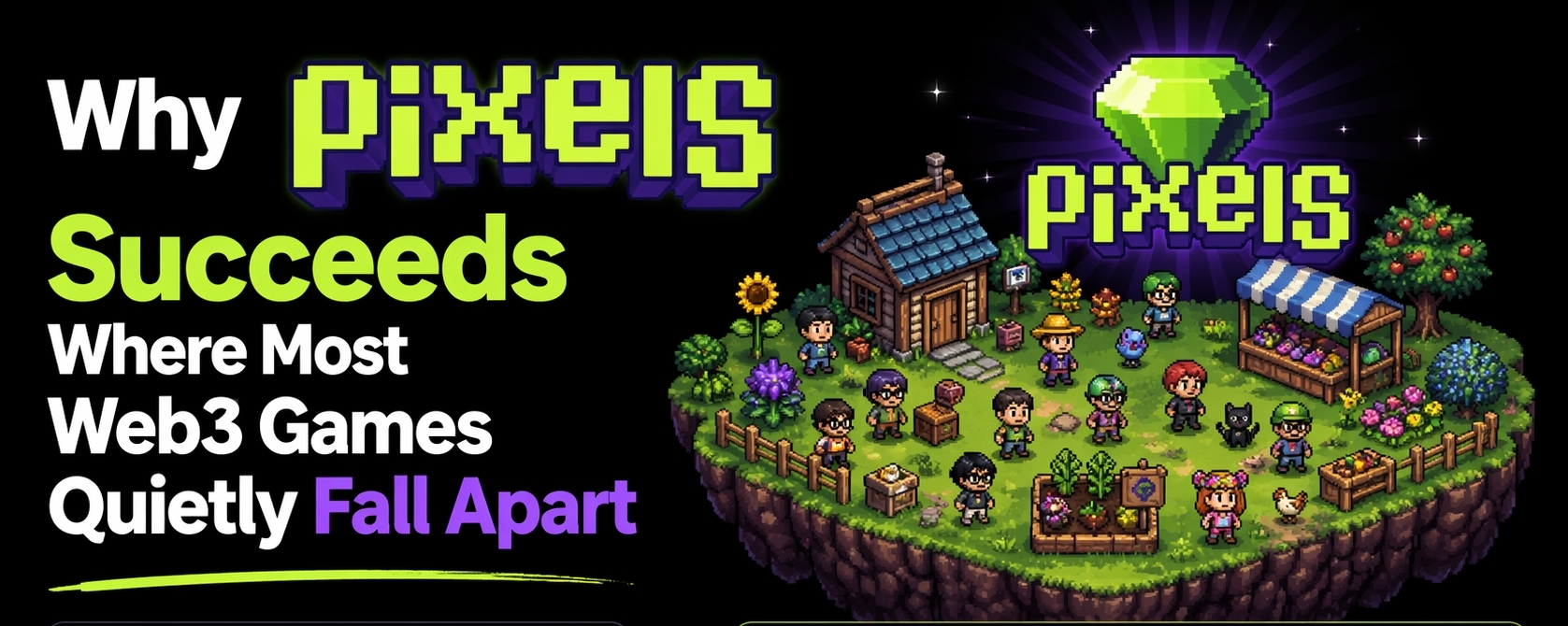
Pixels does not try to impress by force. It does not need to tell you that you are entering some grand digital revolution. Its pull is much less dramatic than that. It lives in the loop. Plant something. Harvest something. Rearrange a space. Move through familiar paths. See other people nearby. Log off. Come back later and do it again. On paper, that can sound almost too simple to matter. But simple things are often what survive because they ask less from people while giving them a reason to return.
That is something crypto has consistently misunderstood. It often assumes intensity creates loyalty. It does not. Intensity creates spikes. Loyalty usually comes from rhythm. It comes from fitting naturally into someone’s day. It comes from becoming easy to revisit. It comes from being familiar enough that returning stops feeling like a decision.
Pixels is closer to that than most Web3 games have ever been.
A lot of projects in this space were built on the assumption that users would forgive almost anything if there was enough upside attached to it. Weak gameplay, thin worlds, clumsy interfaces, repetitive actions, shallow progression — all of it was treated as acceptable because the token was supposed to carry the emotional weight. For a while, that looked workable. People showed up, metrics moved, communities looked active. But much of that activity was conditional. It was not built on belonging. It was built on calculation. The moment the calculation changed, the relationship collapsed.
Pixels still lives inside that danger, because no Web3 game is fully outside it, but it does not seem entirely defined by it. What makes it more interesting is that it offers users something that does not feel purely transactional. That may sound like a modest achievement, yet in this category it matters more than people admit. The farming loop is straightforward. The art style is approachable. The systems are not pretending to be more complex than they are. But simplicity should not be mistaken for weakness. Sometimes simplicity is the reason a product gets used consistently rather than merely admired from a distance.
There is a certain kind of crypto observer who hears the word simple and immediately thinks shallow. I think that is one of the space’s most persistent blind spots. Simple systems are often the ones people come back to because they are legible. Easy to enter. Easy to resume after time away. Easy to recommend. Easy to fit around the rest of life. That matters even more in Web3 because crypto already exhausts attention before the game has even begun. Wallet setup, chain switching, asset movement, security awareness, market noise — all of this takes mental energy. By the time someone reaches the actual game, they are already carrying friction. If the game adds another wall of complexity, the return rate falls before any habit can form.
Pixels seems more aware of that than many of its peers. It lowers the burden of return. That may be one of the least glamorous reasons it works, but it may also be one of the most important.
Then there is Ronin, and its role goes deeper than transaction speed or cheap fees. People often talk about ecosystems in purely technical terms, as if infrastructure alone explains adoption. But culture inside an ecosystem matters just as much as its architecture. Ronin already had users who understood the basic social and economic grammar of blockchain gaming. They were familiar with digital ownership, in-game economies, marketplace behavior, progression tied to assets, and the idea that a game could sit next to an economy without that feeling entirely alien. That kind of cultural readiness is difficult to measure, which is probably why it gets underrated. Pixels did not have to teach everything from zero. It entered an environment where some of the behavioral groundwork had already been laid.
That kind of advantage is easy to miss because it does not show up as a flashy feature. But many products do not win because they are radically superior. They win because they enter the right environment at the right moment with the right degree of accessibility. A stronger game launched into the wrong ecosystem can struggle. A less ambitious game launched into the right one can compound. Pixels seems to have benefited from that second dynamic.
The social layer matters too, maybe more than many people realize. One thing lightweight online worlds often understand better than more ambitious ones is that presence changes everything. The same repetitive loop feels different when other people are visible inside it. Familiar names, movement through shared spaces, land interaction, small signs of ongoing activity — all of this gives emotional texture to what might otherwise feel like mechanical labor. A task stops feeling isolated when it happens somewhere. That is one of the oldest strengths of online games, and it is still one of the hardest things to manufacture artificially.
A lot of crypto communities feel abstract. They exist in slogans, market moods, token-holder identity, and bursts of shared excitement. But a game community becomes more convincing when it is embodied. When it has place. When it has routine. When it has visible behavior instead of just language. Pixels benefits from that. Even when individual actions are ordinary, they happen inside a space that feels inhabited, and that matters more than people who focus only on token design tend to understand.
Still, none of this makes Pixels safe. In some ways, its strengths create their own vulnerabilities. Routine is powerful, but routine can also become obligation. Familiarity can become staleness. A socially alive world can start to feel thin very quickly once enough people stop showing up. That is the real test for games like this. Not whether they can create attention for a while, but whether they can preserve texture after the initial heat fades. Plenty of systems look healthy when incentives are hot. The harder question is what remains when participation has to come from habit more than excitement.
The token complicates all of this further. PIXEL cannot just exist as a badge of belief or a speculative placeholder. It has to live inside the game in a way that feels natural rather than forced. That is where almost every Web3 game starts to feel the strain. If the token becomes too central, player behavior bends around it and the world starts to feel secondary. If it becomes too weak, belief fades and the broader structure loses energy. If spending it feels painful, people hoard. If earning it feels too easy, it loses significance. That balance is incredibly hard to maintain because a game currency and a market asset are not naturally aligned things. One wants circulation. The other attracts people who prefer appreciation.
So the real question is not whether PIXEL has utility in the formal sense. Almost every project can produce a list of token utilities. That part is easy. The harder question is whether the game creates reasons to spend, hold, and care that feel native to the world instead of imposed from outside it. Most projects have symbolic utility. Very few have lived utility. There is a difference between a token being technically usable and it being woven into behavior in a way that feels real.
Pixels at least has a chance because the world itself appears to matter a little. Maybe not enough yet. Maybe not permanently. But enough that the token is not carrying the entire psychological burden alone. That is already a meaningful distinction in a sector where many economies were expected to generate loyalty by themselves.
And that may be the deeper reason Pixels feels different. Not because it has escaped speculation. Not because it is morally cleaner than other projects. But because it is trying, in a quiet and practical way, to build something people return to even when they are not thinking only about the token. That is much harder than launching hype. It is much harder than producing a temporary wave of activity. And it is far more important.
The strange thing about Web3 gaming is that many of the projects most obsessed with reinventing gaming forgot the oldest truth about games. People stay where they feel a rhythm. Not just a payout. Not just an opportunity. A rhythm. Something repeatable. Something familiar. Something that slowly stops feeling external and starts feeling like part of their routine.
Pixels is closer to that than most.
And maybe that is the real point. What makes Pixels feel different is not that it fused gaming and crypto in some revolutionary way. It is that, unlike so many Web3 games, it seems to understand that if people do not first learn how to live inside the world, no economy built around it will ever feel alive.
