
I used to treat time in games as something light.
You log in, do a few things, and leave. If you skip a day, it doesn’t really matter. Time feels flexible, almost invisible. It passes, but it doesn’t ask much from you.
That’s exactly how Pixels felt to me at the start.
I would open it, plant crops, wander a bit, maybe craft something if I had what I needed. It felt calm. There was no urgency. No reason to rush. Just small actions and slow progress.
But after a while, something started to feel different.
Not wrong, just slightly uneven. Some activities felt slower than expected. Others moved faster, almost too smoothly. At first, I ignored it. I thought maybe it was just part of the game’s pacing.
But the more I played, the more I noticed it wasn’t random.
So I started paying attention, not to what I was doing, but to how time was behaving across different activities.
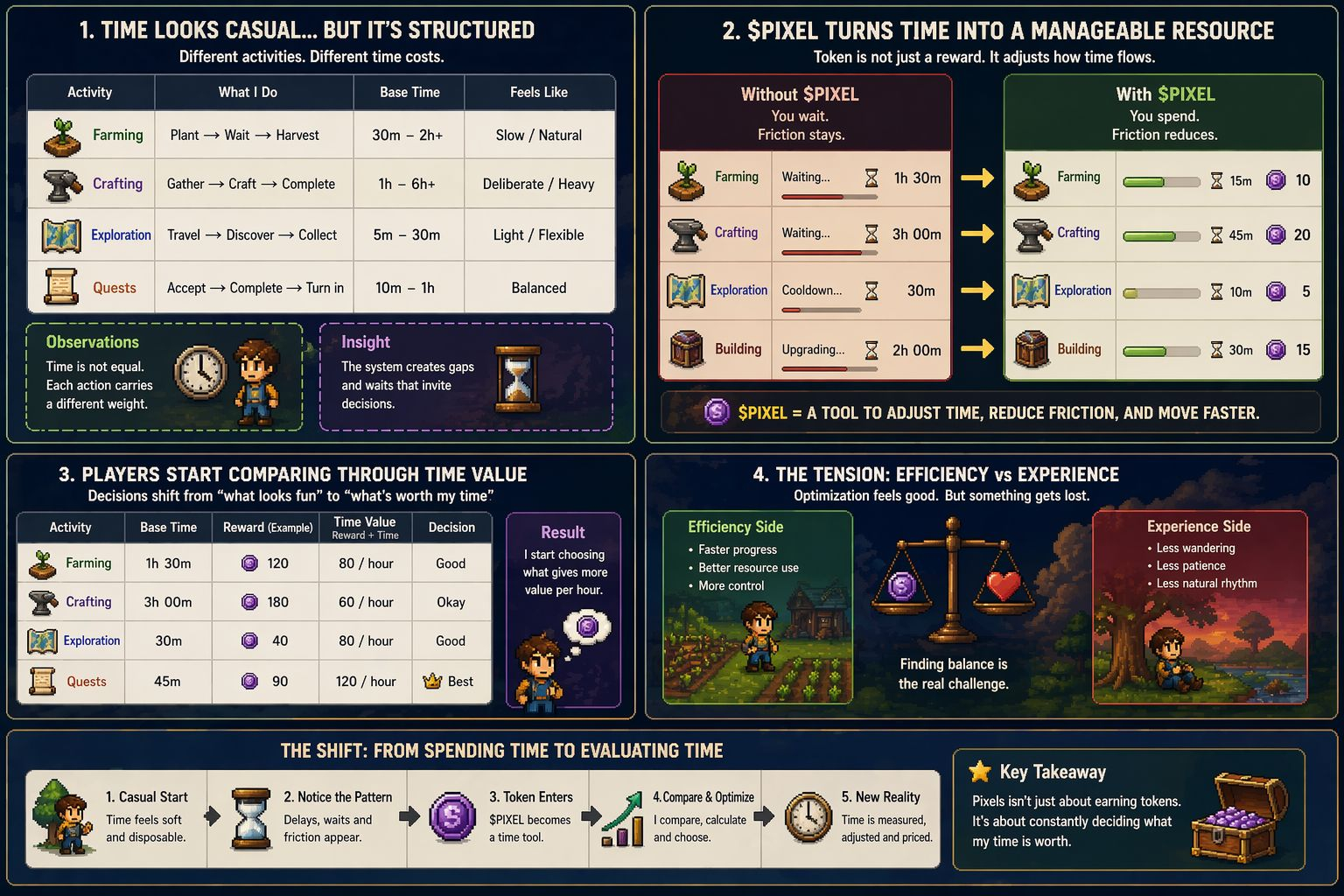
Farming looked simple on the surface. You plant, you wait, you harvest. It feels passive, almost relaxing. But the waiting creates a gap. A small pause that forces a decision.
Do I wait, or do I move on?
That’s where PIXEL starts to change things.
At first, it feels like a normal reward. You earn it by playing, maybe use it later. Nothing unusual.
But over time, it becomes something else.
It starts affecting how time works.
You can use it to speed things up. Reduce waiting. Move through certain processes faster. It doesn’t remove time, but it reshapes it.
And once that option exists, you start noticing time more.
Every activity begins to feel like it has a cost. Not just in effort, but in minutes, in delays, in pacing. Some tasks feel worth it. Others start to feel too slow.
That’s when I realized I wasn’t just playing anymore.
I was comparing.
Should I spend time here or there? Is this process worth waiting for? Should I use $PIXEL move faster, or save it?
These questions don’t appear all at once. They build slowly.
At first, I just followed the flow. Then I started noticing differences. Eventually, I began making decisions based on time.
And that changes the experience.
Crafting, for example, started to feel heavier. It takes longer, requires more setup. Farming felt easier, but slower in return. Exploration felt flexible, but less predictable.
Each activity began to carry its own kind of time weight.
And I found myself choosing based on that weight.
Not because the game forced me to, but because it made sense. Some actions simply felt more efficient. Others felt like they cost too much time for what they gave back.
That’s when optimization quietly enters.
I didn’t plan for it. It just happened.
I started favoring loops that fit better into my time. I avoided tasks that slowed me down. I used $PIXEL waiting felt unnecessary.
Without realizing it, I began managing time instead of just experiencing it.
And that shift is subtle, but important.
At the beginning, waiting didn’t matter. It was part of the rhythm. Now, waiting feels like a choice. Something I either accept or try to reduce.
That creates a different kind of tension.
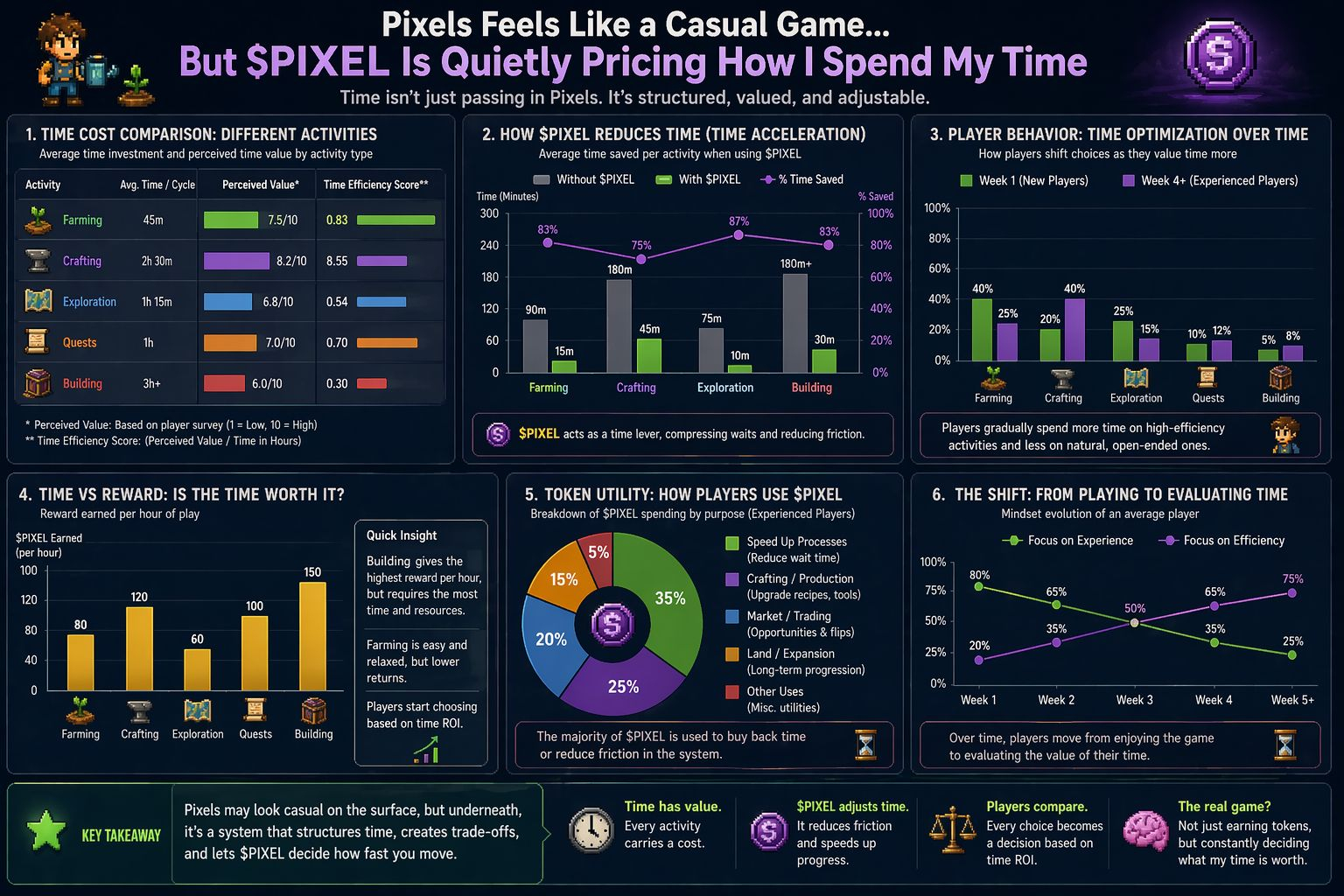
On one side, efficiency feels good. Progress becomes smoother. Decisions feel clearer. You feel more in control of how you move through the system.
But on the other side, something changes.
The slower moments, the pauses, the parts where nothing happens, they start to feel less valuable. You begin to skip them, shorten them, or avoid them altogether.
And those moments were part of the experience too.
They gave the game its pace. Its space.
When everything becomes about efficiency, that space starts to shrink.
The system doesn’t force this shift. It doesn’t tell you to optimize. It simply gives you the tools to do it.
And once those tools exist, it’s hard not to use them.
That’s where PIXEL is more than just a reward.
It turns into a way to adjust time itself.
It lets you move faster when you want to. It reduces friction when you notice it. It gives you control, but also introduces a new way of thinking.
You start evaluating everything.
Not just what you gain, but how long it takes to get there.
And over time, that becomes the main lens through which you play.
Pixels still looks simple. The world is calm. The actions are easy to understand. Nothing about it feels complex on the surface.
But underneath, it’s doing something more structured.
It’s assigning value to time.
It creates differences between activities, then lets you navigate those differences using the token. It doesn’t remove choice, but it shapes how those choices are made.
And I’m not sure that’s immediately obvious when you first start.
It only becomes clear after you spend enough time inside it.
When you begin to notice that you’re not just playing through the system.
You’re constantly weighing your time against it.
Maybe that’s the real layer here.
Not just earning rewards, or progressing through tasks.
But slowly learning to decide what your time is worth… and adjusting it along the way.
