
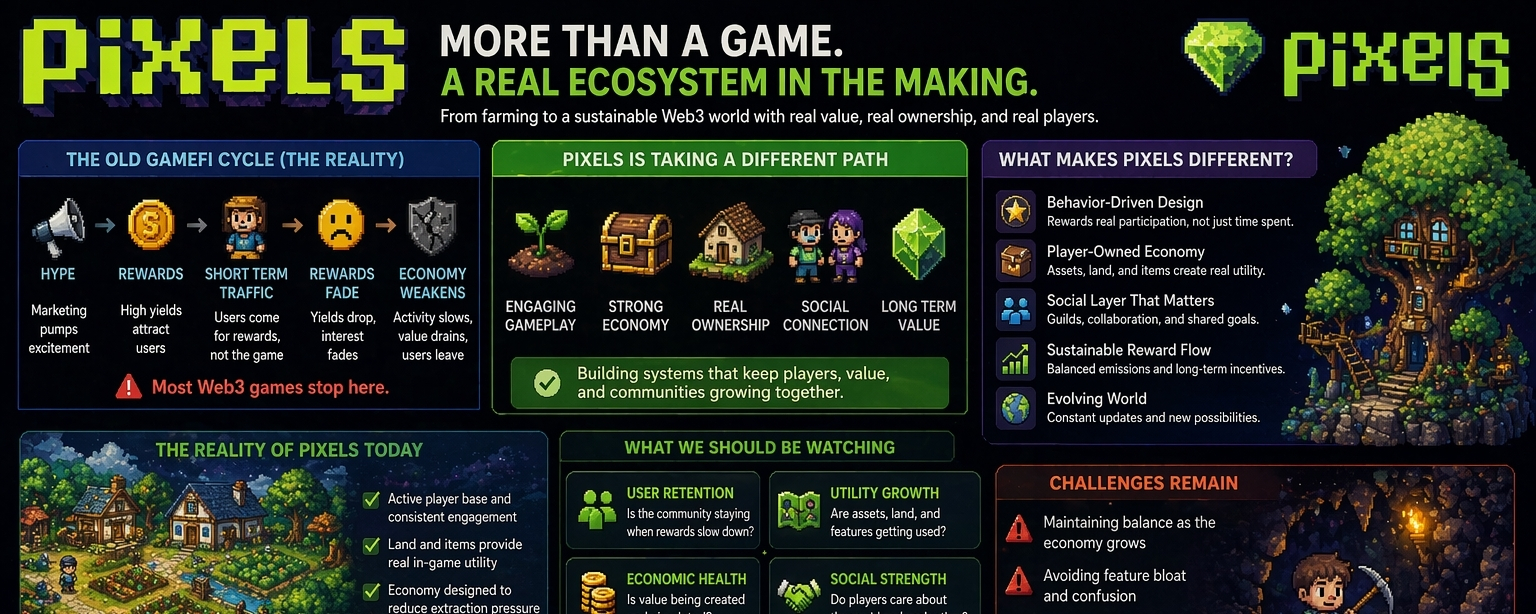
Pixels is one of those projects I keep coming back to. Not because I’m blindly bullish. Not because I think it’s perfect.
I’m watching it because it looks like a project that understands a hard truth many Web3 games still ignore.
The old model doesn’t last forever.
I’ve seen too many gaming projects follow the same path. First comes hype. Then rewards bring in users. Social media gets loud.
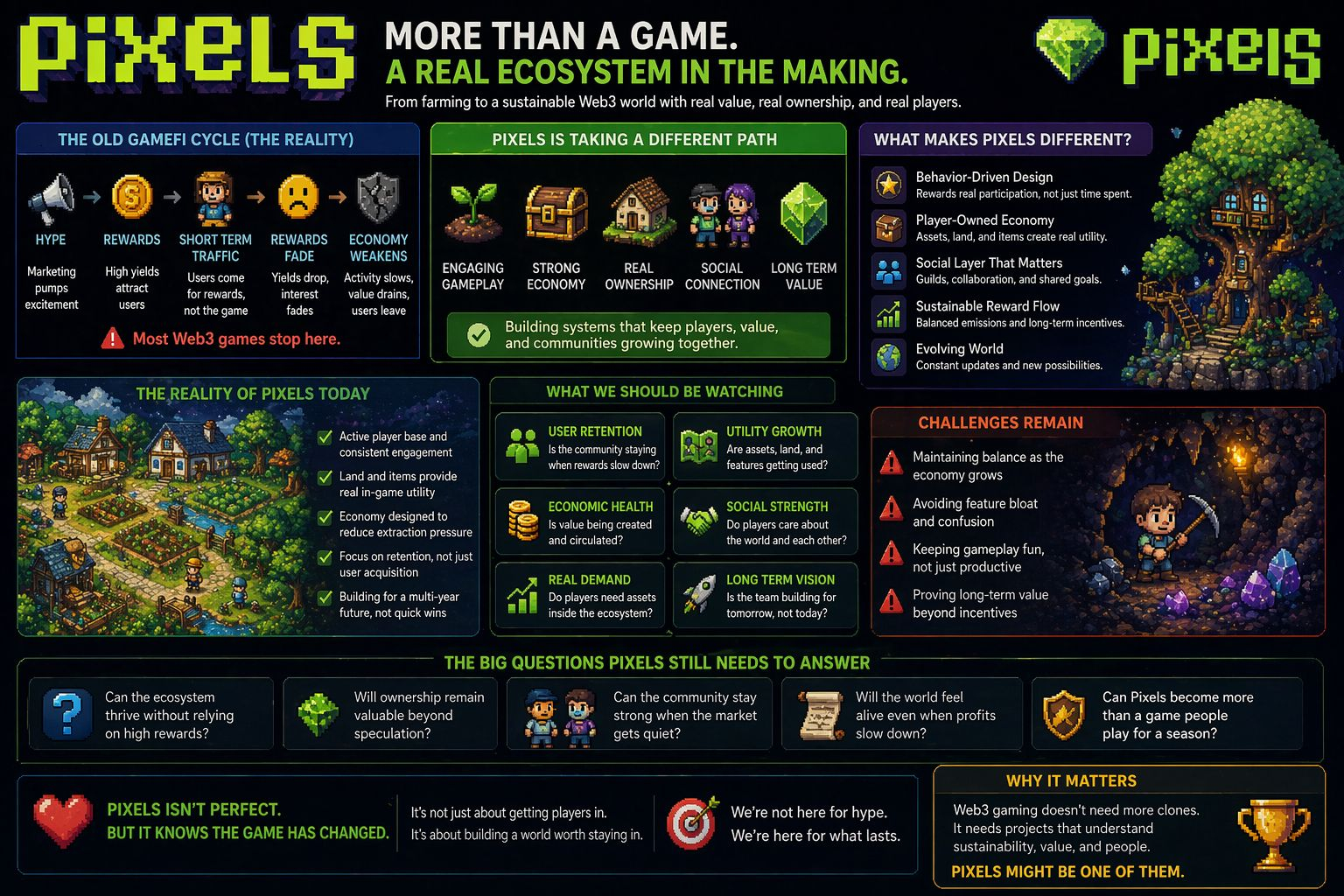
People talk about ownership, community, and the future of gaming. For a while, it looks exciting.
Then reality shows up.
Users get tired. Rewards feel weaker. Activity slows down. The economy starts feeling thin. Projects begin recycling the same ideas just to stay alive.
I’ve watched that happen again and again.
Pixels doesn’t look immune to that problem. No project is. But Pixels does look like it knows it can’t survive forever on the first version of its story.
That matters to me.
What I’m seeing now feels bigger than just gameplay. I’m not only looking at farming, crafting, or daily tasks. I’m watching the deeper structure around the game.
How do players stay interested when easy rewards lose their shine?
How does value move inside the ecosystem?
How does the project keep users engaged without turning into another endless grind?
That’s where Pixels becomes more interesting.
I’m not saying Pixels has solved everything. I don’t believe that. I’m just tired of projects acting like a decent launch and a few sticky reward loops are enough to carry them for years.
They’re not.
Eventually users get smarter. The market gets bored. Weak systems get exposed.
Pixels seems to understand that it needs something stronger than short-term excitement. I’m watching a project that appears to be building around long-term behavior, rewards, ownership, and retention.
That may sound boring to some people.
But real value usually is.
Most important things in crypto don’t look flashy once you remove the marketing words. Strong systems are usually built quietly. They focus on structure, not noise.
That’s why I’m paying attention here.
Still, trying to build something stronger is only step one.
Proving it works is the hard part.
I’ve heard many teams talk about better design, healthier economies, and stronger communities. I’ve heard those promises too many times. Words are easy. Building something that lasts is much harder.
So I’m not just listening.
I’m watching.
Can Pixels hold attention when rewards are no longer the main reason people stay?
Can the ecosystem create real demand instead of depending only on incentives?
Can ownership feel useful instead of just symbolic?
Can players care about the world even when profits slow down?
Those are the real questions.
If Pixels cannot answer them, then the bigger vision doesn’t matter much. It would just become a cleaner version of the same old problem many Web3 games already faced.
That risk is real.
But I don’t think Pixels is trapped there yet.
That’s one reason I’m still interested. It feels like a project trying to grow beyond the category that first made it popular.
Instead of staying just another game token, it looks like it wants to become something with more weight behind it.
That’s not easy.
Sometimes projects try to evolve and only create more confusion.
Sometimes they add features but lose direction. Sometimes they chase a bigger dream and forget what made people care in the first place.
I’m watching for that too.
Because growth can be messy.
Momentum can turn into maintenance faster than people expect.
I’ve seen projects spend all their energy keeping old systems alive while pretending they were still innovating. Then slowly, quietly, everything faded.
That can happen to anyone.
Pixels still has work to do. It still needs to prove that its structure can carry real value on its own. It still needs to show that users will stay for more than short-term rewards.
But at least it seems aware of the challenge.
That already puts it ahead of many others.
Right now, I’m not looking at Pixels with blind optimism.
I’m looking at it with cautious interest. I’m seeing a project that might become more than a game people play for a season and forget.
Maybe it works.
Maybe it doesn’t.
Maybe the shift creates something stronger.
Maybe it only adds complexity.
I’m not pretending to know yet.
I’m just watching for the moment when the deeper structure starts carrying real weight by itself.
Until then, Pixels stays on my screen for one simple reason.
It looks like a project trying to grow up while many others are still repeating old mistakes.