
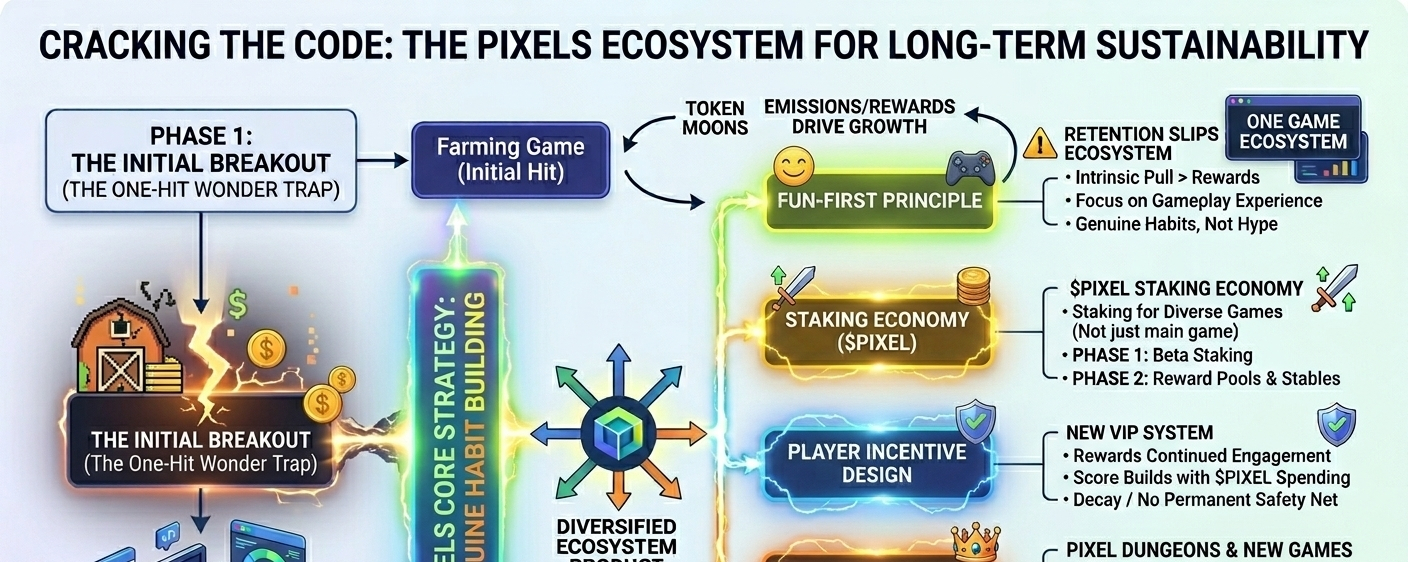
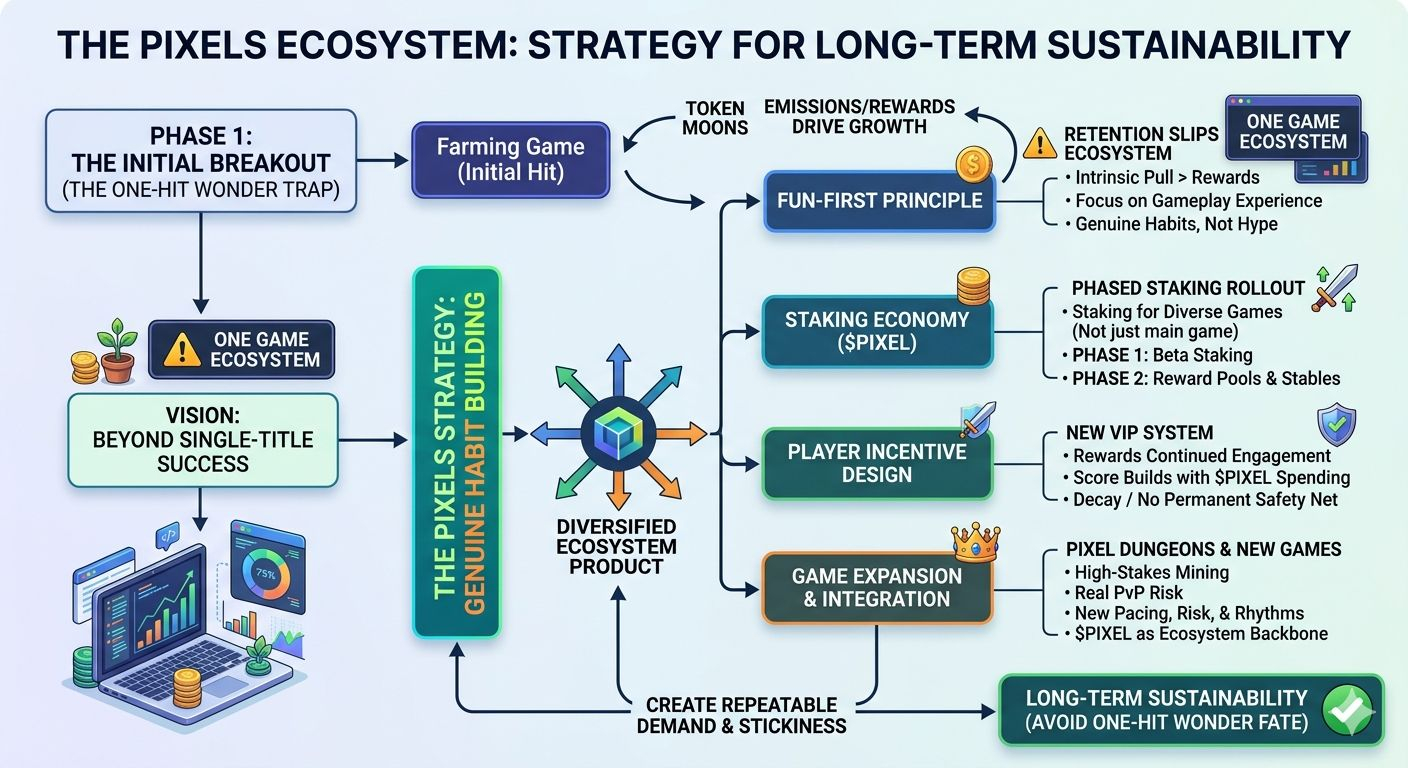
 J'ai toujours ce petit nœud dans l'estomac chaque fois qu'un jeu Web3 explose du jour au lendemain. La croissance elle-même est excitante comme pas possible — j'adore voir ça se produire. Mais j'ai vu la même histoire se répéter trop de fois : un titre prend feu, le token fait un moon, les wallets affluent, les récompenses portent tout pendant un moment, et on a l'impression que le modèle a enfin fonctionné. Puis l'énergie change. La rétention commence à faiblir, les émissions deviennent la seule raison pour laquelle quelqu'un se connecte encore, et tu réalises que tout l'« écosystème » n'était en gros qu'un seul jeu avec un branding flashy.
C'est exactement le piège que j'ai discrètement testé avec Pixels.
Plus je creusais, plus ça me semblait clair — ils n'ont jamais vraiment prévu de surfer sur un seul breakout vers la lune. Leur livre blanc est plutôt honnête à ce sujet : oui, le jeu de farming est devenu le gros succès qui les a mis sur la carte, mais le véritable objectif a toujours été plus profond. Ils voulaient vraiment corriger le play-to-earn avec des récompenses plus intelligentes, un meilleur alignement, et un modèle de croissance qui ne s'effondre pas quand un titre ralentit. Le succès n'est pas « notre jeu principal est devenu viral. » C'est construire quelque chose qui continue à créer de vraies raisons durables pour que les gens restent. Ce cadre seul m'a semblé différent. Ce qui a vraiment commencé à me convaincre, c'est à quel point ils se basent peu sur un discours lourd sur les tokens. Ils commencent par « le plaisir d'abord », ce qui peut sembler simple, mais dans cet espace, c'est encore un signe révélateur. Ça montre que l'équipe comprend la différence entre attirer les gens et réellement les garder. Si le jeu ne semble bon que grâce aux récompenses, alors les récompenses ne soutiennent pas le produit — elles cachent juste ses défauts. Pixels dit tout de suite qu'ils veulent un attrait intrinsèque, quelque chose qui fait que les joueurs apprécient vraiment passer du temps là-bas même quand les chiffres ne s'allument pas.
Bien sûr, les mots sont faciles. Ce qui compte, c'est ce qu'ils ont réellement expédié.
Et c'est là que les choix commencent à sembler plus réfléchis. Ils essaient clairement de dépasser une seule boucle de gameplay qui porte tout le poids de l'économie. Le système de staking est probablement le meilleur exemple. Au lieu de lier $PIXEL juste à la ferme originale, ils ont construit cette configuration plus large où tu peux staker vers différents jeux à travers l'écosystème. Ça se déploie par phases — d'abord une bêta organisée, puis des pools de récompenses qui suivent là où les gens stakent réellement, puis l'ouverture à tout jeu qui prouve une activité réelle, et finalement même des trucs d'acquisition d'utilisateurs financés avec des stables pendant que $PIXEL reste la colonne vertébrale du staking. Ça ne donne pas l'impression qu'ils soutiennent juste le jeu principal. Ça donne l'impression qu'ils construisent une vraie couche de publication qui répartit le risque et garde l'ensemble vivant même si une expérience ralentit.
C'est le genre de mouvement discret qui est facile à manquer, mais qui change toute l'ambiance.
Les succès éphémères s'effondrent généralement parce que tout gravite autour du même public, de la même boucle, du même petit crochet de dopamine. Quand la nouveauté s'estompe, tout commence à vaciller. Pixels semble transformer l'écosystème lui-même en produit réel. Le hub principal met désormais le staking directement dans « L'Économie Pixel », le présentant comme un moyen de gagner, d'améliorer ton gameplay, et même d'aider à façonner l'univers. Ils parlent des plus de 10 millions de joueurs, continuent de déployer des mises à jour, et se concentrent sur l'expansion au lieu de juste polir la même vieille ferme. Les aspects comportementaux semblent tout aussi intentionnels. Le nouveau système VIP n'est pas un symbole de statut tape-à-l'œil. Ton score se construit avec des dépenses réelles en $PIXEL, les améliorations se produisent instantanément quand tu atteins les seuils, ça décroît un peu chaque jour, et le filet de sécurité ne dure pas éternellement. En langage simple, ils récompensent les gens qui continuent à venir, pas juste ceux qui sont venus une fois avec un gros portefeuille. C'est un petit changement, mais ça ressemble à la différence entre courir après le buzz et vraiment construire une habitude. Pixel Dungeons s'intègre à tout cela si naturellement. En surface, ça pourrait ressembler à un projet secondaire aléatoire, mais c'est vraiment une énergie totalement différente — minage à enjeux élevés, risque PvP réel, cartes payantes pour de plus grandes récompenses, et cette vulnérabilité astucieuse où porter trop de butin te ralentit littéralement. Ça a déjà dépassé les 100 000 joueurs sur Taiko avant de se répandre sur Ronin et l'écosystème plus large. Ce que j'aime, ce n'est pas juste les chiffres ; c'est qu'ils ont donné à $PIXEL une arène fraîche avec de nouveaux rythmes, de nouveaux risques, et un autre type de joueur. Ce genre d'expansion paraît beaucoup plus sain que de demander à une boucle fatiguée de porter chaque signal économique pour toujours.
C'est l'audit auquel je prête attention ensuite.@Pixels #pixel $PIXEL