
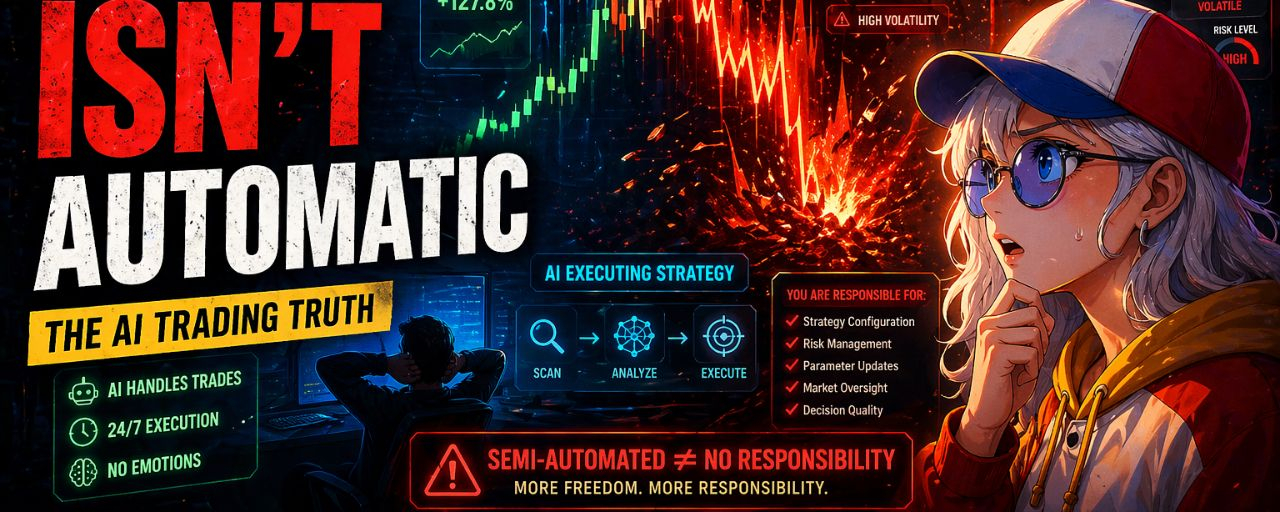

There's a version of AI-assisted trading that sounds almost frictionless. Configure the system once, let it run, check in occasionally, collect results. The marketing language around semi-automation tends to lean toward that frictionless version — the implied promise that intelligent automation reduces the cognitive load of trading rather than redistributing it.
I want to push back on that framing. Not because @binance AI Pro is poorly designed — the architecture is genuinely solid — but because "semi-automated" obscures something important about where the cognitive demand actually goes when you introduce AI into your trading process.
It doesn't disappear. It moves.
Let me work through what that actually looks like in practice.
With fully manual trading, the cognitive load is concentrated at the execution layer. You're doing the analysis, forming the thesis, sizing the position, timing the entry, managing the trade, deciding the exit. Every one of those decisions sits with you. The load is high — uncomfortably high in fast markets — but it's visible. You know what you're responsible for because you're responsible for everything.
Semi-automated trading with Binance AI Pro redistributes that load rather than reducing it. The execution layer gets lighter. The AI handles order placement, position monitoring, and strategy execution within the parameters you've configured. That part of the cognitive burden genuinely decreases — and for traders who struggle with emotional execution, the reduction there is real and meaningful.
But a different cognitive layer gets heavier. The configuration layer.
Before the AI can execute anything intelligently, you have to define what intelligent execution looks like for your specific situation. What's the maximum position size relative to the AI Account balance? What drawdown threshold should trigger a strategy review? Under what market conditions should the AI hold versus exit? How should it respond to sudden volatility spikes? What's the acceptable slippage on execution? How frequently should the strategy parameters be revisited?
These aren't simple settings you dial in once and forget. They're consequential decisions that require a sophisticated understanding of your own risk tolerance, your trading thesis, and how those parameters interact with different market conditions. Getting them wrong doesn't produce an error message — it produces a string of trades that are technically executing your instructions while missing the spirit of what you actually wanted.
There's also the monitoring layer, which I think gets systematically underestimated. Semi-automated doesn't mean unmonitored. If anything, AI-managed positions require a specific kind of attention that's different from — and in some ways more demanding than — manual position management.
With a manual trade, your attention is naturally anchored to the position. You feel the P&L moving. You're watching. The monitoring is almost automatic because the stakes make it automatic. With an AI-managed position, there's a psychological distance that makes it easier to stop watching — the AI is handling it, the logic goes, so the active monitoring is less urgent. That psychological distance is exactly the condition under which problems accumulate unnoticed.
The oversight that Binance AI Pro demands isn't constant screen time. But it is regular, structured engagement — checking whether the AI's behavior is tracking with your intentions, whether market conditions have shifted enough to warrant reconfiguring the strategy, whether the parameters you set a week ago still make sense for the market you're trading in today. That's a different skill set than execution. And it's a skill set most traders haven't had to develop before because the tools that required it didn't exist.
The economic dimension of this is worth sitting with too. The subscription cost of Binance AI Pro is visible — $29.99/month after beta, clearly stated. The oversight cost is invisible but real. Time spent on configuration, monitoring, and strategy review is time not spent on other things. For traders who are already stretched thin across multiple responsibilities, the time cost of doing semi-automation properly may be higher than the time cost of simpler manual approaches.
I'm not arguing that the cognitive redistribution is net negative. For the right trader profile — someone who is disciplined about configuration, consistent about monitoring, and honest with themselves about the oversight commitment — semi-automation is genuinely valuable. The execution consistency alone, the removal of emotional interference from the order placement layer, produces real improvements in outcomes over time.
But the framing matters. Going in with the expectation that AI assistance lightens the load across the board will produce disappointment and probably some avoidable losses. Going in with the understanding that it shifts the load — from execution discipline to configuration discipline and monitoring discipline — produces a very different experience.
The traders who get the most from Binance AI Pro's semi-automated features will be the ones who treat the oversight layer with as much seriousness as they previously gave to manual execution. Not because the AI can't be trusted to execute, but because the quality of what it executes is entirely a function of the quality of the thinking that went into configuring it.
Semi-automated is not a reduced responsibility model. It's a different responsibility model. That distinction is worth understanding before you activate.
$BNB $XAU $BTC
#BinanceAIPro @Binance Vietnam
Trading always carries risk. AI-generated suggestions do not constitute financial advice. Past performance does not reflect future results. Please check product availability in your region.