
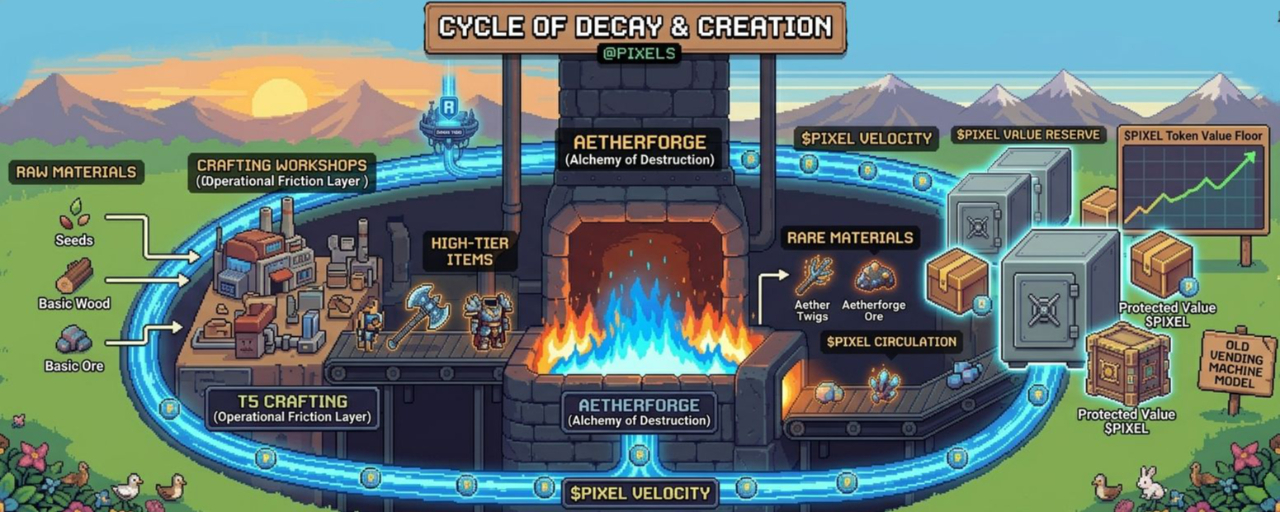
The greatest existential threat to any virtual economy is "Inventory Glut." When players can create digital assets indefinitely without a corresponding "exit" or "sink," the value of those assets and the token used to trade them inevitably trends toward zero. It is the classic hyper-inflationary trap of early GameFi.
@Pixels has introduced a bold, and admittedly controversial, solution to this: The Deconstruction System. By analyzing the "Stacked" ecosystem, we can see how this "Alchemy of Destruction" has become the invisible backbone of $PIXEL’s market health and long-term sustainability.
The Circular Supply Chain
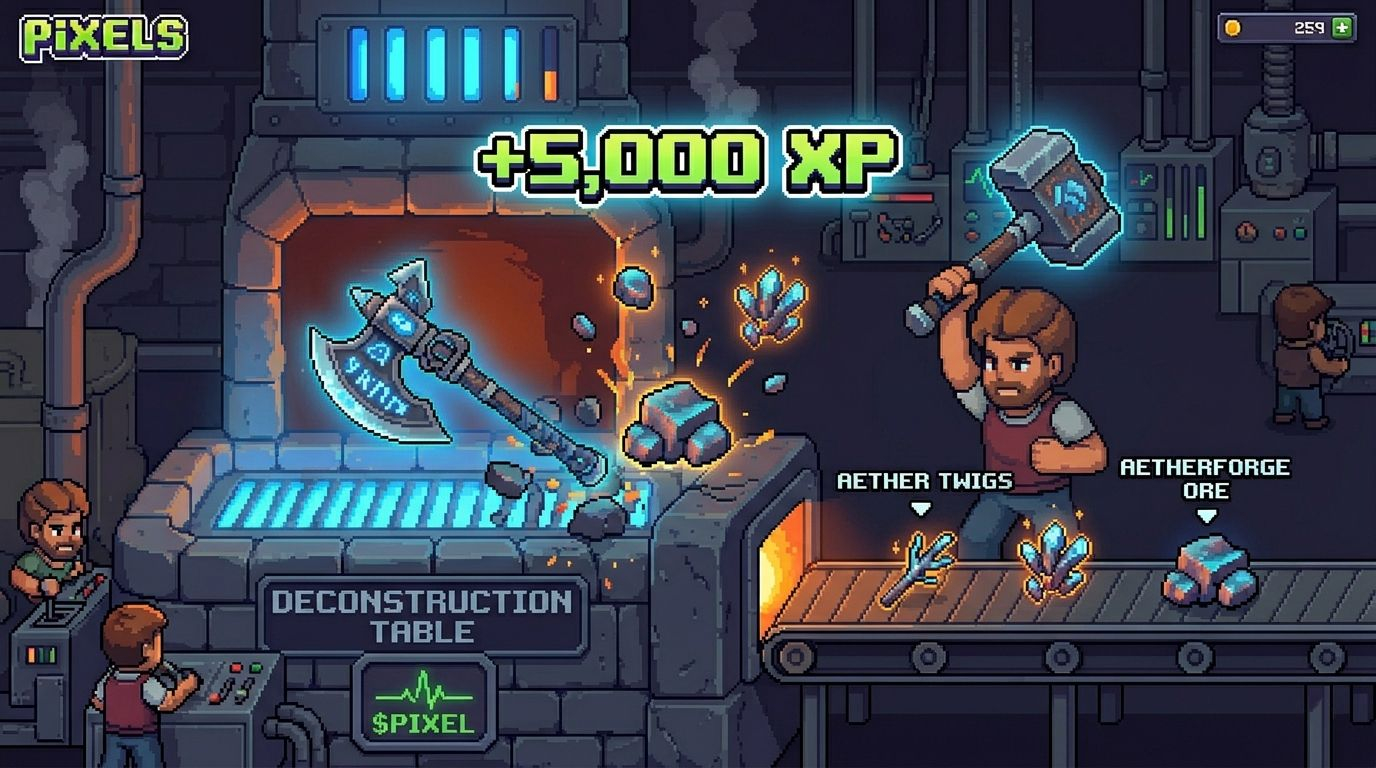
In a traditional, linear game economy, the path is simple: you mine resource A, craft item B, and sell it to player C. Player C then keeps item B in their stash forever. In the @Pixels Tier 5 (T5) economy, that path is a loop. Player C must eventually deconstruct item B to obtain Resource D (such as Aetherforge Ore), which is a non-negotiable requirement to build the even more powerful Item E.
This creates a "Circular Supply Chain" that prevents the "end-game" from becoming a stagnant swamp of unused items. Even the most powerful whales on the leaderboard are forced to stay active in the production loop because their continued progress is mathematically dependent on the destruction of their previous achievements. It turns the economy into a living, breathing organism rather than a dusty warehouse.
Managing the "Emotional Loss"
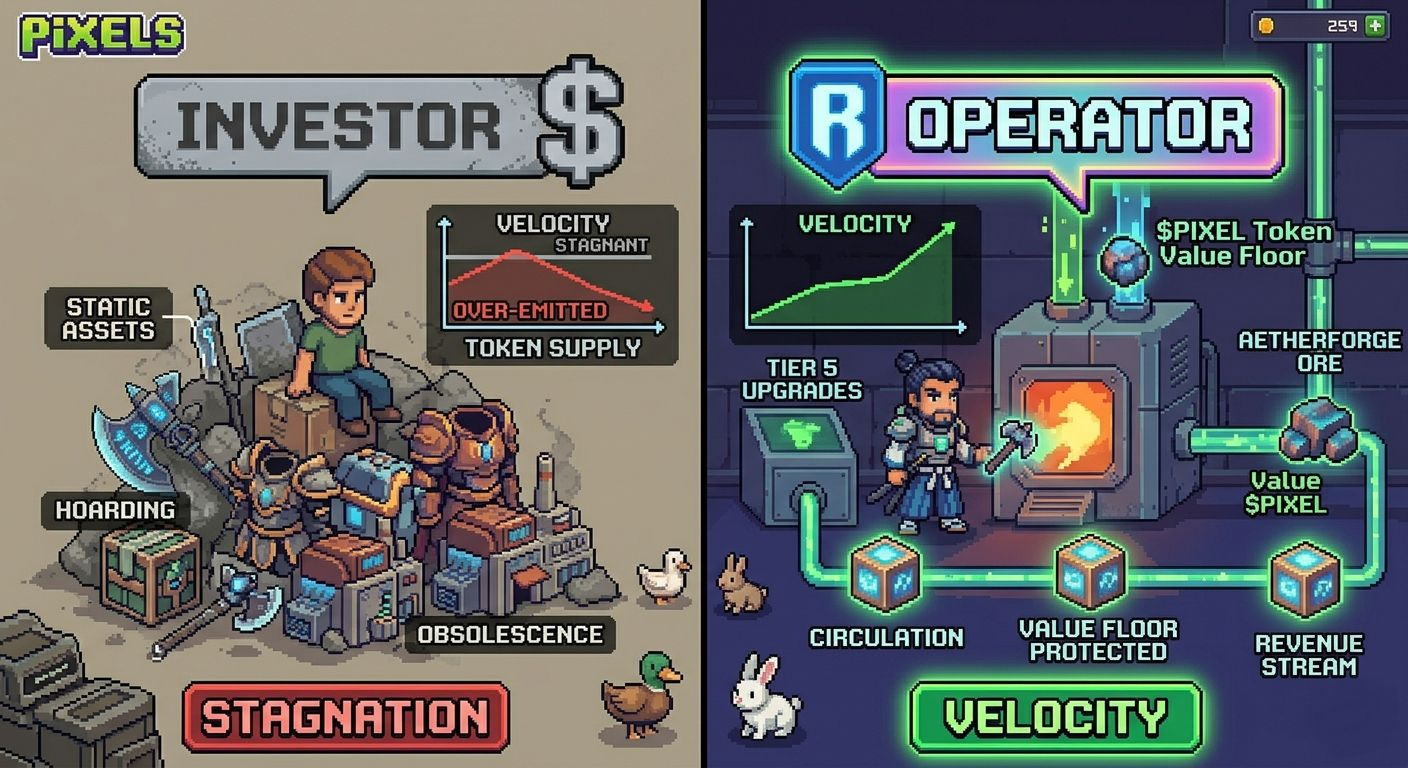
This is, without a doubt, a high-risk design choice. Most gamers are hardwired to hate losing progress. However, the @Pixels team has cleverly mitigated this psychological friction by tying deconstruction to massive XP yields and "High-Yield Slot Access."
You aren't "losing" an item in the traditional sense; you are "trading" its physical form for a higher Economic Tier. As veteran player MAYA_ observed on the leaderboard, this moves the player’s focus from the static asset to the dynamic process. The "Farming" isn't the point anymore the "System Management" is. This represents a massive psychological shift for Web3. It turns passive "investors" into active "operators" who must constantly weigh the cost of obsolescence against the benefit of innovation.
The Aetherforge as a Central Bank
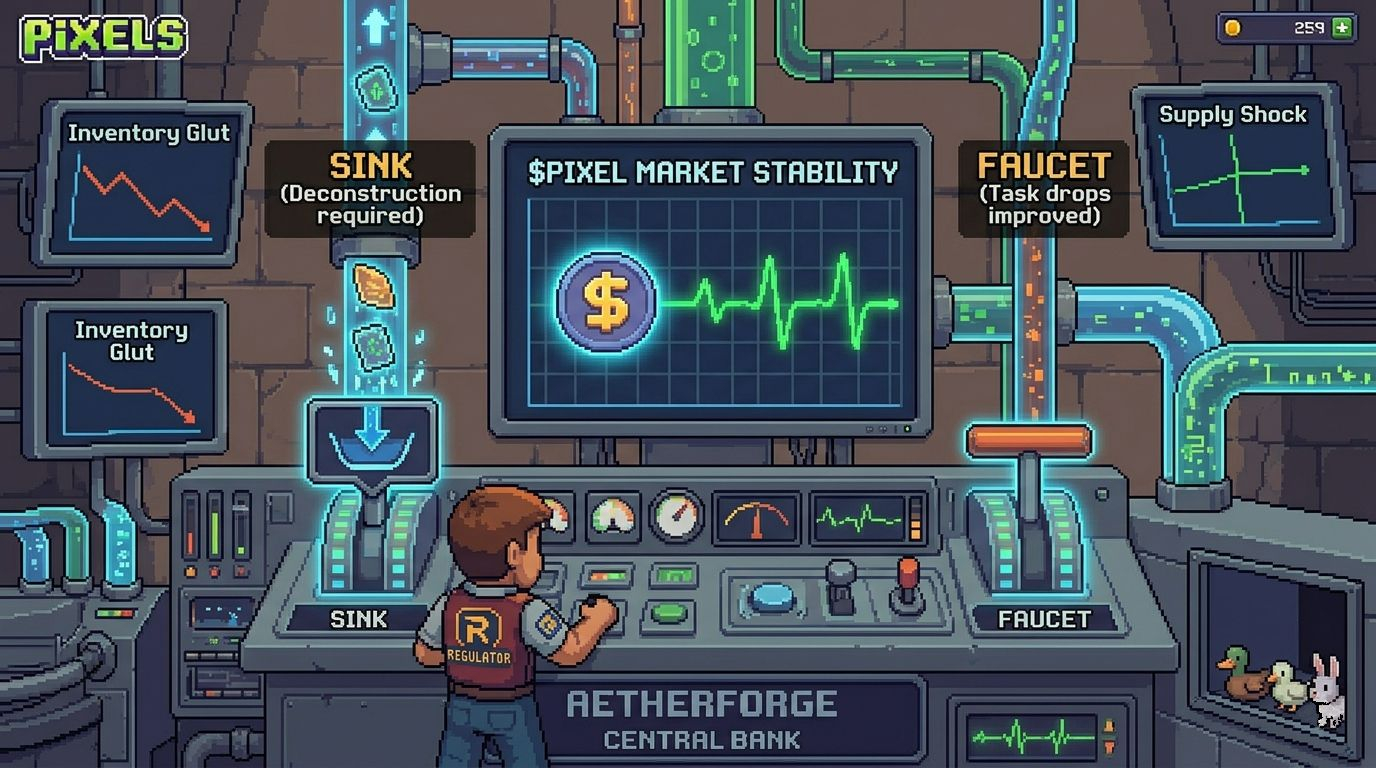
If we view the Aetherforge as a regulatory body, its "interest rate" is effectively the cost of deconstruction. By adjusting the specific materials and PIXEL amounts required for high-tier crafts, the developers can effectively speed up or slow down the velocity of the $PIXEL token with surgical precision.
Market Stabilization: If the token supply is over-saturated, the developers can increase the "sink" (requiring more deconstruction for progress).
Economic Stimulus: If the economy feels stagnant or "too hard," they can increase the "faucet" (improving drops from tasks or deconstruction yields).
This level of granular control is what gives PIXEL its "pulse." It is a managed economy that mimics real-world industrial cycles of production, use, and planned obsolescence. It ensures that the "Digital Production Layer" always has a reason to keep the machines running.
Conclusion: The Future of Digital Assets
The days of "buy and forget" in GameFi are officially over. @Pixels is proving that for a digital world to feel "real" and economically viable, its assets must have a natural lifecycle. They must be born, they must be utilized to their peak efficiency, and they must eventually be recycled to make room for the new.
While concepts like "Caged Liquidity" and "Operational Friction" may frustrate the casual player looking for a quick exit, they are the very guardrails that ensure the $PIXEL in your wallet today will still have a functional world to be spent in tomorrow. The "Stacked" vision is one where nothing is permanent, but the system itself is eternal. In the Aetherforge, we don't just burn items; we forge longevity.