
Initially, I never realized that the staking in Pixel had any connection to me personally.
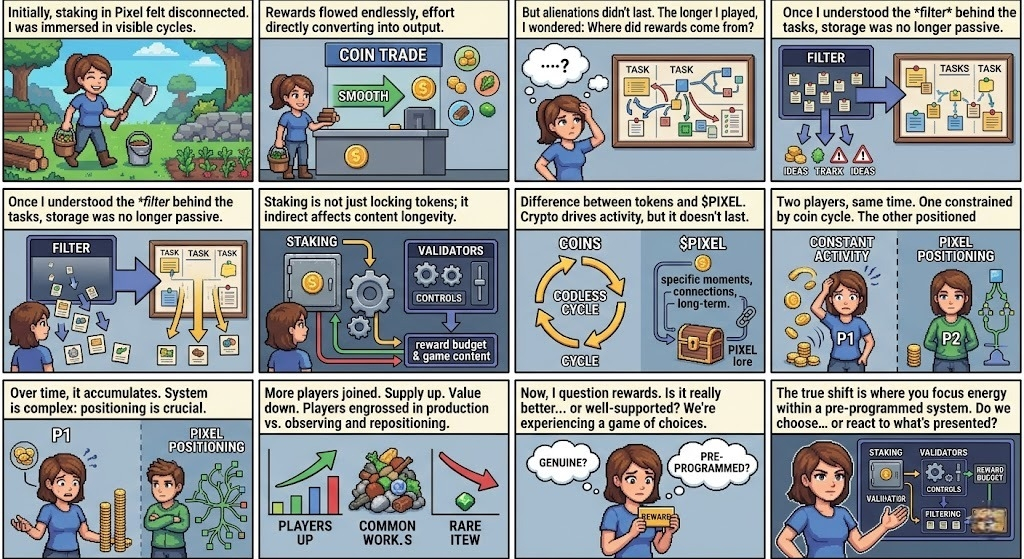
I was completely immersed in the visible aspects, collecting resources, completing tasks, repeating a seemingly stable and predictable cycle. Rewards flowed endlessly, coin trading was smooth, everything seemed like a closed system, effort directly converting into output. Storage seemed unattainable, passively received, as if it were the exclusive domain of players with far more resources than they actually invested.
But this sense of alienation didn't last long.
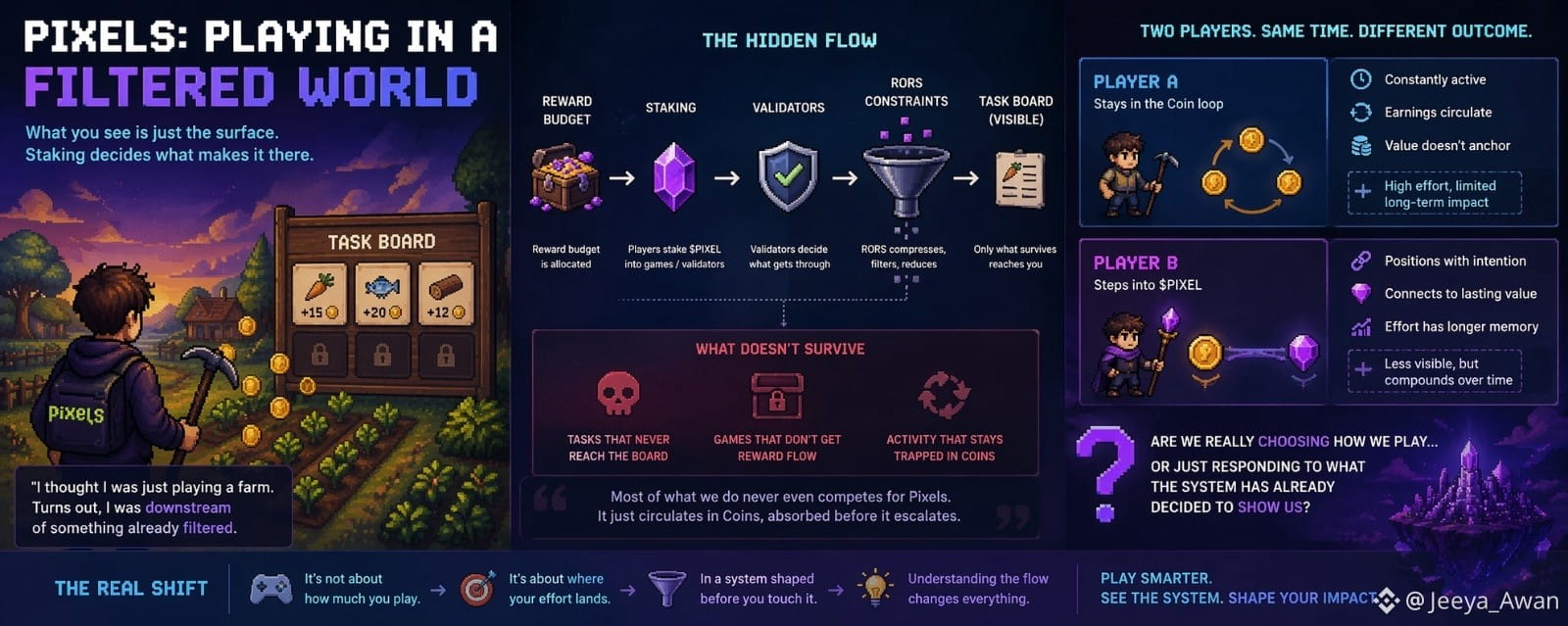
The longer I played, the harder it became to ignore a simple question: Where did these rewards come from? They weren't vague, but rather appeared systematically. Because they didn't appear out of thin air. There was a process behind it, a process of allocating, filtering, and ultimately deciding which rewards would be presented as tasks.
Once I began to understand this, storage was no longer passive.
It began to become directional.
What I saw on the task board was no longer just raw opportunities. Before they were presented to me, they had been filtered, streamlined, and subject to various limitations. When I interacted with a task, the decision had already been made behind the scenes.
That's where the change lies. If staking feeds into validators, and validators influence the allocation of the reward budget, then staking isn’t just locking tokens; it also indirectly affects the content that appears in the game, which content will last long enough for players to experience.
Therefore, the experience is different.
I will still collect tokens, and I will still play the game. But you'll realize that the content that seems active might be pre-selected. Some chapters appear active not only because they are better in themselves, but also because they receive enough traffic to bypass any pre-selection process.
What about the chapters with insufficient traffic?
They are not complete failures; they simply don't appear at all.
The system doesn't remove content from your path; it simply limits what you can access initially.
Meanwhile, another layer becomes clear: the difference between tokens and $PIXEL.
Crypto is everywhere. It drives everything. It represents activity, what you do, what you spend, what you repeat. But it doesn't last. It just cycles endlessly, unable to establish any long-term connection.
PIXEL is different. It appears at specific moments, where things are interconnected, last longer, or persist. It's not louder, but it carries weight in a different way.
This creates a subtle difference.
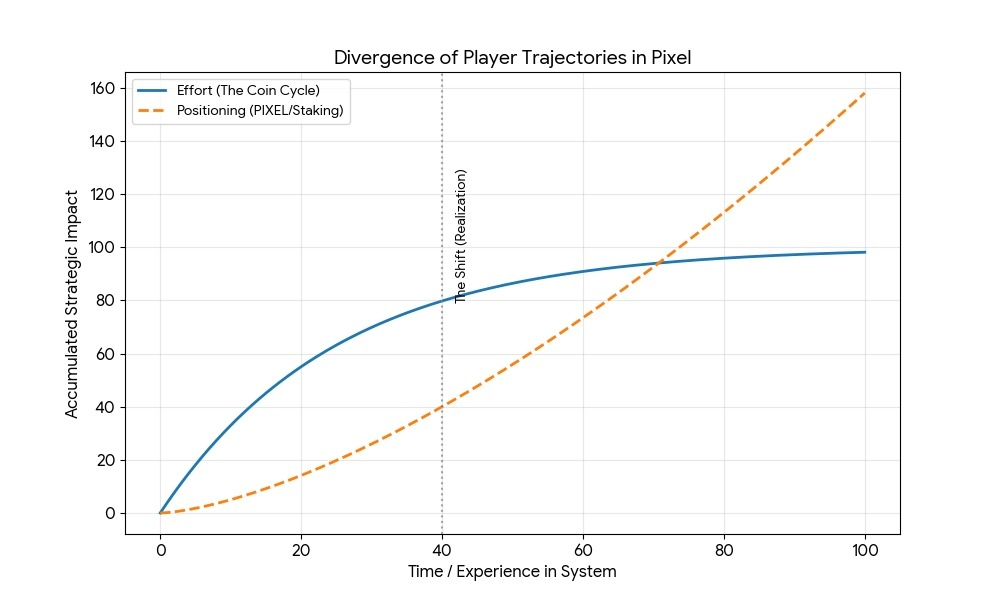
Two players might spend the same amount of time in the game. One player is constantly in the coin cycle, active but constrained. The other occasionally enters the world of PIXEL, not by investing more effort, but through a different positioning.
Initially, this difference is hard to detect.
Over time, it accumulates.
Then, the system is no longer a simple "the more you play, the more you win," but begins to become complex, effort is important, but positioning is even more crucial.
I also began to notice some cyclical changes.
Initially, the rewards seemed plentiful because demand was high and supply was limited. But as more players joined, supply increased. More resources, more production, and pressure increased. The rewards didn't disappear, just their value decreased.
Player behavior began to diverge.
Some players became engrossed in production, endlessly repeating the cycle. Others chose to step back, observe, and reposition. Active players experience the pressure of increased supply. Inactive players act based on timing rather than consistency.
Over time, this gap becomes apparent.
Surprisingly, the system seems flawless. It works well, maintaining activity and keeping players engaged. But it's not neutral. It subtly filters and guides value.
So now, when I feel something is pleasurable or rewarding, I question it.
Is it really better… or is it only sustained because it's well-supported?
Because if so, we're experiencing more than just a game.
This is a game of choices.
This brings me back to the issue of stakes, the part I initially overlooked. It no longer feels like a secondary factor. It feels like a quiet center, a mechanism that shapes what is amplified and what quietly fades away before you even realize it.
On the surface, I'm still playing the same game.
But beneath the surface, it seems meticulously constructed, as if not everything has the same impact.
Perhaps, this is the real shift. The key is no longer how much you play.
It's where you focus your energy within a system that's already pre-programmed before you even touch it.
So, the question that's been nagging at me is:
Do we truly choose how we participate… or are we simply reacting to what the system has already decided to present to us?
