
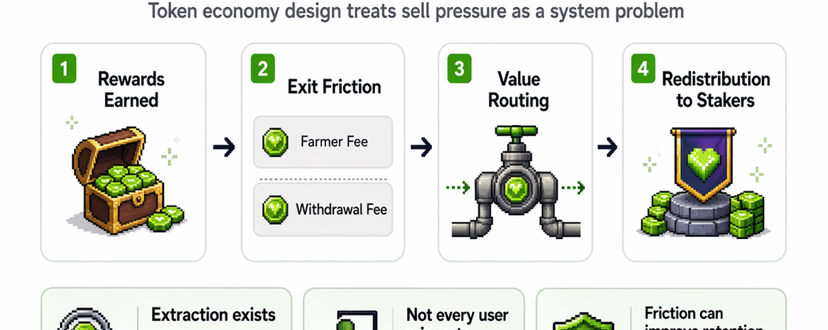

A lot of game token systems sell the same dream: give out rewards, users stay happy, hold the token, and the ecosystem becomes stronger on its own. It sounds nice. But in practice, we all know what usually happens. The moment rewards hit a wallet, most users ask one question first: “Can I cash this out?” That is where a game economy faces its real test.#pixel @Pixels $PIXEL
What stood out to me in the Pixels paper is this: the project does not seem to deny sell pressure. It is not trying to sell the fantasy that everyone will become a loyal long-term holder. Instead, it appears to accept a more practical reality—extraction exists, not every user will reinvest, and not everyone who earns rewards will behave like an ecosystem builder. So if the economy is meant to stay healthy, incentives need friction, better routing, and some consequence attached to pure extraction.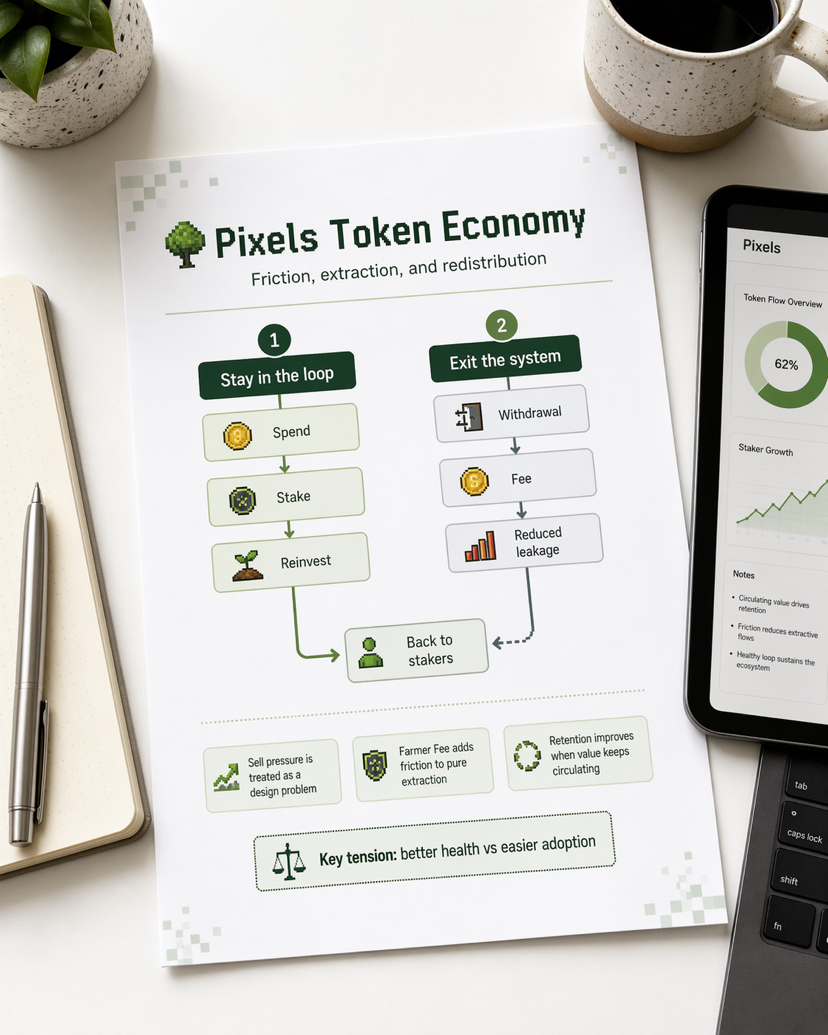
My thesis is simple: Pixels seems to be designing its token economy around behavior, not around hope. Instead of telling users “please don’t sell,” it tries to make pure extraction a little more expensive, a little less automatic, and to make keeping value inside the ecosystem feel more reasonable by comparison.
That is where the Farmer Fee, withdrawal fee logic, and redistribution design start to matter.The easiest way to understand it is through a simple example. Imagine a village with a shared water reservoir. If people use that water to farm, the village benefits. If they use it to run local businesses, value stays inside the village. But if people start pulling water out just to sell it elsewhere, the problem is not that they used water. The problem is unmanaged leakage. Pixels feels similar. The issue is not rewards themselves. The issue is where those rewards go, how quickly they leave, and what remains for the system after they do.
From the paper’s logic, extraction is not treated as something that can be eliminated. But unmanaged extraction appears to be something the system wants to make more expensive. That is why the Farmer Fee matters. The signal seems to be: value can leave the ecosystem, but pure farming behavior should not be treated like a free lunch. If a participant is mainly extracting from the system, the economy should register a cost. This is not moral punishment. It is economic routing. The design seems to be saying: “You can exit, but exit is not free.”
The withdrawal fee logic makes that view even clearer. In many token economies, the biggest weakness begins right after the reward moment. A token is earned, claimed, and then the path to liquidity becomes almost frictionless. Once that happens, the whole system can quietly turn into a dump pipeline. Pixels seems to add friction exactly at that point, which reflects a more honest assumption: not every reward is long-term aligned capital. Some of it is short-term extraction. So withdrawals are not treated as neutral utility they are treated as a mechanism that shapes behavior.
But friction alone would not make this design meaningful. The more interesting part is the redistribution logic: value taken from exit-related fees appears to be routed back toward stakers or ecosystem-aligned participants. That is what stops the design from feeling purely punitive. If a fee is charged and simply disappears, users may see it as unfair gatekeeping. But if that value goes back to participants who stay committed, stake, or help support ecosystem health, then the fee starts to look less like a punishment and more like a balancing tool.
Put another way, Pixels seems to be building a structure that says: “If you extract value quickly, you leave something behind. If you keep value inside the ecosystem, support it, or stake into it, you should receive some of that benefit.” That may not sound emotionally exciting, but economically it feels more mature than the usual tokenomics slogans.
And this matters because retention economics usually depends less on reward volume than on reward recycling. If a player earns value, then spends it, stakes it, or routes it into another loop inside the ecosystem, the same token can keep doing work. But if the reward is immediately extracted, the system has to patch that leak again with new emissions in the next cycle. That can look sustainable for a while, but it usually becomes fragile over time. If Pixels is trying to slow value leakage, redirect it, and recirculate it, then this is really an attempt to improve retention quality, not just defend the token price.
Think about a practical scenario. Two players both earn rewards. The first keeps that value inside the ecosystem staking it, allocating it to a game pool, or spending it inside internal use cases. The second just wants to cash out. In a friction-heavy design like this, the second player can still exit, but not at zero cost. Part of that cost then flows back to the more committed side of the system. That means the design does not remove choice. It changes the economics around that choice.
What I like here is that Pixels does not seem to idealize user behavior. Many projects treat community alignment like a moral identity, as if the “good” user is the one who holds, stakes, and believes. Pixels feels more adult than that. It seems to accept that some users will arrive, farm, and leave. And if you give that behavior a zero-friction path, the economy becomes weaker. That is not a pleasant truth, but it is a useful one.
Still, there is a real tradeoff here. Friction may sound healthy in theory, but too much friction can damage adoption. If a player earns rewards, then tries to withdraw and runs into too many fees, too many rules, too much delay, or a haircut that feels unfair, the system stops feeling healthy and starts feeling hostile. Crypto gaming already has a trust problem. If users begin to feel that rewards are easy to earn but annoying to use or cash out, retention may not improve at all resentment may grow instead.
So the challenge for Pixels is not only inventing the mechanism. It is calibrating it correctly. The friction has to be strong enough to make extraction meaningfully more expensive, but not so strong that the user experience starts to feel like a trap. That line is very thin. There is only a small distance between a healthy filter and a bad product experienceAnother thing I keep thinking about is whether that redistribution will actually matter in real life.The logic can look good on paper, but in practice the key question is whether the value sent back to stakers is substantial enough to matter. Does it genuinely reward long-term participation, or does it become more of a symbolic justification? And even if withdrawal friction reduces short-term dumping, does the ecosystem also create enough internal utility, enough reinvestment demand, and enough strong loops to make staying worthwhile? Because friction alone is not an economy. Friction can slow leakage, but loops are what create lasting value.One thing I’m still watching closely is whether that redistribution ends up meaningfully helping the people who stay in the system.The logic can look good on paper, but in practice the key question is whether the value sent back to stakers is substantial enough to matter. Does it genuinely reward long-term participation, or does it become more of a symbolic justification? And even if withdrawal friction reduces short-term dumping, does the ecosystem also create enough internal utility, enough reinvestment demand, and enough strong loops to make staying worthwhile? Because friction alone is not an economy. Friction can slow leakage, but loops are what create lasting value.
My overall read is that Pixels is choosing to accept the hard reality of behavior instead of selling a fantasy. It is not trying to shame sell pressure out of existence. It is trying to absorb it into system design. The Farmer Fee, withdrawal fee logic, and redistribution back to stakers all seem to point to one larger idea: extraction will always exist, so the real task is to change the economics around extraction.That could be a mature approach. But maturity alone is not enough. The friction also has to feel fair, understandable, and worthwhile from the user’s side. Otherwise, in trying to build a healthier economy, the project may end up making participation feel heavier than it should.
That is what I am watching next. Can Pixels keep friction high enough to filter pure extraction, while still making genuine participation feel attractive and rewarding? Because the best token economy is not the one that blocks exit. It is the one that makes staying feel more sensible than leaving.#pixel @Pixels $PIXEL
