
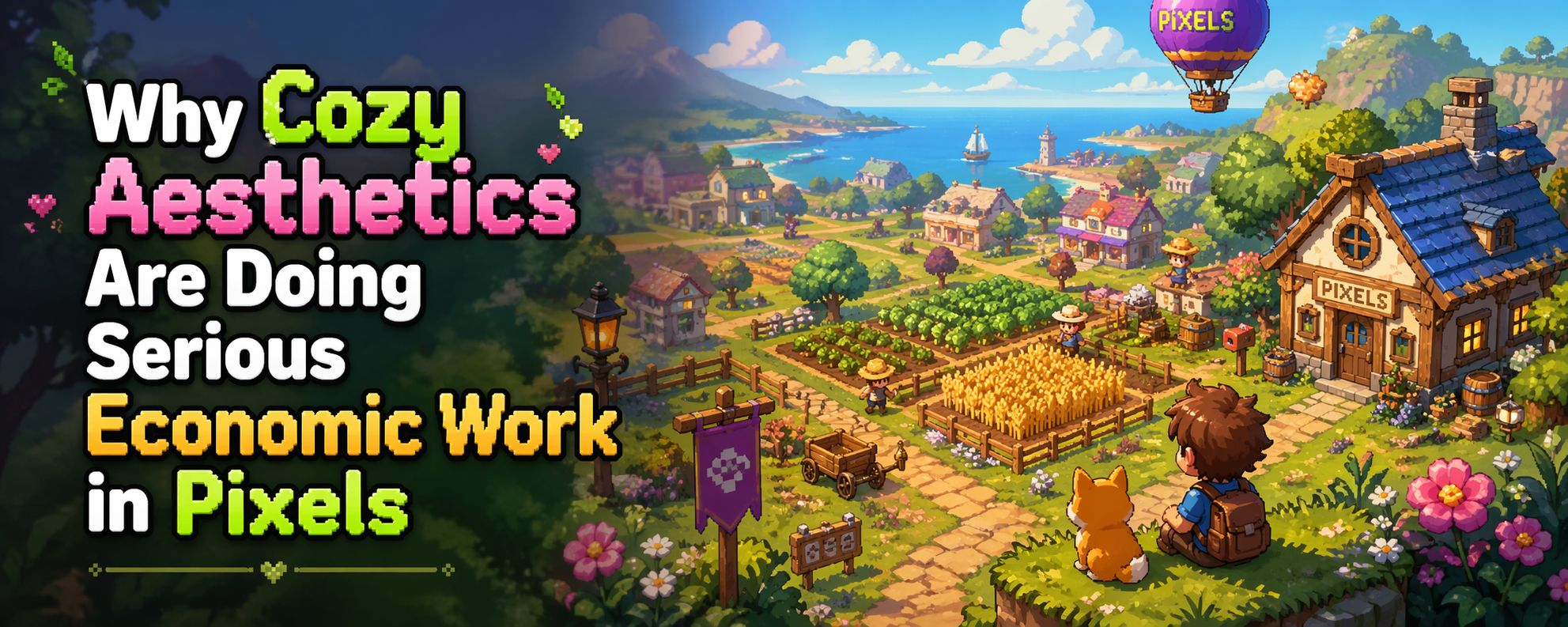

When you first open Pixels, it does not feel like an economy. It feels like a place. Soft colors, quiet farming loops, simple routines. Nothing is shouting at you to optimize. Nothing feels urgent. And that is exactly why it works.
The mistake most people make is thinking the cozy aesthetic is just there to make the game approachable. I think it goes deeper. Pixels uses comfort to make structure feel natural. It makes you accept systems that, in another setting, would feel restrictive.
Because under the surface, Pixels is not loose at all. It is carefully shaped. What you can produce, how fast you progress, what access you unlock, how rewards flow, even how much your time is worth, all of it is guided. But you do not experience it as control. You experience it as routine.
That difference matters more than it sounds.
In most Web3 games, the economy shows itself too quickly. You start to see the grind, the extraction, the imbalance. The illusion breaks, and suddenly everything feels like work. Pixels avoids that early fracture. It gives you something softer to hold onto. Farming, crafting, walking around your land, helping others. These are familiar rhythms. They make repetition feel normal, even comforting.
I have found myself doing the same actions again and again in Pixels without questioning it. Not because the rewards are extraordinary, but because the environment makes it feel okay. That is the quiet trick. The game lowers your resistance before it asks for your effort.
And once that resistance is lowered, the system can do more.
Gated progression feels like something to look forward to instead of something being kept from you. Task boards feel like daily structure instead of obligation. Even reliance on other players starts to feel social rather than necessary. The game turns economic coordination into something that resembles community.
That is not accidental design. It is intentional framing.
Pixels understands something most crypto games ignore. The problem is not just building an economy. The problem is getting people to live inside it without constantly noticing the edges. Cozy aesthetics blur those edges. They make the system easier to accept, easier to stay in, and easier to return to.
There is also a subtle psychological trade happening. Players are more forgiving in a world that feels pleasant. You tolerate slower progress. You accept repetition. You do not question every imbalance immediately. The atmosphere buys the system time. Time to adjust, to rebalance, to guide behavior without triggering backlash.
But there is a limit to this.
If players ever start to feel like the routine is no longer calming but demanding, the illusion flips. The same cozy loop that once felt relaxing can start to feel like a quiet obligation. And when that happens, the softness no longer protects the system. It exposes it.
That tension is where Pixels lives right now.
For me, that is what makes the project interesting. Not the token, not the farming, not even the growth. It is the way it uses feeling as part of its economic design. It does not just build incentives. It shapes how those incentives are experienced.
Pixels is not hiding its economy. It is cushioning it.
And in a space where most projects feel like spreadsheets from the first click, that alone might be one of its smartest decisions.