
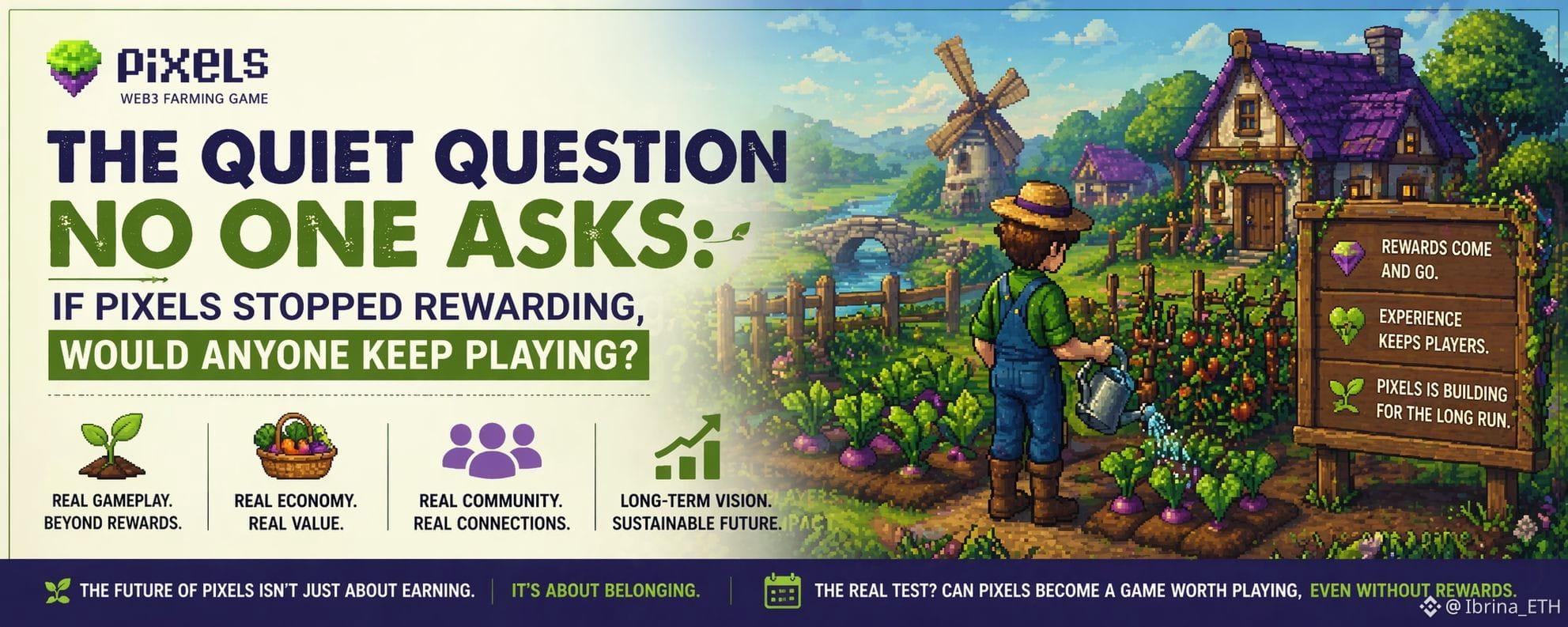

I’ve been watching Pixels closely for a while now not just the charts or the token, but the actual behavior of players inside the game. And there’s one question that keeps coming back to me:
If Pixels removed rewards tomorrow… would people still log in?
It’s not the kind of question people like to ask. But it’s the one that reveals everything.
At first glance, Pixels feels familiar. Farming, progression, social interaction—it mirrors the comfort of traditional games. But underneath that layer sits something much more powerful: a real, functioning economy. Players aren’t just playing for fun—they’re participating in a system where time converts into value.
And that system worked. At its peak, Pixels reached hundreds of thousands of daily active users, becoming one of the most active Web3 games on the Ronin Network. That kind of scale isn’t easy to achieve, especially in Web3 gaming where most projects struggle to retain users beyond the initial hype.
But here’s where things get interesting.
High activity doesn’t necessarily mean high engagement. Sometimes, it just means people have found an efficient way to extract value.
That’s exactly what I started noticing.
A significant portion of players in Pixels aren’t approaching it like a traditional game. They’re approaching it like a system to optimize. Every action is calculated—energy usage, farming routes, task efficiency. The focus isn’t “what’s fun,” it’s “what’s profitable.”
And to be clear, that’s not a flaw. It actually proves the economic layer is working.
But it also exposes a deeper issue.
When earning becomes the primary reason to participate, the entire experience becomes dependent on it. The moment rewards tighten, sentiment shifts.
And we’ve already seen signs of that.
There was a phase where rewards felt relatively easy. New players entered quickly, activity surged, and the economy expanded fast. But as adjustments came in—whether through balancing or increased competition—things changed.
Rewards became harder to farm
Efficiency started to matter more
Casual players found it difficult to keep up
The shift wasn’t loud. There was no sudden collapse. But behavior changed in subtle ways.
Some players became less active. Others stopped scaling. A portion simply left without making noise.
That kind of quiet decline is more telling than any dramatic drop.
What makes this situation even more complex is the position Pixels holds. It sits between two worlds: traditional gaming and Web3 economies.
In traditional games, retention is driven by experience—storytelling, creativity, challenge, and community. In Web3, retention is often driven by incentives—tokens, rewards, and financial upside.
Pixels is trying to merge both.
And that’s where the real challenge lies.
Because if rewards are doing most of the heavy lifting right now, then gameplay alone hasn’t fully proven its strength yet.
Which brings me back to the core question.
If rewards disappeared, what would actually remain?
Would players still log in daily just to farm?
Would communities remain active without financial incentives?
Would new players join purely for the experience?
My honest answer is simple:
Some would. Most wouldn’t.
And that’s not a failure—it’s a stage.
Because what Pixels is attempting is far more ambitious than it appears. It’s not just building a game—it’s building a player-driven economy that needs to sustain itself over time.
That requires balance.
Too many rewards, and the system becomes inflationary and short-term focused.
Too few rewards, and participation drops.
Right now, it feels like Pixels is adjusting that balance. What many players perceive as “reduced rewards” could actually be intentional economic calibration.
In systems like this, tightening rewards often acts as a filter.
Short-term extractors lose interest
Efficiency-driven players adapt
Long-term participants start to stand out
It’s an uncomfortable phase, but it’s necessary for sustainability.
The biggest mistake people make is assuming that lower rewards automatically mean the project is weakening. Sometimes, it simply means the system is evolving.
If anything, this is where the real test begins.
Because the long-term success of Pixels doesn’t depend on how much it rewards—it depends on whether it can transition into something deeper:
A game where rewards support the experience, not define it.
Right now, Pixels is still in that transition.
Still proving whether it can move from a system people use to earn…
into a world people choose to stay in—even when earning isn’t the main reason anymore.
And until that question is fully answered, everything else—growth, tokens, hype—remains secondary.
