
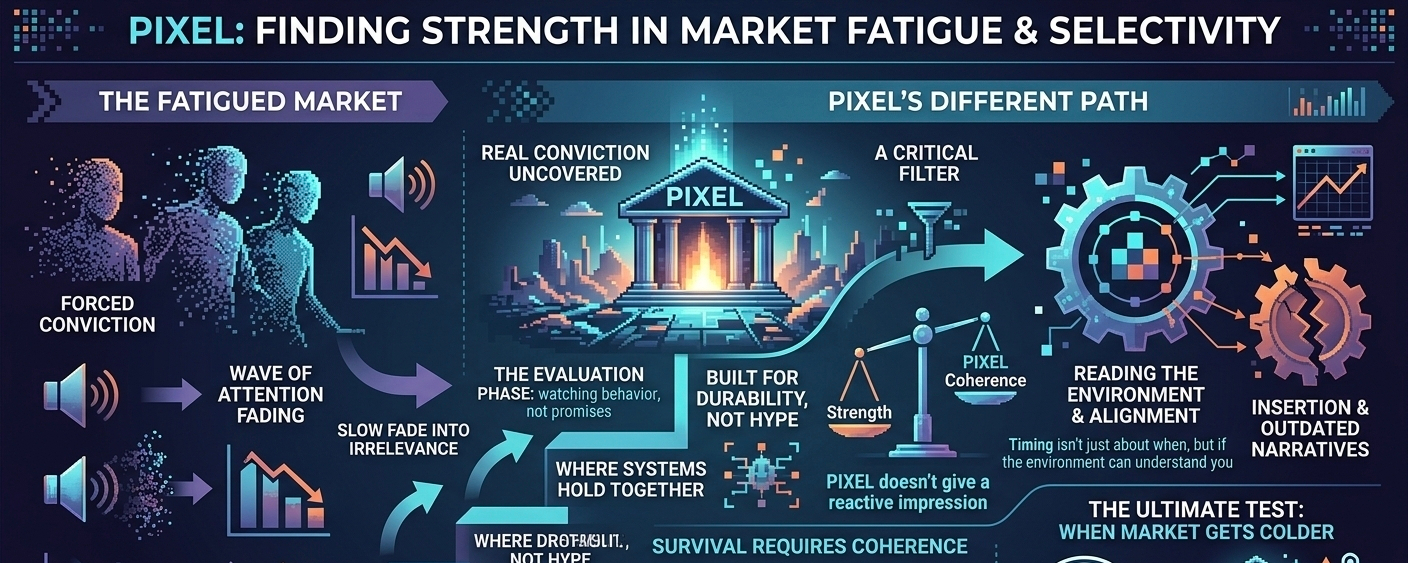
I’ve been in this market long enough to recognize how most stories end. Not with collapse or drama, but with a slow fade into irrelevance. It usually follows a familiar pattern: a burst of attention, a wave of forced conviction, timelines filled with confident language, and then a gradual loss of energy. Engagement drops, the noise fades, and what once felt important quietly disappears. That cycle doesn’t surprise me anymore. What stands out now is when something doesn’t follow it.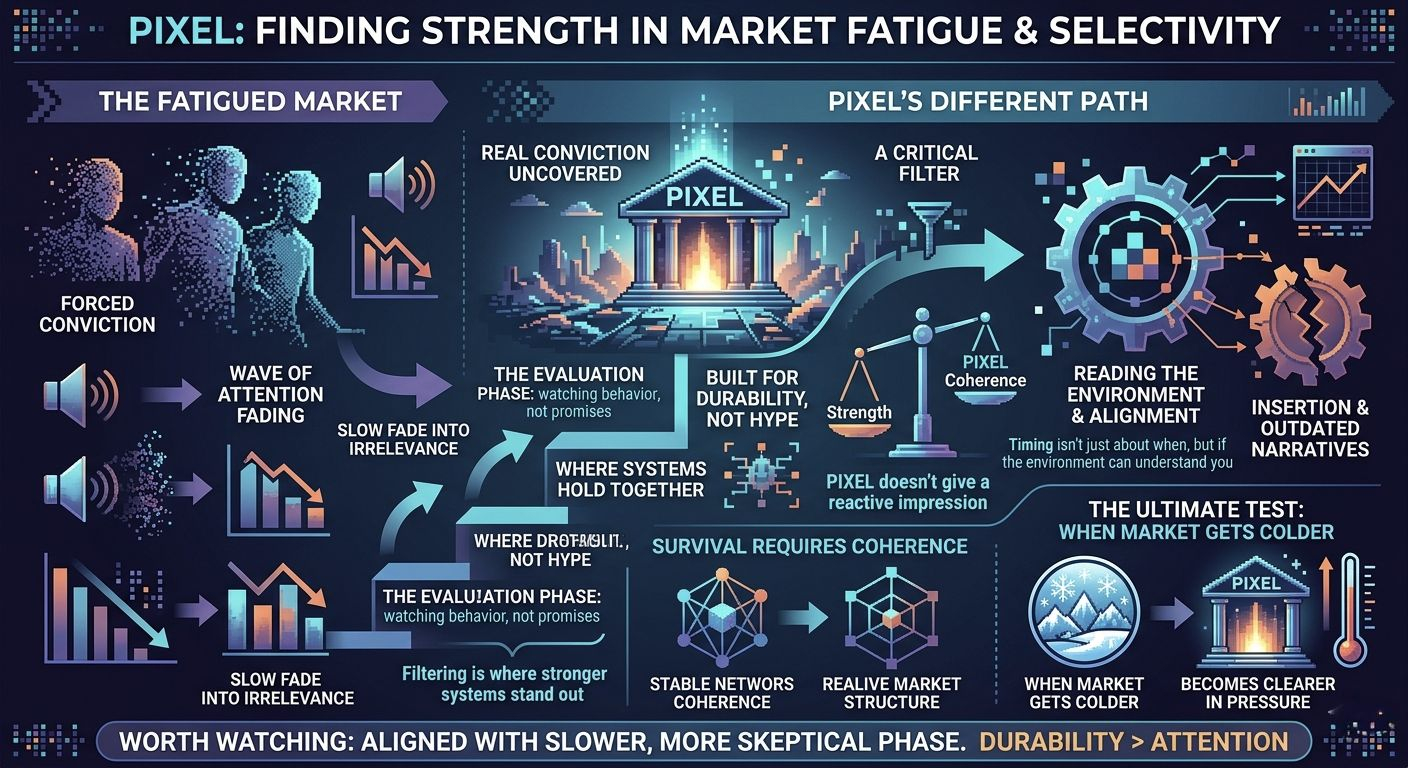
That’s where PIXEL caught my attention.
This isn’t a dead market—it’s a tired one. Price still moves, narratives still rotate, and people still perform excitement when something starts trending. But the energy underneath feels heavier, more selective. You can sense the hesitation in how people engage, the way attention arrives late and leaves early, and how often the same ideas get recycled with only minor changes. It’s not a lack of activity—it’s a lack of belief. And that difference matters more than most realize.
I’ve come to respect this phase more than the louder ones. In euphoric markets, speed and volume dominate. The biggest story wins, regardless of substance. But in a worn-down environment, the filter changes. People question more, commit less, and look harder for something that actually holds together. That shift forces projects to operate differently. It exposes anything built purely on momentum.
That’s why PIXEL feels out of place—in a good way.
If this were a full mania cycle, I’d probably ignore it. Subtle structures don’t survive in loud environments. They get buried under bigger promises and more aggressive narratives. But this market isn’t rewarding noise the same way anymore. It’s slower, more selective, and less forgiving. And within that kind of atmosphere, PIXEL starts to make more sense.
It doesn’t feel like something trying to force immediate relevance. There’s no urgency to dominate conversation, no desperation to be instantly understood. Instead, it feels like a project that can exist without constant validation. That alone separates it from a large part of the market. Too many projects depend on attention the way fragile systems depend on constant input—once the flow stops, they break. PIXEL doesn’t give that same impression. It feels more stable, less reactive.
I trust that more—at least a little.
Experience changes how you evaluate things in this space. You stop reacting to polished language because you’ve seen how cheap it is. You stop confusing visibility with strength because you’ve watched highly visible projects disappear overnight. Over time, you stop listening to what something says and start watching how it behaves. More importantly, you start looking for where it might fail.
Every system has a weak point. Every narrative eventually meets friction. The real question is not how something performs when attention is high, but how it holds together when attention fades and the market becomes less forgiving. That’s the phase that matters most. And so far, PIXEL hasn’t shown a clear break there. That doesn’t mean it won’t—but it hasn’t yet, and that already puts it ahead of most.
One thing I’ve noticed is that many projects don’t actually understand the environment they enter. They launch with assumptions from past cycles, rely on outdated narratives, and design systems around behaviors that no longer dominate. There’s a difference between entering the market and reading it. PIXEL feels closer to alignment than insertion. It doesn’t seem like it’s forcing itself into a narrative—it feels like it exists within the current mood.
That matters more than it sounds.
Because hype is easy to manufacture, but survival is not. I’ve seen empty projects outperform solid ones purely because they captured attention at the right moment. But that kind of success rarely lasts. It spikes, then fades. Survival requires something deeper. It requires coherence, structure, and the ability to hold together when conditions change.
That’s what I look for now.
Not whether something can dominate a conversation, but whether it still makes sense after the conversation moves on. PIXEL hasn’t fully been tested there yet, but it feels like it’s built with that phase in mind. It doesn’t rely on constant noise to justify its presence. It doesn’t feel fragile in the absence of hype.
Timing also plays a bigger role than most people admit. I’ve seen strong projects fail because they arrived too early, and weak ones succeed temporarily because they arrived at the right moment. But timing isn’t just about when you show up—it’s about whether the environment can understand you. Right now, the market is shifting into a more critical phase. People are more selective, less patient, and less willing to support ideas that don’t hold up under pressure.
That kind of environment filters aggressively.
And filtering is where stronger systems begin to stand out—not immediately, but over time. PIXEL feels like it belongs more in this kind of environment than in a fast-moving speculative phase. It doesn’t need to dominate instantly. In fact, if it did, it would probably raise more questions than confidence.
Still, the real test hasn’t happened yet.
That test comes when the market gets colder, more selective, and less forgiving. When attention becomes scarce and only the most coherent systems continue to hold interest. That’s when clarity appears—and when many projects start to look the same.
The question for PIXEL is whether it becomes clearer in that environment or starts to blend into the same pattern as everything else.
For now, I’m not treating it as something guaranteed to succeed. Nothing in this space deserves that assumption. But it doesn’t feel immediately disposable either, and in this market, that already sets it apart.
It feels aligned with a slower, more skeptical phase—one where being understood matters more than being seen, and where durability matters more than attention.
That doesn’t make it safe.
But it makes it worth watching.
