
I used to think progress in games followed a simple logic. You put in time, you move forward. You unlock something, upgrade something, or expand your space, and that movement feels clear. Even when it’s slow, it still feels consistent. Effort turns into visible results, and that’s enough to keep going.
That’s exactly how Pixels appeared to me in the beginning. I would log in, plant crops, collect resources, craft when possible, and gradually build things up. It all felt natural. Each action seemed to contribute in its own way, and I didn’t question whether one activity mattered more than another. Everything looked like part of the same steady progression.
But after spending more time inside the system, I started noticing a small inconsistency. It wasn’t obvious or disruptive, just a quiet sense that not all progress was moving in the same way. Some actions seemed to carry forward more smoothly, while others felt like they existed in isolation, without really connecting to anything larger.
At first, I assumed it was just pacing or balance. Maybe some activities were meant to be slower, others more rewarding. But the more I paid attention, the more it felt like something deeper was shaping how progress actually worked.
So instead of focusing on how much I was doing, I started paying attention to what kind of progress the system seemed to respond to.
That shift changed everything.
It no longer felt like a simple accumulation of effort. It started to feel selective. Certain actions didn’t just give results, they connected to other parts of the system. They created continuity. Other actions, even if they gave rewards, didn’t seem to lead anywhere beyond themselves.
And that difference began to matter.
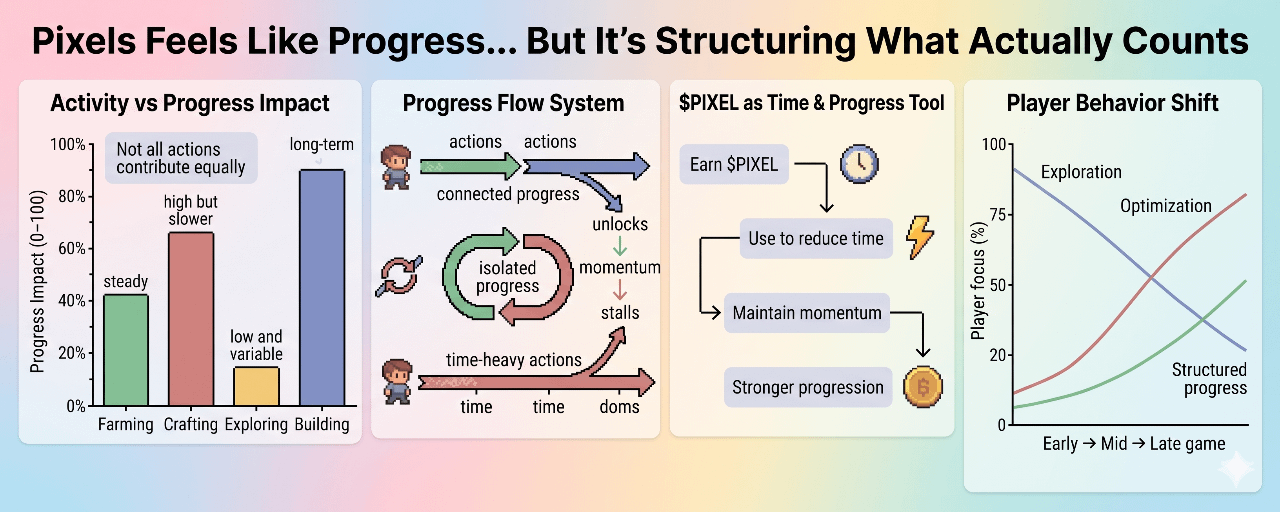
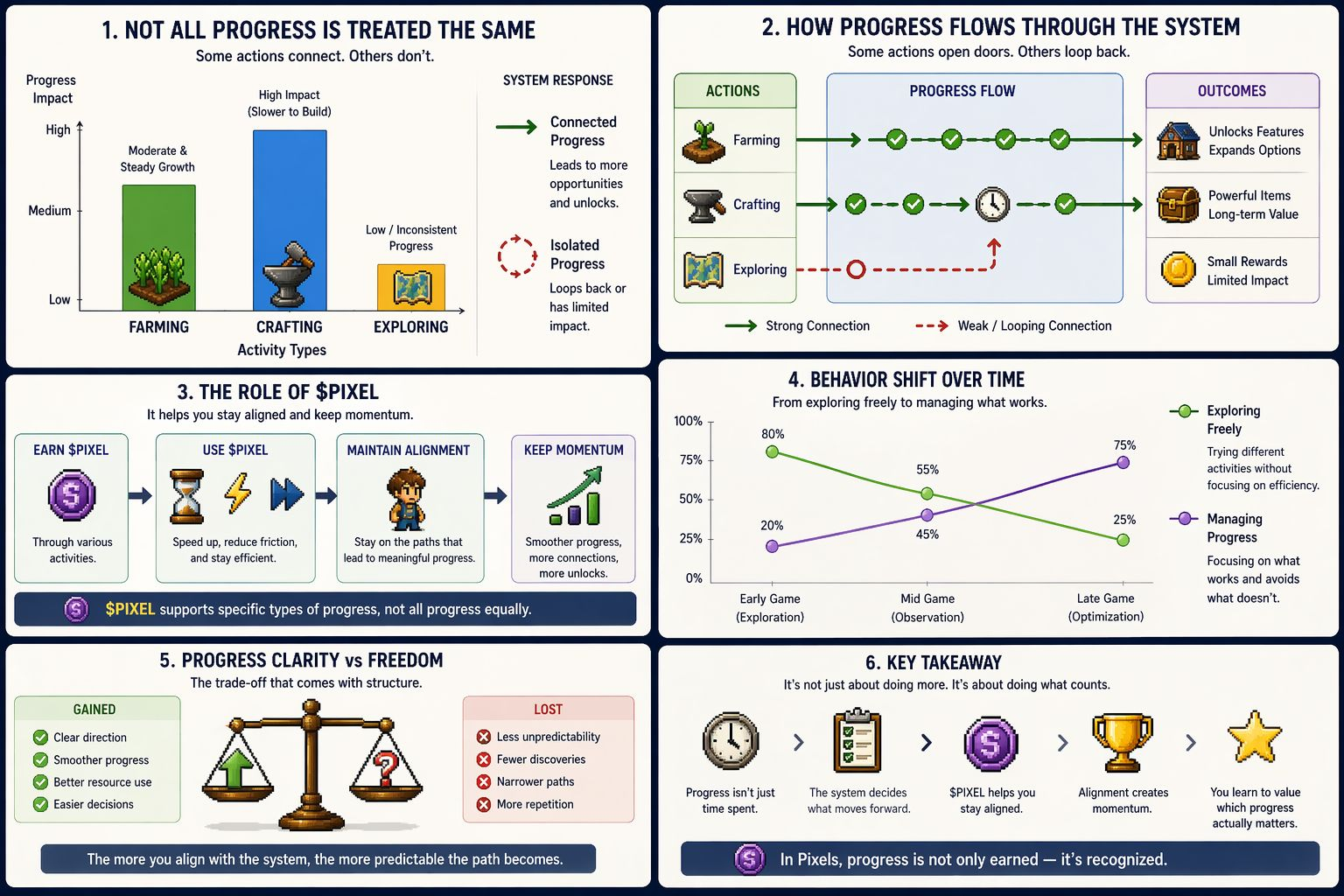
On the surface, everything is still available. Farming, crafting, exploring, all presented equally. But over time, you start to feel which paths carry weight and which ones don’t. Not because the system explains it, but because of how outcomes unfold.
Some actions open into more opportunities. Others quietly loop back into themselves.
Naturally, I began adjusting. In the beginning, I explored freely, trying different activities without thinking too much about efficiency. It felt open and flexible. But gradually, I started repeating what worked. I noticed which actions created smoother progress and which ones felt disconnected.
Without making a deliberate decision, I shifted from exploring progress to managing it.
That’s when it became clear that Pixels isn’t just offering progress, it’s shaping what counts as progress.
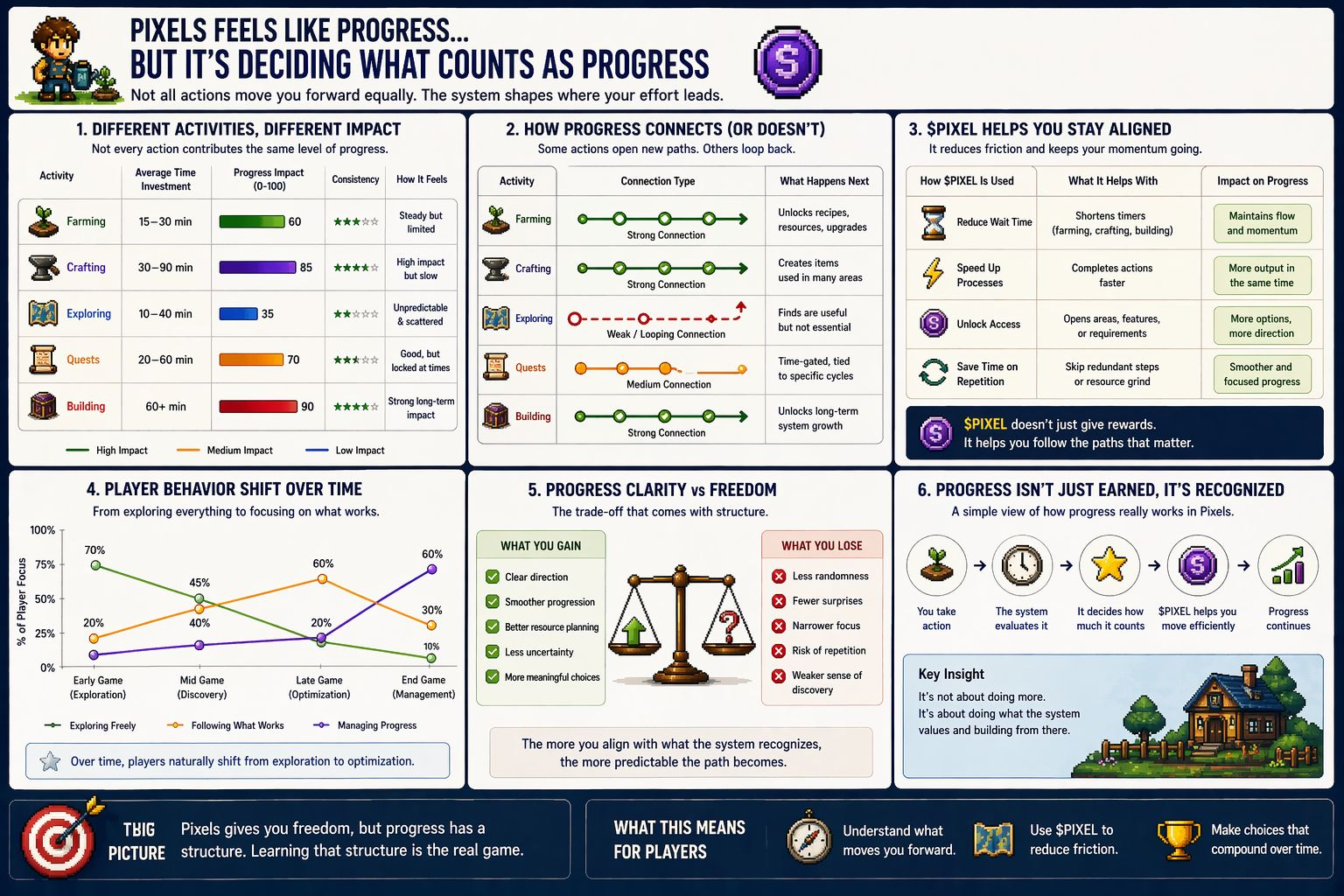
This distinction is subtle, but it changes how the entire system feels. Once progress becomes selective, behavior follows. I begin prioritizing actions that align with that structure, even if I don’t fully understand why they work better. At the same time, I start ignoring actions that feel less connected, even if they are still part of the system.
Over time, this creates a pattern.
I move toward what keeps momentum going and away from what slows it down. The system doesn’t force this behavior, but it encourages it through outcomes. Progress feels smoother when I follow certain paths, and less stable when I don’t.
That’s where $PIXEL starts to take on a different role.
At first, it feels like a standard reward, something you earn and use as needed. But gradually, it becomes part of how I stay aligned with the system. It allows me to move through certain processes more efficiently, reduce friction, and maintain continuity in my progress.
In that sense, it doesn’t just support progress, it supports specific types of progress.
Not by limiting options, but by making some directions easier to sustain than others.
This introduces a quiet kind of pressure. Not the kind that blocks choices, but the kind that shapes them over time. I find myself choosing actions that maintain flow, that keep everything connected, rather than actions that feel isolated or inefficient.
And this is where the tension begins to appear.
Because while progress becomes smoother, it also becomes narrower. The more I align with what works, the less I experiment. I begin to follow patterns that I know will produce results, and I stop exploring paths that feel uncertain.
The system becomes clearer, but also more structured.
That clarity has its advantages. It reduces confusion, makes decisions easier, and creates a sense of direction. But it also reduces variation. There’s less room for discovery, less unpredictability in how progress unfolds.
It’s not a limitation, but it is a shift.
What started as open-ended progression slowly becomes guided progression.
And I’m not sure this change is immediately visible. It builds gradually, through repeated actions and small adjustments. One decision leads to another, and over time, those decisions start to follow a pattern.
Eventually, you realize that you’re not just progressing freely.
You’re progressing in a way that the system recognizes and supports.
That realization changes how I see the entire experience.
It’s no longer just about moving forward. It’s about understanding which kind of forward actually matters. Pixels still presents itself as a simple, accessible world where everything feels open. But beneath that simplicity, there is a structure organizing how progress connects, how it builds, and how it continues.
And that structure isn’t something you immediately see.
You feel it over time.
Through the way certain actions lead somewhere, and others don’t. Through the way momentum builds in some directions and fades in others.
Until eventually, it becomes clear that progress here isn’t just something you create on your own.
It’s something you learn to align with.
