
A lot of Web3 games make their priorities obvious within minutes.
You log in, click through a few tasks, collect a few resources, and before long it becomes clear that the real point is not the world, the gameplay, or even the experience of spending time there. The real point is the loop. Produce, collect, convert, repeat. Everything else is decoration.
Pixels does not entirely escape that conversation, but it does feel different from most projects that sit in the same category.
On the surface, it is easy to mistake it for just another blockchain farming game. It has crops, land, gathering, crafting, and a bright social world built around casual play. That description is technically true, but it does not really explain why the game has managed to hold attention in a way so many token-driven titles never do. The farming is only the visible layer. Underneath it, Pixels feels much closer to a functioning digital economy than a simple reward machine dressed up as a game.
That difference is more important than it sounds.
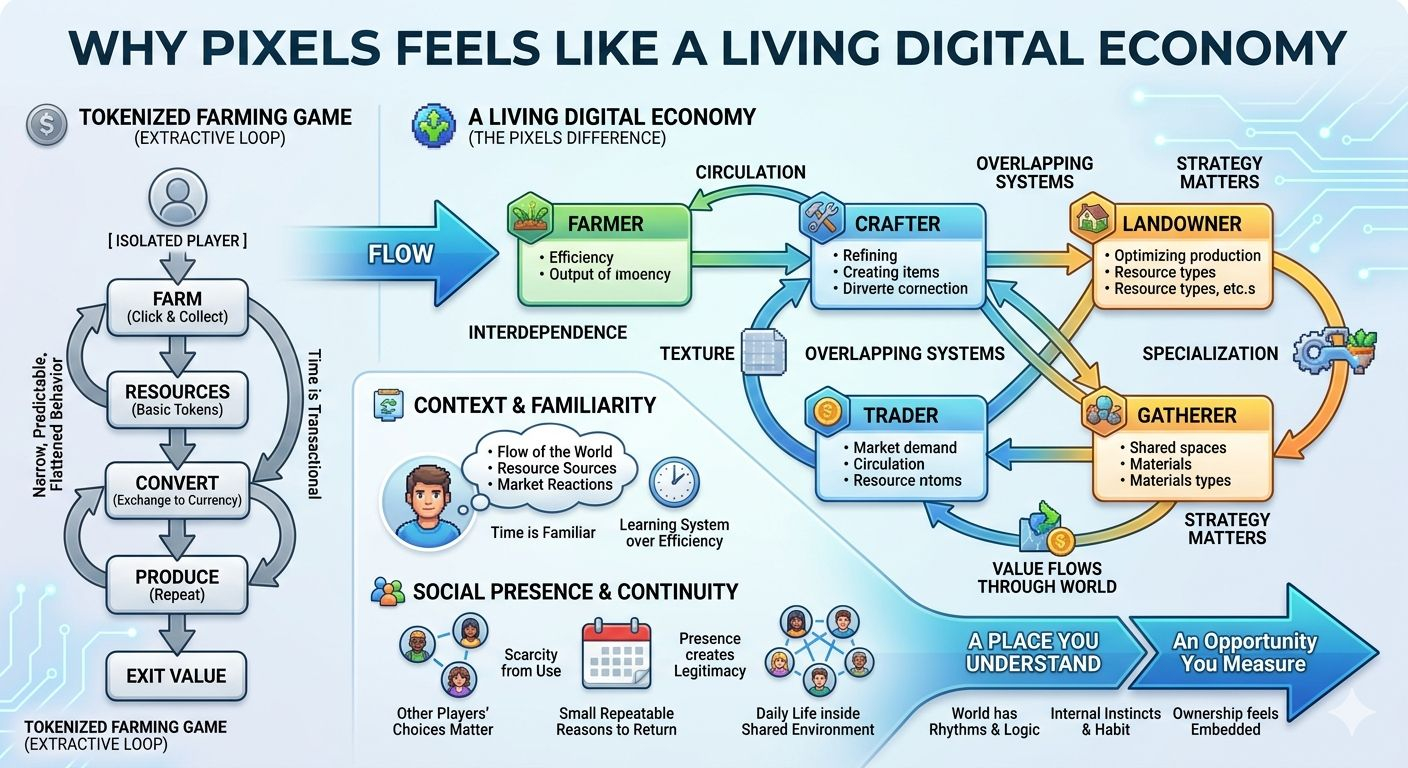
A tokenized farming game usually feels narrow. You are there to work a system. The actions may look playful, but the structure underneath them is often rigid and obvious. Your job is to feed a loop and pull value out of it as efficiently as possible. Once you understand that, the illusion fades quickly. The world stops feeling like a place and starts feeling like a spreadsheet with trees.
Pixels works better because the world does not feel entirely built around extraction.
It feels active. Occupied. Slightly messy in the way actual economies tend to be.
Farming matters, but farming is not the whole story. Players are not only planting and harvesting. They are gathering, crafting, trading, upgrading, moving through shared spaces, using land in different ways, and finding small advantages in systems that overlap with one another. That overlap is what gives the game its pulse. It creates the sense that value is moving through the world instead of simply being generated on demand.
That is where Pixels starts to feel less like a game with tokens and more like a place with circulation.
And circulation changes everything.
In a thin economic game, every player is basically doing the same thing with slightly different numbers. The activity may be spread across different menus or mechanics, but it all leads back to one predictable purpose. That makes the economy feel artificial. It exists, but only in the most basic sense. There is no real texture to it. No roles. No pressure points. No sense that one person’s decisions meaningfully shape another person’s opportunities.
Pixels is more convincing because it allows different kinds of participation to matter.
One player might focus on farming efficiency. Another might spend more time gathering or refining materials. Someone else may lean into crafting, trading, or land-based productivity. Another player may not produce the most at all, but still ends up ahead because they understand demand better than the people around them. Once that starts happening, the game stops feeling like a single loop and starts feeling like a network of smaller loops feeding one another.
That is a real shift.
Living economies depend on interdependence. They need people doing different things for different reasons, with enough variation that strategy actually matters. When every player follows the same path, the system may still generate activity, but it will never feel alive. Pixels gets closer to that feeling of life because it gives players room to occupy different positions inside the world. It does not flatten everyone into the same behavior.
That alone gives the game more weight than many Web3 titles ever achieve.
It also changes how players think about time.
In weaker blockchain games, time is mostly transactional. You put it in and expect something measurable back. The relationship is blunt. If the return weakens, the motivation usually disappears with it. There is not much else holding the experience together.
Pixels can still be approached that way, of course. Any game with an open economy will attract that mindset. But it also supports another kind of engagement, and that is where it becomes more interesting. Time in Pixels can become familiar rather than merely extractive. You start learning the flow of the world. You notice where resources come from, what is worth producing, when certain actions make sense, how land use shapes output, and how the market reacts to player behavior. You are no longer just spending time for yield. You are building context.
That context is what makes a world feel lived in.
The strongest game economies are never only about rewards. They are about relationships between systems. A crop matters because it leads to something. A resource matters because someone needs it. A crafted item matters because it sits inside a wider chain of demand. Land matters because it changes what can be produced, organized, or improved. When those relationships are clear enough for players to feel them, the economy stops feeling decorative. It becomes part of the world’s logic.
Pixels understands this better than many projects in the space.
That may be why it feels more durable than the older “play-to-earn” model that defined so much of the first Web3 gaming wave. That phrase always sounded clean in theory, but in practice it reduced games to a simple question: is the output worth the time? Once players start looking at a world through that lens alone, the world usually loses. If earning weakens, interest collapses. There is no deeper attachment because there was never much reason to care beyond the return.
Pixels seems more aware of that trap.
It does not rely entirely on financial motivation to keep people around. It leans into routine, social presence, progression, and low-pressure participation. That matters more than people sometimes admit. Not every game needs intensity to feel compelling. Sometimes accessibility is the advantage. Pixels is easy to enter, easy to understand at a surface level, and structured in a way that lets players gradually discover more depth instead of forcing everything upfront. That softness makes the economy easier to live inside.
And that may be its smartest design choice.
Because the truth is, digital economies feel more believable when they are wrapped in a world people actually want to spend time in.
That has been true long before blockchain entered the conversation. The best MMO economies worked not because players loved auction houses in isolation, but because trade, crafting, scarcity, and specialization were embedded in worlds that gave those systems meaning. Pixels follows a lighter version of that logic. It does not need overwhelming complexity to create a sense of economic life. It just needs enough moving pieces for players to feel that their actions connect to other people’s actions.
Once that happens, ownership stops feeling like a slogan.
That is another area where Pixels benefits from restraint. In many blockchain projects, the technology is pushed so aggressively that it overwhelms the actual experience. The chain becomes the story because the game itself is too thin to carry one. In Pixels, the infrastructure matters, but it does not have to dominate the player’s attention every second. What matters moment to moment is the world, the routines, the production loops, the exchange, and the feeling that the space is active. The technology supports that structure rather than replacing it.
That is a healthier balance.
A real in-game economy also depends on continuity. Players need to believe the world will still make sense tomorrow. They need to feel that learning the system is worth something, that their habits are building familiarity, and that the surrounding activity is not purely temporary noise. Pixels often succeeds here because it gives players small, repeatable reasons to return. Check what is happening. Adjust production. Gather what is needed. Improve the setup. Trade when it makes sense. Explore a little. Watch how the world shifts around you.
None of those actions sound dramatic on their own.
But real economies are not made of dramatic moments. They are made of repeated decisions, minor optimizations, small changes in behavior, and accumulated knowledge. Pixels feels more alive when it embraces that truth. It does not need every action to feel monumental. It only needs actions to connect.
The social element helps a lot here too.
Economies rarely feel real in isolation. They feel real when other people’s choices become visible. When you can sense movement around you, the world gains credibility. Demand feels more convincing when it is clearly tied to actual behavior. Scarcity feels more believable when it emerges from use rather than from a fixed design trick. Land feels more meaningful when it reflects activity instead of passive ownership. Even seeing people move through the world, work different loops, and shape local patterns adds something important. Presence creates legitimacy.
Pixels benefits from that sense of presence.
It makes value feel embedded rather than abstract. Not floating above the game, not trapped in a token chart somewhere outside the experience, but moving through the world itself. That is a major reason it leaves a different impression from colder, more mechanical Web3 games. It is not just trying to financialize play. It is trying, at least at its best, to make economic participation feel like part of daily life inside a shared environment.
That is a much harder thing to build.
It also means the game has to keep managing a delicate balance. Any live economy can become distorted. Push rewards too hard and everything turns into optimization theater. Strip too much economic force out of the system and the world loses momentum. Make things too simple and the economy feels hollow. Make them too dense and the casual appeal starts to break. Pixels is interesting partly because it lives inside that tension. It has to keep proving that the world can stay approachable without becoming shallow, and economically active without becoming joyless.
That challenge is real.
But it is also what makes the project worth paying attention to.
Pixels is not compelling because it put farming on-chain. That alone would not mean much. Plenty of projects have already shown that attaching tokens to repetitive gameplay does not create depth by itself. What makes Pixels stand out is that it comes closer to building an environment where production, exchange, specialization, and routine actually feel connected. It gives the player something better than a simple loop. It gives them a small world with its own internal logic.
And once a game has that, people relate to it differently.
They stop treating it like a temporary opportunity and start treating it like a place they understand.
That is the real distinction.
An opportunity is something you measure from the outside. A place is something you learn from within. In an opportunity, you ask whether the numbers still work. In a place, you start to notice rhythms, inefficiencies, habits, and openings that are invisible to people who only glance at it. You develop instincts. You build familiarity. You return not only because something can be extracted, but because the world itself has become readable to you.
That is what Pixels gets right more often than its label suggests.
It may look like a farming game with token infrastructure attached. But when its systems are working well, it feels closer to a modest digital society built on production, exchange, and shared routine. Farming is just the entry point. The real experience is learning how value moves through the world, where your role fits inside it, and why other people’s participation matters to your own.
That is why Pixels can feel less like a tokenized game mechanic and more like a living economy.
And in Web3 gaming, that difference is not small. It is the line between a system people pass through and a world people keep coming back to.