
At first, Pixels feels like it never really stops.
You log in, things are already moving. Farms progressing, resources circulating, players doing their routines. It gives the impression of a system that’s always active, always flowing forward.
Nothing feels blocked.
That’s what makes it easy to assume everything happening inside it holds equal weight.
But after spending more time watching it closely, that assumption starts to weaken.
Not everything moves at the same depth.
Some actions feel like they pass through quickly. They happen, they resolve, and then they’re gone. You stay active, but nothing really builds in a lasting way.
Other moments feel different.
Less frequent, but heavier.
They don’t just pass through the system. They seem to settle into it.
That’s where I started paying attention.
Because the difference between those two types of actions isn’t clearly defined. The game doesn’t tell you which ones matter more. It just lets you experience both until you begin to notice the gap yourself.
At first, I thought it was just progression.
Some actions naturally lead to bigger outcomes. That’s normal in any system. But this didn’t feel like a simple progression curve.
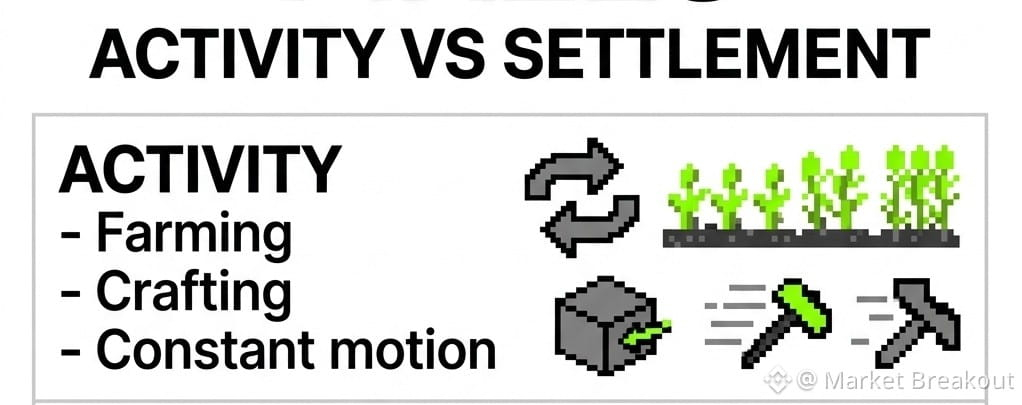
It felt more like a separation between activity and settlement.
Most of what happens in Pixels lives in motion.
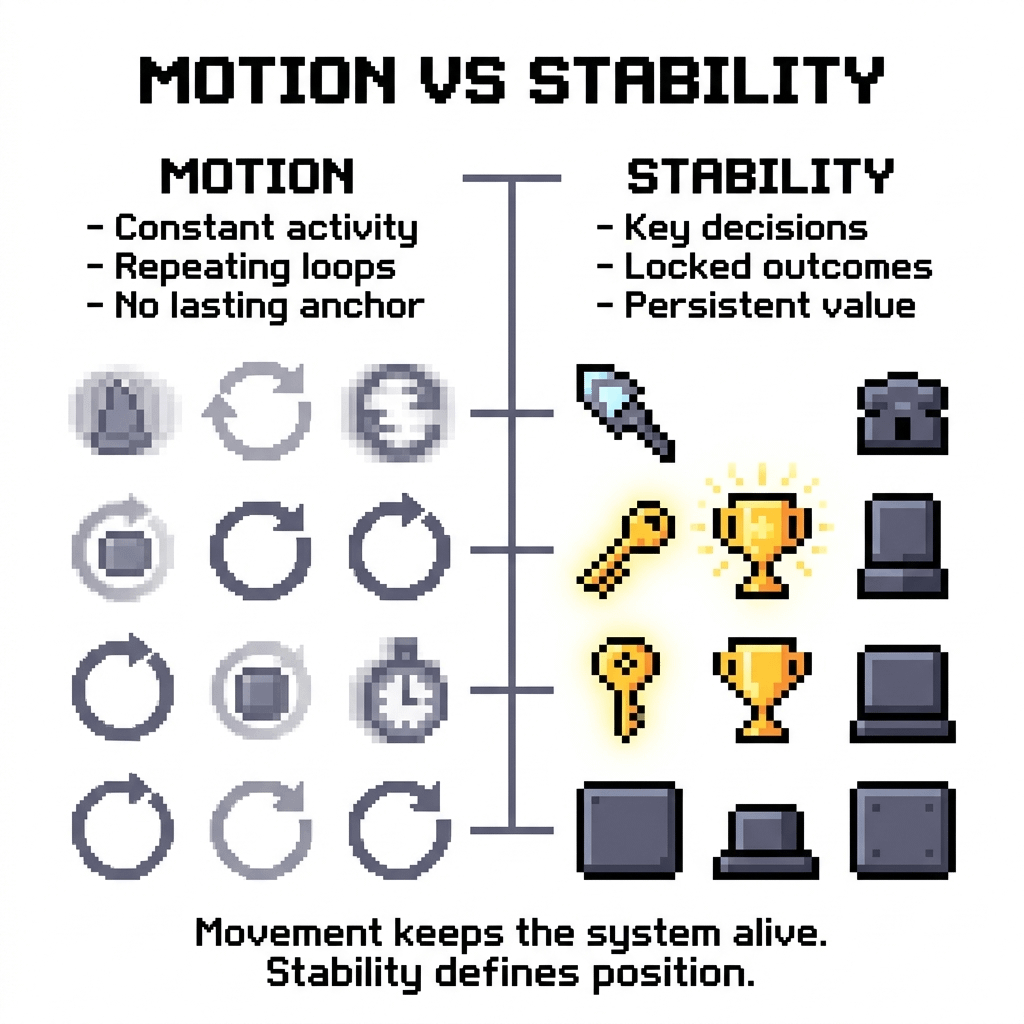
You’re constantly doing something, but that “something” doesn’t always carry forward in a meaningful way. It keeps the system alive, but it doesn’t necessarily anchor your position inside it.
Then there are points where things stop moving.
Not completely. Just enough that the outcome feels fixed.
Those are the moments that seem to define where you actually stand.
And they don’t happen randomly.
They tend to appear around limited opportunities, upgrades, asset decisions, or moments where timing suddenly matters more than effort.
That’s where $PIXEL starts to feel less like a reward and more like a requirement.
Not in an obvious sense.
You’re not forced to use it constantly. You can stay active without it. You can keep playing, keep progressing on the surface.
But when the system shifts from movement to settlement, having Pixel available changes what you can do in that moment.
If you’re ready, you move through it.
If you’re not, you stay in motion while others lock things in.
That distinction is subtle, but over time it compounds.
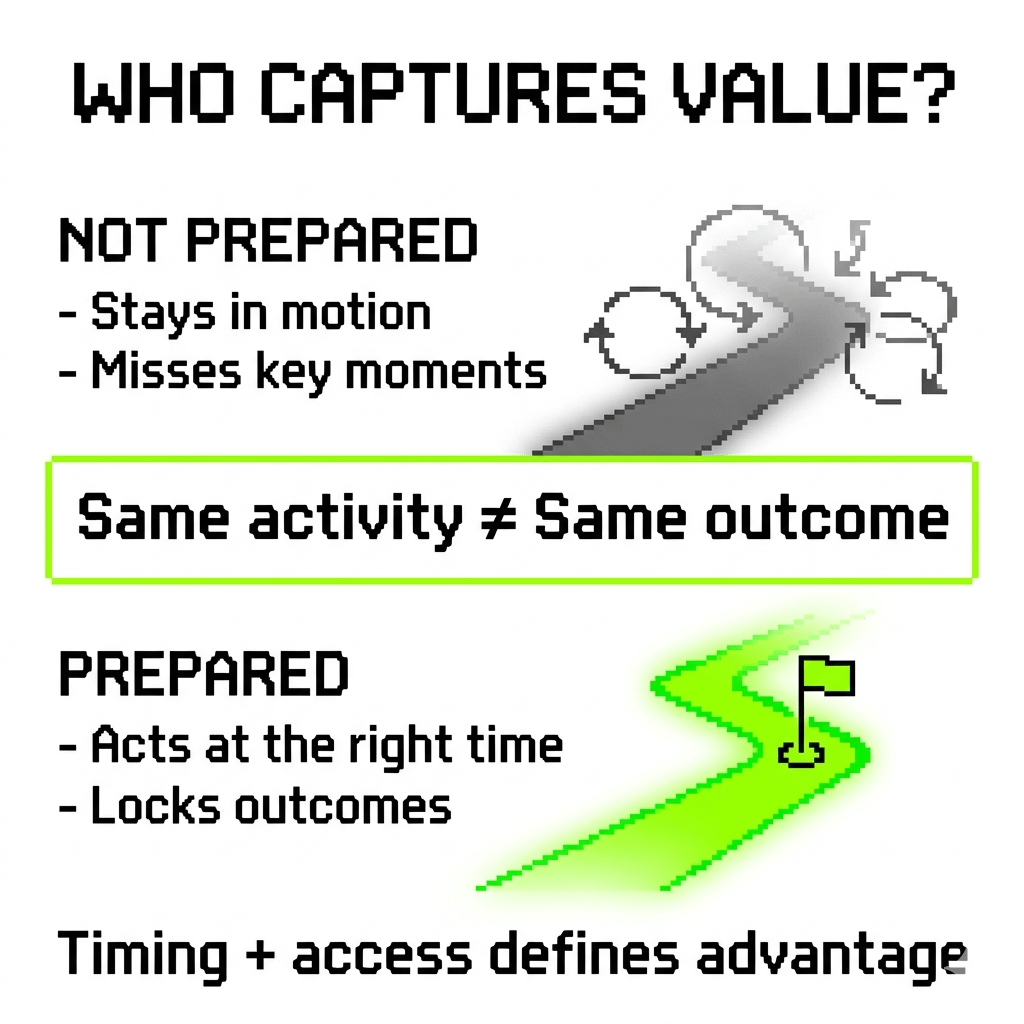
I started noticing that certain players consistently appeared at those “settling points.” Not because they were more active overall, but because they were prepared when it mattered.
That’s a different kind of advantage.
It’s not about effort. It’s about timing combined with access.
I’ve seen similar dynamics outside of games.
In markets, not every transaction matters equally. Most activity happens in the background, but real positioning happens at specific moments, when liquidity is tight, when opportunities are brief, when decisions can’t be delayed.
Those who are ready at those moments shape the outcome.
Everyone else is still participating, but not at the same level.
Pixels is starting to feel like it operates on a similar principle.
The system remains open on the surface. Anyone can join, anyone can play, anyone can contribute activity.
But the moments that actually define position are more selective.
And selection always introduces structure.
Once players begin to recognize where those moments are, behavior shifts. Less time is spent wandering through the system. More time is spent preparing for when something meaningful appears.
Activity becomes secondary.
Readiness becomes primary.
That’s where the design starts to reveal its tension.
Because if value only settles at certain points, and those points require preparation, then over time the same group of players will naturally begin to dominate them.
Not aggressively.
Just consistently.
New players still generate activity. They still contribute to the system’s movement. But translating that movement into position becomes harder if you’re not aligned with when and how settlement happens.
That creates a kind of invisible layer inside the economy.
Everything looks active.
But not everything is equally recognized.
And that’s where $PIXEL seems to sit.
Not as something that increases activity, but as something that determines when activity stops being temporary.
That’s a subtle but important shift.
Because it means the token isn’t just part of the reward cycle. It’s part of how the system decides what becomes permanent.
I’m not sure if that was the intention.
It might just be a natural outcome of combining a high-frequency off-chain system with selective on-chain finality. Not everything can be recorded. Not everything should be.
So the system filters.
And once there’s a filter, there has to be a way to pass through it.
Pixel looks like that mechanism.
From a distance, it still behaves like a standard game token.
But up close, it feels more like a timing layer.
Something that determines when your actions move from motion into structure.
That’s harder to measure than simple activity.
But it might explain why some outcomes feel uneven, even when effort looks similar on the surface.
And if that dynamic continues to develop, then the real question isn’t how much activity Pixels can generate.
It’s how selectively it turns that activity into something that actually stays.