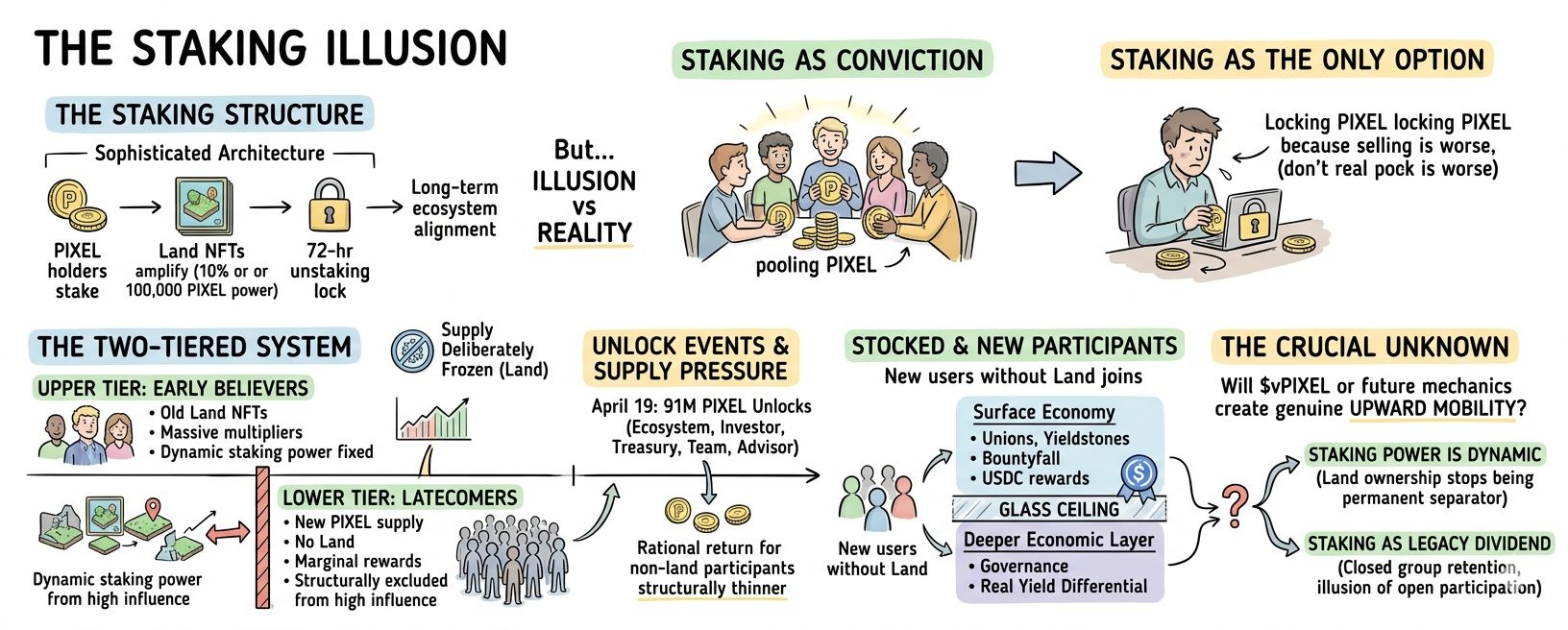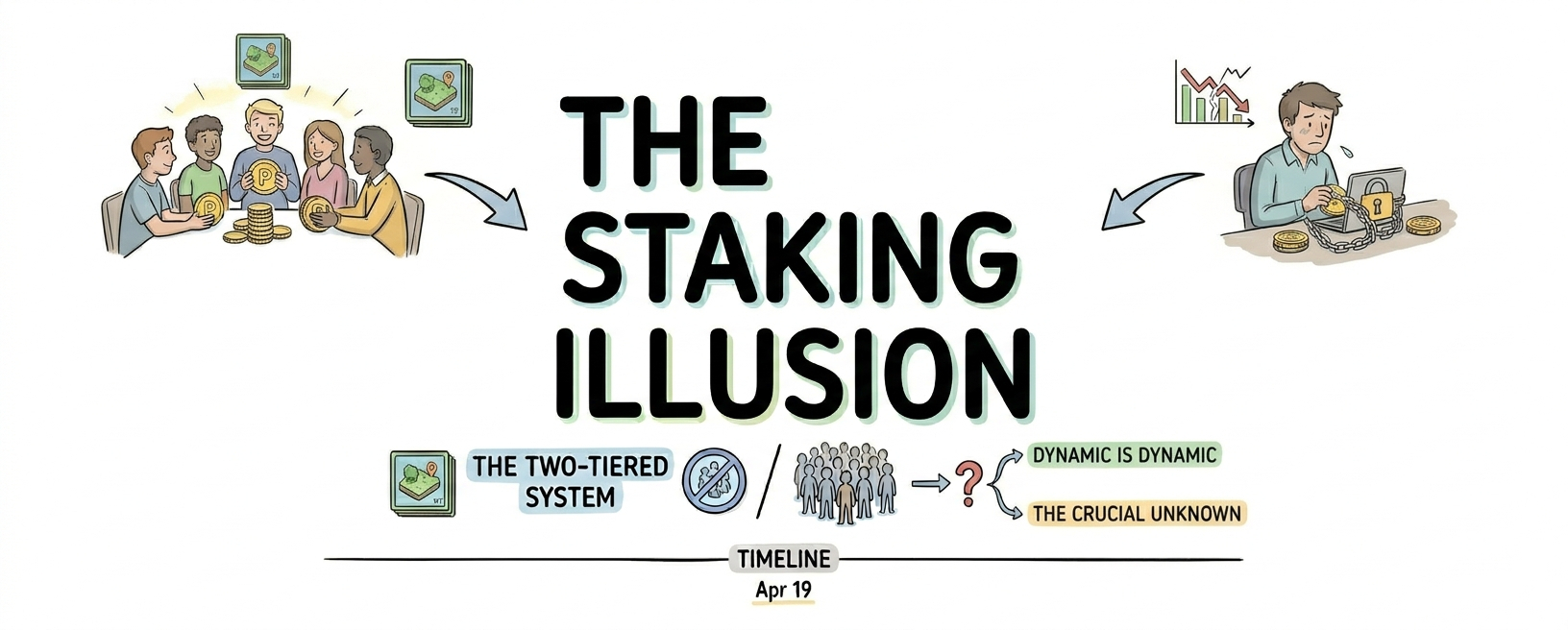
I kept looking at the staking numbers and something felt off. Not wrong exactly just unconvincing in a way I couldn't immediately place. Pixels has built what looks like a genuinely sophisticated staking architecture: PIXEL holders stake to earn rewards, land NFTs amplify staking power up to 10% or 100,000 PIXEL power per plot, unstaking carries a 72-hour lock, and the whole thing is positioned as the backbone of long-term ecosystem alignment. On paper that's a real incentive structure. But the more I sat with it the more I noticed that demand flowing into staking looks less like conviction and more like the only available alternative to selling. That distinction matters more than it sounds. And I'm not sure the current price reflects that it's even a question worth asking.
The reason it felt strange is that staking in Pixels isn't supposed to be passive. It's meant to be productive directing ecosystem resources toward specific games, supporting validators, earning shares of reward pools, unlocking gameplay perks like energy boosts and VIP access. That's a real utility stack, not just a lockup dressed up as yield. But when you actually look at who holds meaningful staking power, the picture narrows uncomfortably fast. Land NFT holders get disproportionate amplification, and no new farmland has been minted in years. The supply is deliberately frozen. Which means the staking power hierarchy isn't dynamic it's fixed. Wallets that got in early and acquired land hold structural advantages that newer participants genuinely cannot replicate, regardless of how much PIXEL they stack now. I keep coming back to this because it reframes what staking actually is inside Pixels. It's not an open system where commitment earns influence proportionally. It's a tiered system where early land ownership created a permanent separation between one class of participant and everyone who came after and that gap only widens as circulating supply keeps climbing toward the 5 billion cap. The architecture doesn't just reward early believers. It structurally excludes latecomers from the part of the system where real influence concentrates, quietly and by design.
What this may explain is something I find more interesting than the price itself why unlock events produce the specific kind of pressure they do. Roughly 3.38 billion PIXEL is now circulating, with another 91 million scheduled for April 19 across ecosystem, investor, treasury, team, and advisor categories. These aren't just supply events in the abstract. They're new tokens entering a staking system where the most productive positions are already fully occupied by a fixed group of land-holding wallets. New supply has nowhere particularly advantageous to go. It can stake but without land amplification it earns proportionally less and carries proportionally less governance weight with every additional token that unlocks. So what reads as routine vesting is actually fresh supply flowing continuously into the lower tier of a stratified system. That produces sell pressure not because holders are disloyal but because the rational return for non-land participants gets structurally thinner every single month. I'm not fully convinced this is the dominant factor in price behavior. But I think it's seriously underweighted in most readings of why the token keeps grinding at these levels despite genuine product work happening underneath it.
The part that feels more important and harder to resolve is what Stacked actually changes about any of this. The team built Stacked partly to route rewards in USDC rather than raw PIXEL, which genuinely reduces immediate sell pressure from players who need liquidity. Smarter than most Web3 games attempt. But Stacked also onboards new participants who arrive without land, without elevated staking power, without the reputation score needed to access the marketplace or withdrawals. They can join Unions, deposit Yieldstones, compete in Bountyfall seasons. The surface economy welcomes them. The deeper economic layer where staking influence actually concentrates, where governance weight compounds, where the real yield differential lives stays controlled by the same older, smaller cohort it always has. The publishing flywheel the team describes depends on new entrants eventually becoming economically productive inside the ecosystem. What I can't fully resolve is whether the staking architecture as currently designed actually pulls people deeper over time or keeps them meaningfully engaged at the surface while the real economic gravity stays exactly where it started. From the outside those two outcomes are nearly indistinguishable for a long time. Until one of them quietly runs out of new entrants willing to participate in a system where the ceiling on their influence was set years before they arrived.
The part that matters to me going forward isn't the April unlock or how the current Union season resolves. It's whether the team does anything that creates genuine upward mobility inside the staking layer for participants who missed the land window. Right now the architecture rewards early land holders so disproportionately that staking functions more like a legacy dividend for a closed group than a live incentive mechanism open to the current player base. I understand the logic early believers took real risk at a time when nothing about this project was certain, and the land freeze was a deliberate supply decision to protect scarcity. That reasoning holds. But it also means every new PIXEL holder coming through Stacked, every external studio player discovering the ecosystem, every person who simply arrived too late is staking into a system where their ceiling was set years before they showed up and nothing currently scheduled changes that. If that ceiling stays fixed while circulating supply keeps expanding toward 5 billion, the staking narrative starts functioning less like genuine long-term alignment and more like a retention mechanism for a legacy cohort dressed in the language of open participation. What would actually shift my reading cleanly and completely is whether $vPIXEL or any future mechanic creates a staking pathway where land ownership stops being the permanent separator between meaningful yield and marginal yield. That single design decision would tell me more about where Pixels is genuinely headed than every chapter update and unlock event combined between now and the end of 2026.