I’mwaiting.I’mwatching.I’mlooking.I’vebeenseeingthesamequestiononloop:Okay,buthowmuchcanitreallyhandle?Ifollowthenumbers,butIalsofollowthesilencesthepausesbetweenblocks,thelittleRPChesitations,themomenttradersstartretryingandpretendit’snormal.Ifocusonwhatstayssteadywhenit’smessy,notwhatlooksprettywhenit’squiet.
Pixels on Ronin feels less like a test and more like a busy street that never really empties. At first glance, it’s just farming, walking around, crafting things. Simple loops. But once enough people are doing those loops together, the chain starts telling a different story. It’s not about one big action. It’s about thousands of tiny ones stacking on top of each other at the same time.
That’s where the usual “TPS” talk falls apart. A chain can handle a quick burst and still struggle when the same pressure keeps coming without a break. Pixels isn’t about spikesit’s about consistency. People log in, repeat actions, interact, and they don’t stop at the same time. That kind of load is harder to fake and harder to optimize for.
Ronin keeps things moving fast on the surface. Blocks come in quickly, and most actions feel smooth. But what matters is how much work actually fits inside each block without causing delays somewhere else. Because when things slow down, they don’t always slow down where you expect. Sometimes the chain is fine, but the response you’re waiting for isn’t.
The real pressure shows up in small moments. A harvest takes a second longer than usual. A transaction looks stuck, so the user tries again. The wallet confirms, but the game hasn’t updated yet. None of these are major issues alone, but together they start to build friction. And friction spreads fast when thousands of players are doing the same thing.
Execution isn’t just about raw power. It’s everything around it too. Data has to move across the network. Signatures need to be checked. Transactions have to be ordered and processed without stepping on each other. In a game like Pixels, a lot of actions touch the same areassame land, same resources, same shared points. That creates congestion in ways that aren’t always visible but are definitely felt.
Even though it’s a game, the behavior starts to look a lot like DeFi under pressure. You get sudden bursts when something valuable happens. You get users acting fast, sometimes like bots, trying to optimize timing. You get conflicts when too many actions hit the same target. And you get retries when things don’t respond instantly. Those retries matterthey quietly double the load without anyone planning it.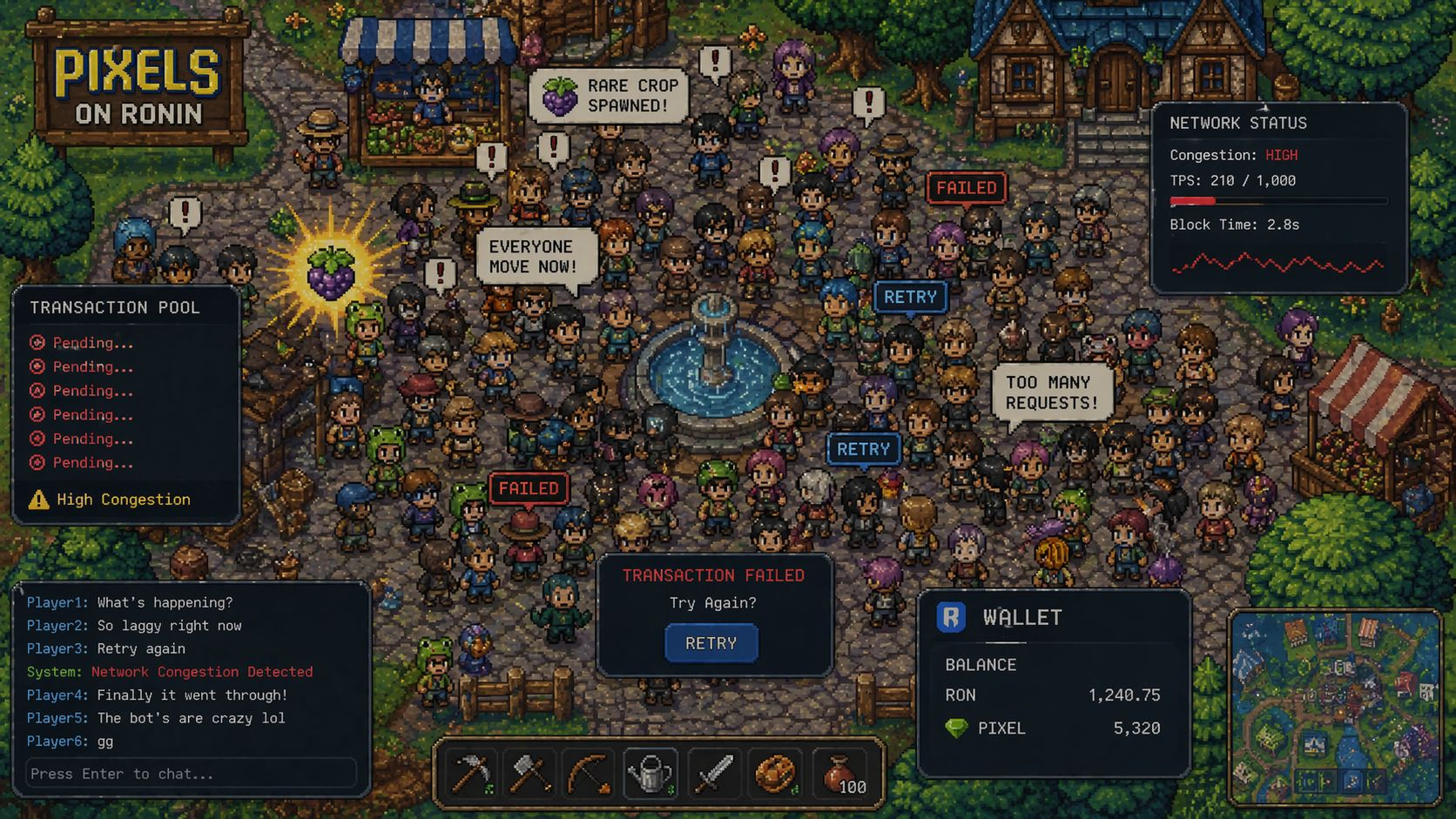
Ronin’s setup clearly leans toward speed and control. That helps keep the experience smooth most of the time. The path from the user to the chain is shorter, cleaner, and more predictable. But there’s always a trade-off. Tighter control can mean less flexibility when something unexpected happens. Fewer moving parts can be efficient, but it also means less room for error.
What I keep an eye on isn’t the polished metricsit’s the edges. Public RPC performance is one of the first places cracks show. If that slows down, everything feels slower, even if the chain itself is still running fine. Indexers are another weak spot. If they lag, users think their actions didn’t go through, even when they did. That gap creates confusion, and confusion leads to more retries.
Wallet experience plays a big role too. If signing a transaction feels uncertain, people hesitate or repeat the action. That adds pressure instantly. Bridges are another layer. Moving assets in and out should feel simple, but when activity increases, delays there become more noticeable. And users don’t separate these layersthey experience it all as one system.
What stands out is that systems like this rarely break in obvious ways first. Blocks don’t stop. The chain doesn’t crash. Instead, things just start to feel off. Slight delays. Small mismatches. Tiny inconsistencies. And those are enough to change how people behave. They click more. They wait less. They trust the system a little less each time.
So instead of asking if Ronin can handle Pixels, I’m more interested in how it behaves when everything gets slightly uncomfortable. Because that’s where the truth shows upnot in perfect conditions, but in crowded, messy, real ones.
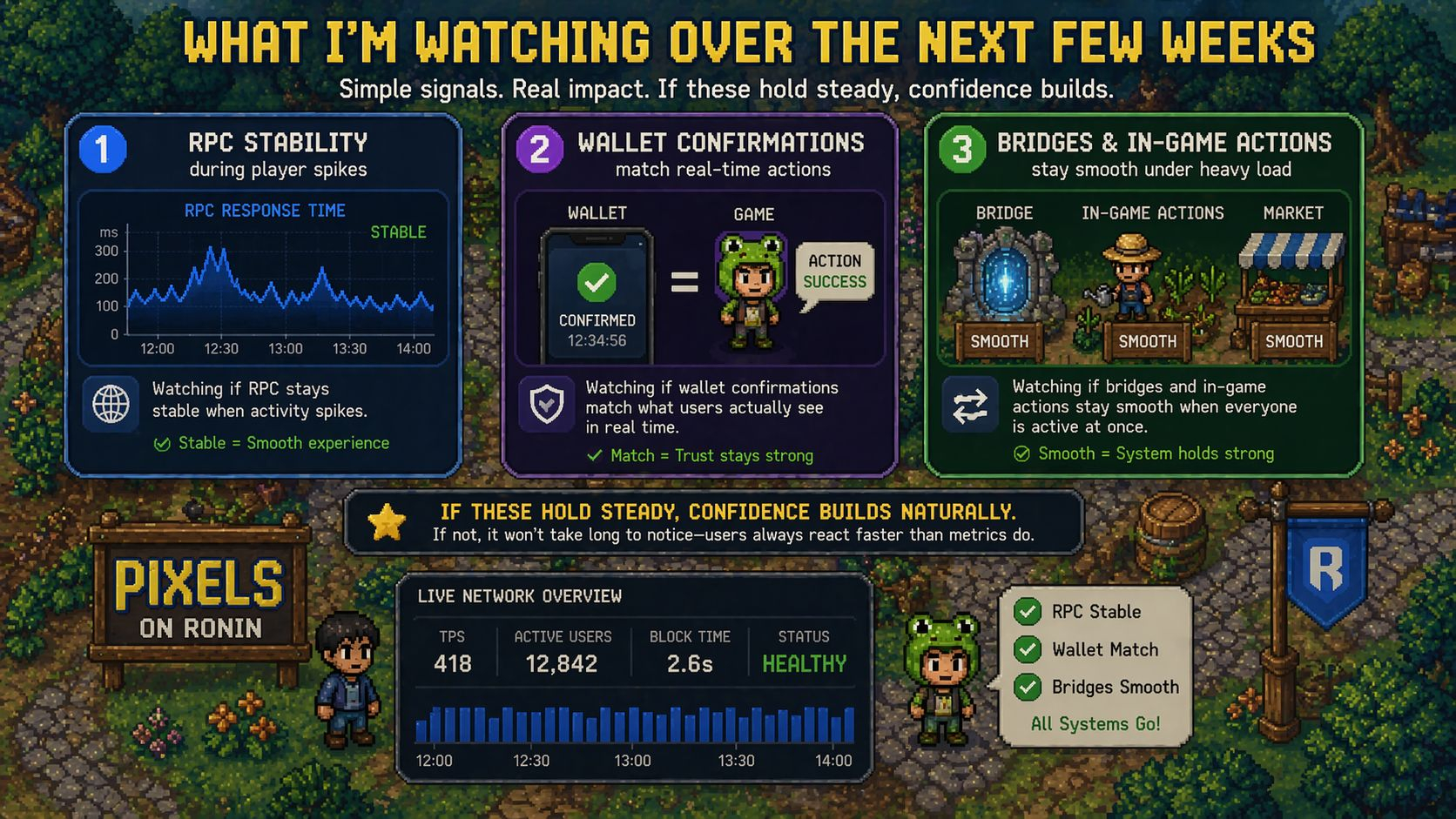
Over the next few weeks, I’m watching a few simple things. Whether RPC stays stable when player activity spikes. Whether wallet confirmations match what users actually see in real time. And whether bridges and in-game actions stay smooth when everyone is active at once. If those hold steady, confidence builds naturally. If not, it won’t take long to noticebecause users always react faster than metrics do.#pixel @Pixels $PIXEL