
The first time I spent a full evening inside Pixels, nothing felt obviously wrong. That’s probably why it stayed with me.
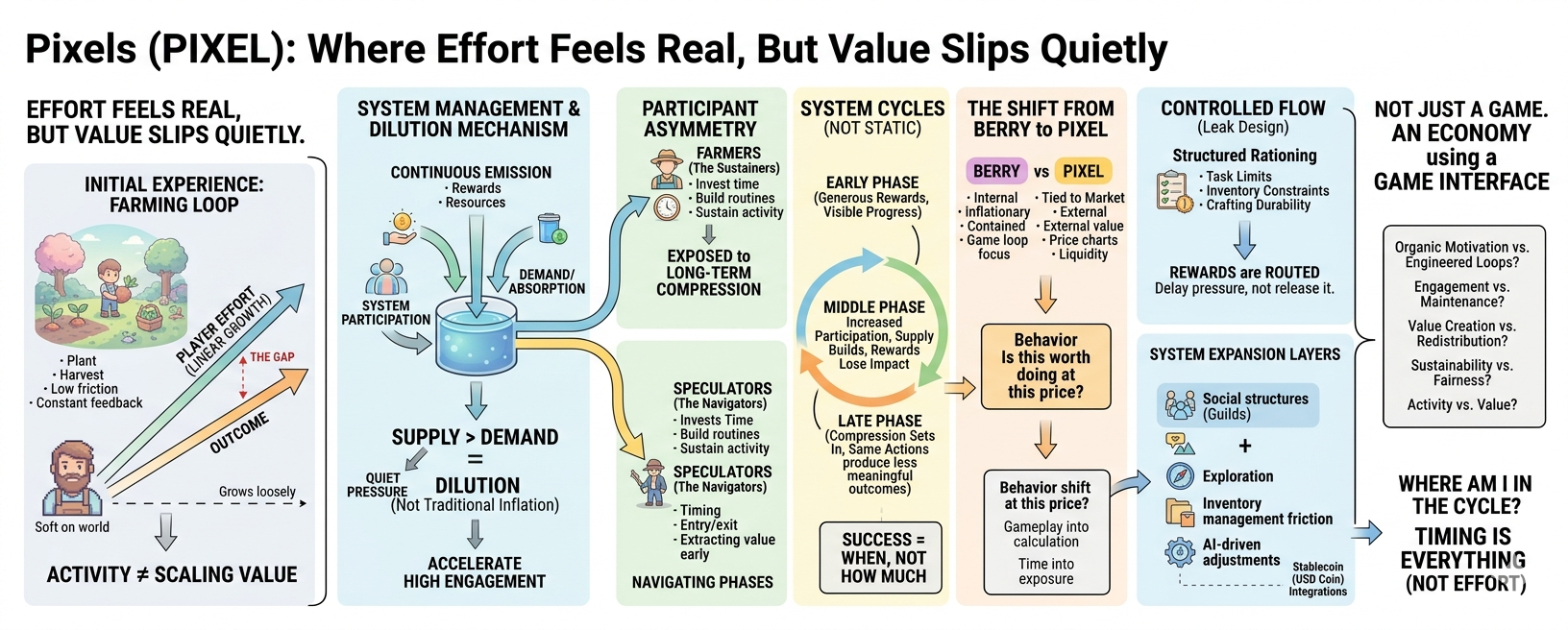
You plant, you harvest, you move around a soft-colored world that doesn’t demand too much from you. The friction is low. The feedback is constant. There’s always something to do, always something ticking forward. On the surface, it feels productive in a quiet, almost comforting way.
But after a while, a small contradiction starts to form. You’re active. You’re consistent. You’re doing everything the system seems to ask of you. And yet, the outcome doesn’t scale the way your effort does. Not linearly. Not even proportionally. Just… loosely.
That gap is subtle at first. Then it becomes the thing you can’t unsee.
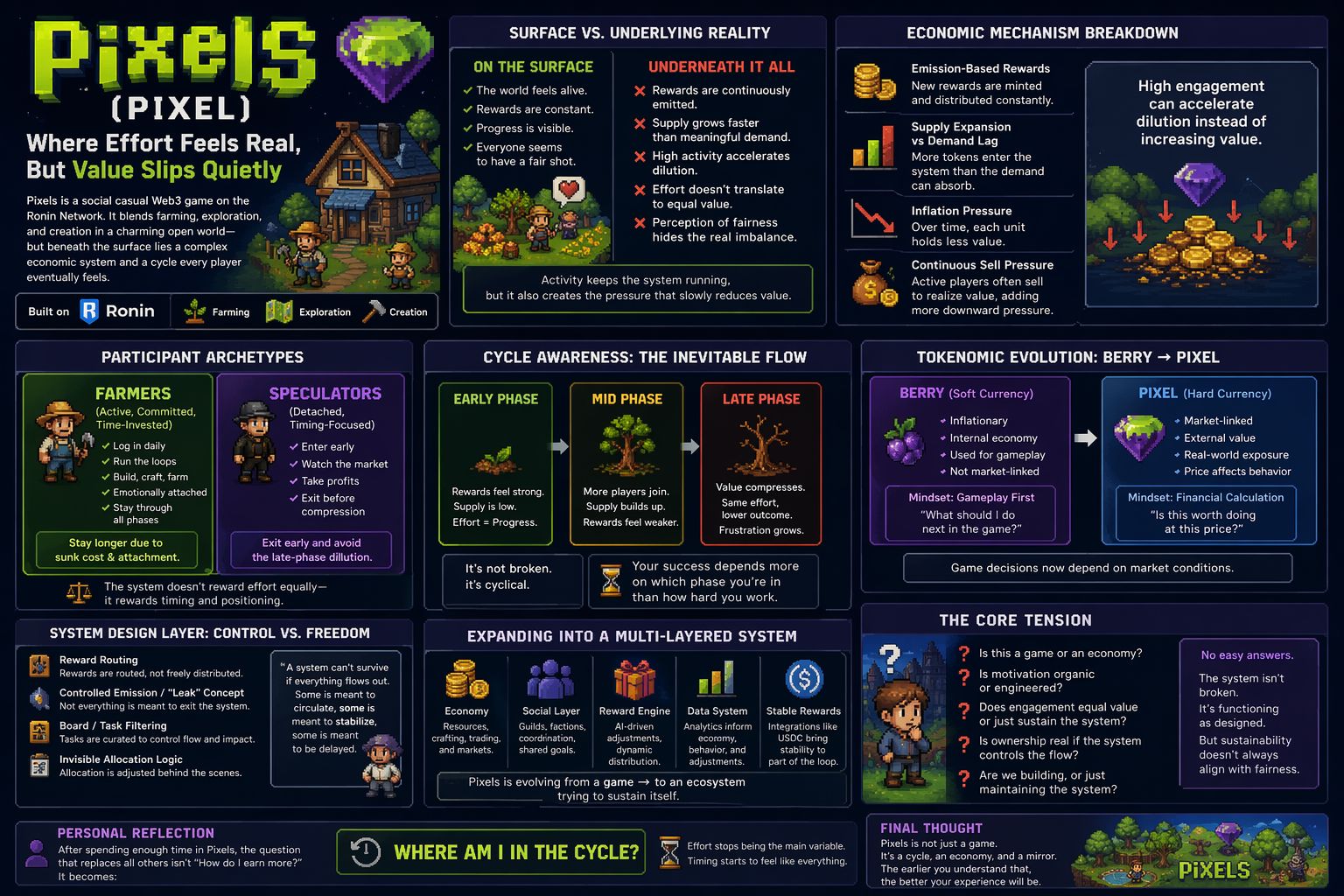
On the surface, Pixels looks fair. Everyone has access to the same loops farming, crafting, exploration. Rewards are visible. Progress is measurable. The system feels alive because everyone is participating. Fields are always being harvested. Markets are always moving. There’s a sense of shared momentum.
But underneath that activity, something else is happening. The system isn’t just rewarding participation it’s managing it.
And that’s where the imbalance begins to show.
The core mechanism isn’t complicated, but it doesn’t announce itself either. Rewards are emitted continuously. Resources flow outward. But demand doesn’t necessarily expand at the same pace. So what you end up with is a quiet pressure building beneath the surface supply increasing faster than meaningful absorption.
It doesn’t feel like inflation in the traditional sense. It feels like dilution. Slow. Persistent. Easy to ignore if you’re focused on staying busy.
High engagement, paradoxically, accelerates this. The more people play, the more rewards enter circulation. The more rewards enter circulation, the harder it becomes for any single unit of effort to retain value. Activity feeds the system but it also weighs it down.
And most players don’t step back far enough to see that dynamic clearly.
Inside that structure, two types of participants emerge, even if no one explicitly identifies as either.
The farmers are the ones who stay. They invest time. They build routines. They optimize their loops. There’s a kind of attachment that forms not just to assets, but to the rhythm itself. Logging in starts to feel less like a choice and more like a continuation.
Then there are the speculators. They move differently. They’re less concerned with the daily loop and more focused on timing entry, exit, positioning. They don’t need the system to feel rewarding over time. They just need it to be predictable in phases.
And that’s the asymmetry.
Farmers contribute most of the activity, but they’re also the most exposed to long-term compression. Speculators extract value early and avoid the phase where effort starts to outpace reward. One group sustains the system. The other navigates it.
Neither is wrong. But they’re not playing the same game.
Because this isn’t a static system—it’s cyclical.
Early on, everything feels generous. Rewards are strong relative to participation. The economy feels light, almost underutilized. Effort translates into visible progress.
Then comes the middle phase. Participation increases. Emissions continue. Supply starts to build. Nothing breaks, but the edges soften. Rewards still come, just with less impact.
And eventually, the late phase. This is where compression sets in. The same actions produce less meaningful outcomes. Not because the system failed but because it followed its own logic all the way through.
From that perspective, success isn’t really about how much you do. It’s about when you’re doing it.
That becomes even clearer when you look at the shift from BERRY to PIXEL.
BERRY felt internal. Inflationary, yes, but contained. Its purpose was to keep the game loop moving, not to represent external value. You didn’t think too hard about its price because it wasn’t really designed to hold one.
PIXEL changes that framing entirely. Now the reward layer is tied to the market. Every action inside the game has a shadow outside it price charts, liquidity, sentiment. The moment that connection forms, behavior shifts.
You stop asking, “What should I do next in the game?”
You start asking, “Is this worth doing at this price?”
It’s a subtle shift, but it rewires the experience. Gameplay becomes calculation. Time becomes exposure. And suddenly, the system isn’t just managing resources it’s managing expectations.
What’s interesting is how much of this is controlled, even if it doesn’t feel that way.
Rewards aren’t just generated they’re routed. Distributed through tasks, filtered through boards, shaped by invisible constraints. Not everything you earn is meant to leave the system. Some of it is meant to circulate, to stabilize, to delay pressure rather than release it.
There’s a kind of “leak design” at play. A recognition that if everything exits freely, the system collapses under its own weight. So instead, rewards are rationed not explicitly, but structurally.
You see it in task limits. In inventory constraints. In crafting durability. In the way certain actions feel encouraged while others quietly fade into inefficiency.
And then the system expands.
What started as a farming loop begins to layer itself. Social structures emerge guilds, coordination, shared strategies. Exploration mechanics widen the surface area. Inventory management becomes a form of friction. Even AI-driven adjustments start to influence how rewards are distributed, subtly reshaping behavior over time.
There are hints of stablecoin integrations, like USD Coin, introducing yet another layer one that ties parts of the system to something more stable, more external, more anchored.
At that point, it stops feeling like a game in the traditional sense.
It feels like an economy that happens to use a game as its interface.
And that raises a question that doesn’t have a clean answer.
Is the motivation here actually organic? Or is it engineered through carefully tuned reward loops?
When players log in every day, is that engagement or maintenance?
When value moves, is it being created or redistributed?
None of this means the system is broken. If anything, it suggests the opposite. It’s functioning exactly as designed balancing participation, emission, and retention in a way that allows it to continue.
But sustainability doesn’t always align with fairness. And activity doesn’t always translate into value.
That’s the tension that lingers.
After spending enough time inside Pixels, the question that quietly replaces all the others isn’t “How do I optimize this loop?” or even “How do I earn more?”
It becomes something less comfortable.
Where am I in the cycle?
Because once you start seeing the system that way, effort stops feeling like the main variable.
And timing starts to feel like everything.