
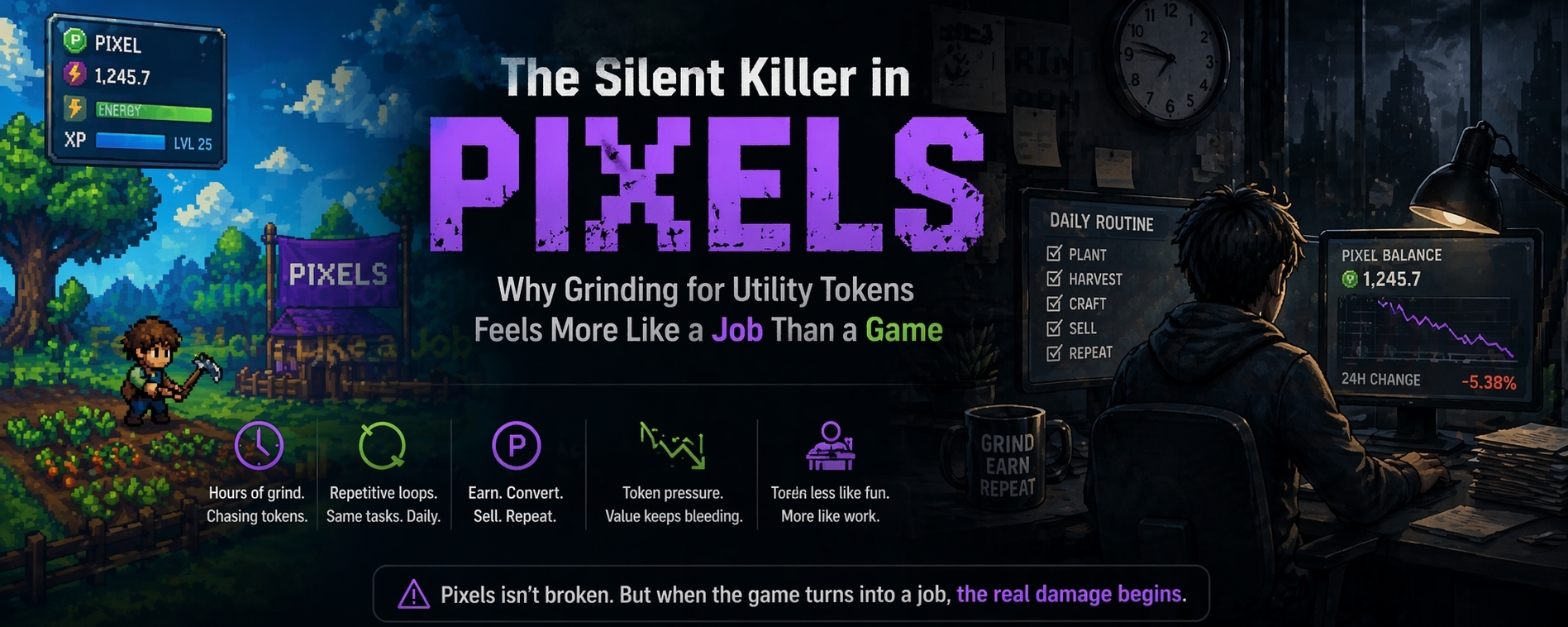

I’ll be honest when I first opened Pixels, I wasn’t thinking about token economics, retention curves, or sustainability. I just wanted to see why everyone was talking about it. The early experience felt smooth, even addictive in a simple way. Plant, harvest, explore, repeat. It was easy to get into, and that’s exactly why it worked.
But the longer I stayed, the more something started to feel off not suddenly, but gradually.
At first, I was playing out of curiosity. Then I was playing out of habit. And eventually, I was playing with a purpose: to earn PIXEL token.
That shift sounds small, but it completely changed how the game felt.
Instead of exploring or experimenting, I started optimizing. Every action became a calculation — which crops yield more, which tasks are faster, which loops maximize output. I wasn’t asking “what’s fun?” anymore. I was asking “what’s efficient?”
And once you start thinking like that, it stops feeling like a game.
The core loop in Pixels is deceptively simple: gather resources, process them, and convert them into value. But the problem isn’t the loop itself — it’s how heavily that loop is tied to rewards. The moment rewards become the main driver, the experience becomes transactional.
You log in with a goal.
You execute tasks.
You collect output.
That’s not exploration — that’s production.
And I started noticing I wasn’t alone in this. A large portion of the player base behaves the same way. Players run multiple accounts, follow strict farming schedules, and log in at specific times just to maintain efficiency. These are patterns you’d expect in a system people are trying to optimize — not in a world they’re trying to enjoy.
What makes this more interesting is that Pixels, by most surface-level metrics, looks incredibly successful. At one point, it reached over 700,000 daily active wallets, making it one of the most active Web3 games. That kind of scale is rare.
But numbers like that raise a deeper question: what kind of activity is this?
Because high activity doesn’t always mean high engagement. There’s a difference between players who are emotionally invested and participants who are economically motivated. From what I’ve seen, Pixels leans heavily toward the latter.
The design encourages it. Rewards are frequent, progression is tied to output, and efficiency is constantly reinforced. If you’re not optimizing, you’re falling behind. And if you’re falling behind, your rewards shrink — which directly impacts your reason to play.
That pressure is subtle, but it’s always there.
The role of the PIXEL token sits right at the center of this dynamic. It’s not just a reward — it’s the backbone of progression. You need it for upgrades, crafting, and moving forward in the game. But at the same time, it creates a constant cycle: players earn tokens, and many of them sell those tokens.
This creates a system where:
Activity generates tokens
Tokens get extracted
Value leaves the ecosystem
So even as the game grows in activity, it’s simultaneously dealing with continuous sell pressure. That’s a difficult balance to maintain, especially if new players are the main source of demand.
From the outside, Pixels looks like it’s expanding — more users, more transactions, more visibility. But when I look closer, I keep coming back to the same thought: how much of this growth is organic, and how much of it is incentive-driven?
Because incentive-driven growth behaves differently. It scales quickly, but it’s fragile. The moment rewards slow down or become less attractive, participation can drop just as quickly as it rose.
And that’s where the “silent killer” really shows up.
It’s not in the price.
It’s not in the mechanics.
It’s in the feeling.
When a game starts to feel like something you have to keep up with, instead of something you want to return to, it slowly loses its core identity.
I noticed this in my own behavior. I wasn’t logging in because I was excited — I was logging in because I didn’t want to miss out on potential output. That’s not enjoyment. That’s obligation.
And once obligation enters the picture, burnout isn’t far behind.
To be fair, Pixels gets a lot of things right. It has one of the smoothest onboarding experiences in Web3 gaming. The mechanics are easy to understand, the barrier to entry is low, and it successfully brought a large number of users into the ecosystem. That’s not easy to achieve.
But attracting users is only half the challenge.
The harder part is giving them a reason to stay that isn’t purely financial.
Because grinding, by itself, isn’t the problem. Many successful games are built around grinding. The difference is motivation. In traditional games, players grind for progress, status, or mastery. There’s an emotional reward tied to the effort.
In Pixels, the primary reward often feels financial.
That distinction changes everything. It turns the game into a system where time equals output, and output equals value. Over time, that loop becomes predictable — and once it becomes predictable, it starts to feel repetitive.
From my perspective, Pixels isn’t failing. It’s actually one of the more advanced examples of what Web3 gaming can achieve right now. But it’s also exposing a deeper issue within the model itself.
If players are primarily there to extract value, the system depends on continuous incentives to keep running. And systems that depend on constant incentives are inherently fragile.
The real challenge for Pixels isn’t growth — it’s sustainability.
Can it create an experience where players stay even when rewards are reduced?
Can it shift motivation from earning to enjoyment?
Can it make the world feel alive beyond the economy?
Because in the long run, the games that survive aren’t the ones that pay the most they’re the ones that people genuinely want to come back to.
Right now, Pixels is walking a very fine line between being a game and being a system.
And if that balance doesn’t shift, the grind won’t just exhaust players it will quietly define the entire experience.