
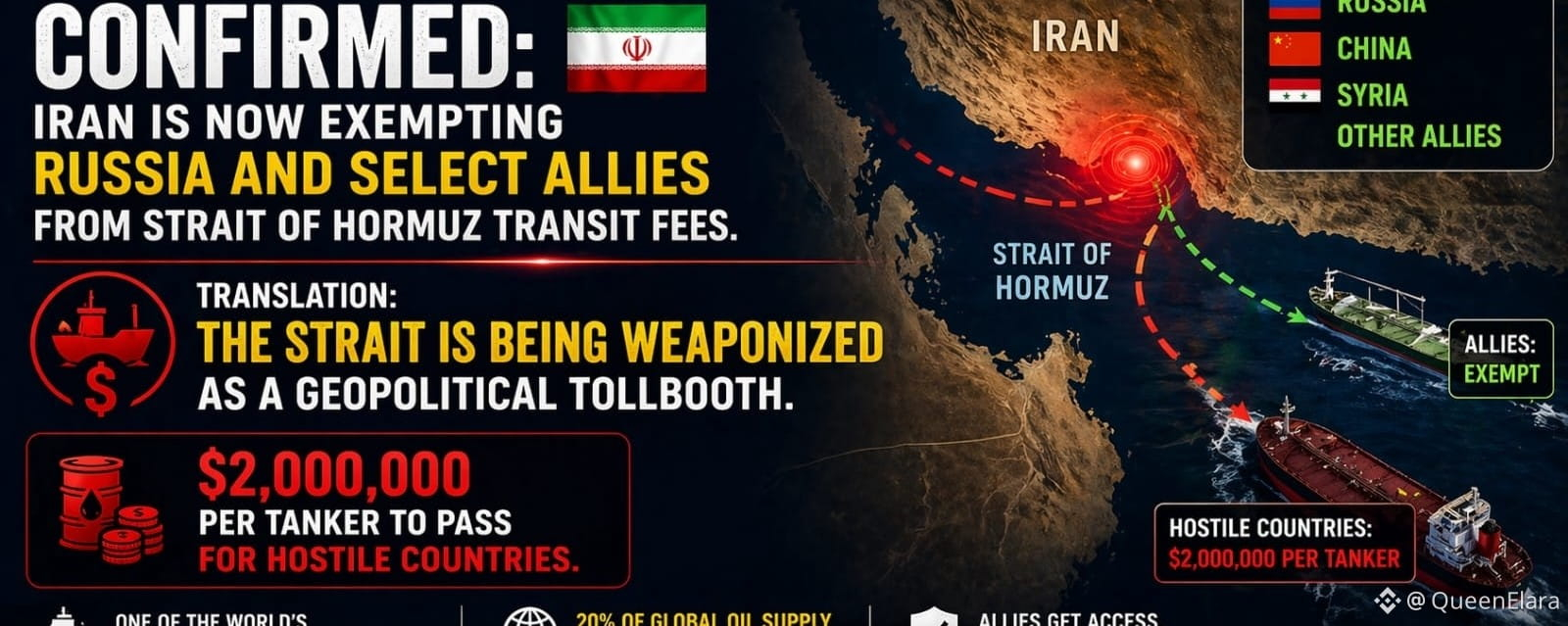
Over the past few hours, I’ve been watching a development that feels like a major shift in how global trade routes are being used. Iran is now reportedly introducing transit fees for ships passing through the Strait of Hormuz—while at the same time exempting allies like Russia and other “friendly” nations. From my perspective, this isn’t just policy—it’s strategy.
What stands out to me is the selective nature of these rules. This isn’t a blanket system applied equally—it’s targeted. Allies move freely, while others face heavy costs, reportedly reaching millions per tanker. That kind of structure doesn’t just regulate traffic—it reshapes it.
From where I’m standing, this is what people mean when they say trade routes are being “weaponized.” The Strait of Hormuz isn’t just any passage—it handles roughly 20% of the world’s oil supply, making it one of the most critical chokepoints on the planet . When control over a route like this becomes conditional, it immediately turns into leverage.
Another thing I’m noticing is how this ties into the broader conflict. Shipping through the strait is already disrupted, with traffic collapsing and companies avoiding the route due to rising risks . Adding fees—and exemptions—on top of that doesn’t just increase costs, it increases uncertainty.
At the same time, I think it’s important to understand the bigger picture. Iran has framed these fees as part of managing security and control after ongoing tensions and blockades . But globally, this move is being seen as a shift toward controlled access rather than open transit.
From my perspective, the key takeaway is simple:
This isn’t just about shipping fees—it’s about power over flow.
Who gets access, who pays, and who gets priority.
And when a chokepoint this important starts operating like a toll system based on alliances,
the impact goes far beyond shipping.
It touches energy markets, global trade, and geopolitical balance.
Right now, this feels like a turning point.
Because the Strait of Hormuz isn’t just a route anymore—
It’s becoming a tool.