
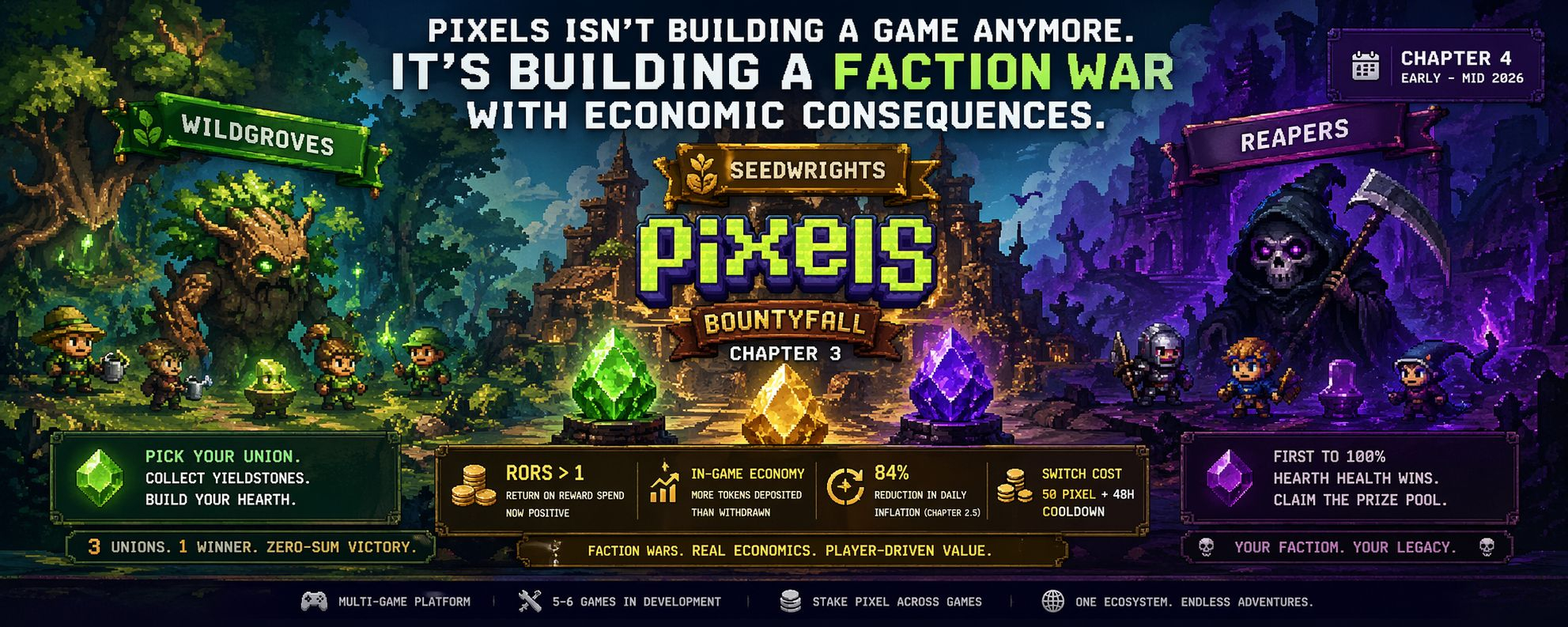

I almost missed what Chapter 3 actually changed. From the outside it looked like a content drop. New lore, three unions, some competitive flavor added on top of the usual farming loop. The kind of update you see in live-service games every quarter. But after going deeper into how Yieldstones actually work inside Bountyfall, I started thinking about it differently. This isn't really a content update. It's an architecture shift.
Bountyfall asks players to pick one of three Unions Wildgroves, Seedwrights, or Reapers and contribute to their faction's Hearth by collecting and depositing Yieldstones earned through standard gameplay. That sounds simple enough. But the economic logic sitting underneath it is more interesting than it first appears. Yieldstones aren't tradable. You can't sell them or extract value from them directly. Their only function is to either build your side up or tear another side down. The first Union to reach 100% Hearth Health wins the season and claims the majority of the prize pool. The whole thing is zero-sum at the faction level, but positive-sum at the individual level if you stay active.
That combination is rare in GameFi. Most token economies reward individual performance in isolation. You farm, you earn, you sell. The loop is clean and entirely personal. Pixels is trying to inject collective stake into that loop without removing the personal incentive. Whether that actually works depends on whether players feel the faction affiliation is real enough to matter. I'm not sure yet. But the structure is genuinely different.
What caught me more was the RORS signal. The team has been tracking return on reward spend, and for the first time it crossed above one heading into Chapter 3 meaning in-game activity is now generating more value than the rewards being distributed. That's the metric that actually matters here. Not price. Not daily active users. Whether the system is taking in more than it's giving out. For a long time that ratio was inverted, which is the normal failure mode in GameFi. Rewards come out fast, value creation lags behind, token bleeds. Chapter 2.5 cut daily inflation by nearly 84% as part of an effort to close that gap.The RORS crossing above one suggests the gap is closing from both directions simultaneously. Spending going up, emissions tightening.
A healthier in-game economy where more tokens are deposited than withdrawn a milestone the team says was first hit in May 2025 supports price stability driven by players rather than traders. That distinction matters more than people usually give it credit for. Trader-driven demand evaporates at the first sign of weakness. Player-driven demand, if it's genuine, is at least partially insulated from pure sentiment swings because players have sunk cost in a different currency. Time. Progress. Faction reputation.
The union switching mechanic tells you something about how they're thinking about token sinks. Switching unions costs 50 PIXEL and has a 48-hour cooldown between changes. That's not a lot individually. But it's intentional friction. The kind that creates just enough resistance to make the decision feel meaningful without locking players out entirely. It's the same design logic as the withdrawal fee mechanics I've looked at before in Pixels. Make the exit slightly costly, not prohibitively so, and a portion of players will choose not to exit at all.
What I'm less certain about is whether the faction model can sustain real rivalry. Unlike traditional guilds, which require structured communication and are often gated, Unions offer a more accessible social layer any player can join any Union. That accessibility is probably necessary for scale. But it also potentially dilutes the faction identity. If it's frictionless to join the Wildgroves and equally frictionless to leave, then being a Wildgrove doesn't mean much beyond the current season. Real faction wars in gaming work because the affiliations feel permanent, or at least costly to abandon. Pixels is trying to create that feeling with economic penalties rather than social or narrative weight. I'm not sure the 50 $PIXEL switching cost is heavy enough to do that job at scale.
Chapter 4 is expected in early-to-mid 2026, following the established development cycle. That gives roughly a quarter for Bountyfall's economics to settle and reveal whether the RORS improvement was structural or situational. If the metric holds above one through multiple full seasons, that's meaningful. If it drifts back down when the novelty of Unions fades, then it suggests the underlying player behavior hasn't actually changed just the wrapper around it.
Pixels is also evolving toward a multi-game platform, with five to six titles in development and a staking system that lets PIXEL be deployed across different games. That ambition is real. But it's also where the model gets complicated. A single game with a single token economy is hard enough to balance. Multiple games sharing token flows means mistakes in one game can create pressure across the whole system. Staking rewards that look attractive in one game can pull liquidity away from another.
The supply pressure is still there too. The total token supply stands at 5 billion PIXEL, with unlock tranches continuing to add circulating supply on a regular schedule. No amount of good in-game economics fully neutralizes that if the unlock cadence outpaces demand creation. The question is whether the sink depth in Bountyfall Yieldstone crafting, switching fees, Offering mechanics — is thick enough to absorb meaningful chunks of what gets unlocked.
I don't know the answer to that. Nobody does cleanly right now.
What I do think is that Pixels is doing something most GameFi projects don't bother with. They're watching the behavioral data closely and adjusting mid-flight. The goal the team has consistently pointed to is net ecosystem spend the state where in-game purchasing consistently exceeds token distribution. That's a real economic target. Not a vague narrative. Reaching it would mean the game has become self-sustaining in a way most token economies never achieve.
Whether Bountyfall is the mechanic that gets them there, or just another iteration in the long process of finding out what players actually care about enough to spend on that's the question still sitting open.
And I don't think the factions have finished answering it yet.