as energy, land, and time
Most people still talk about pixels like it’s basically “a farming game with a token,” and sure, if you’re just planting and harvesting that’s what it feels like. but once i started following the actual resource loops, it’s pretty obvious the farming is just the friendliest way to introduce constraints. the economy seems to be the real system, and the crops are the ui for it.
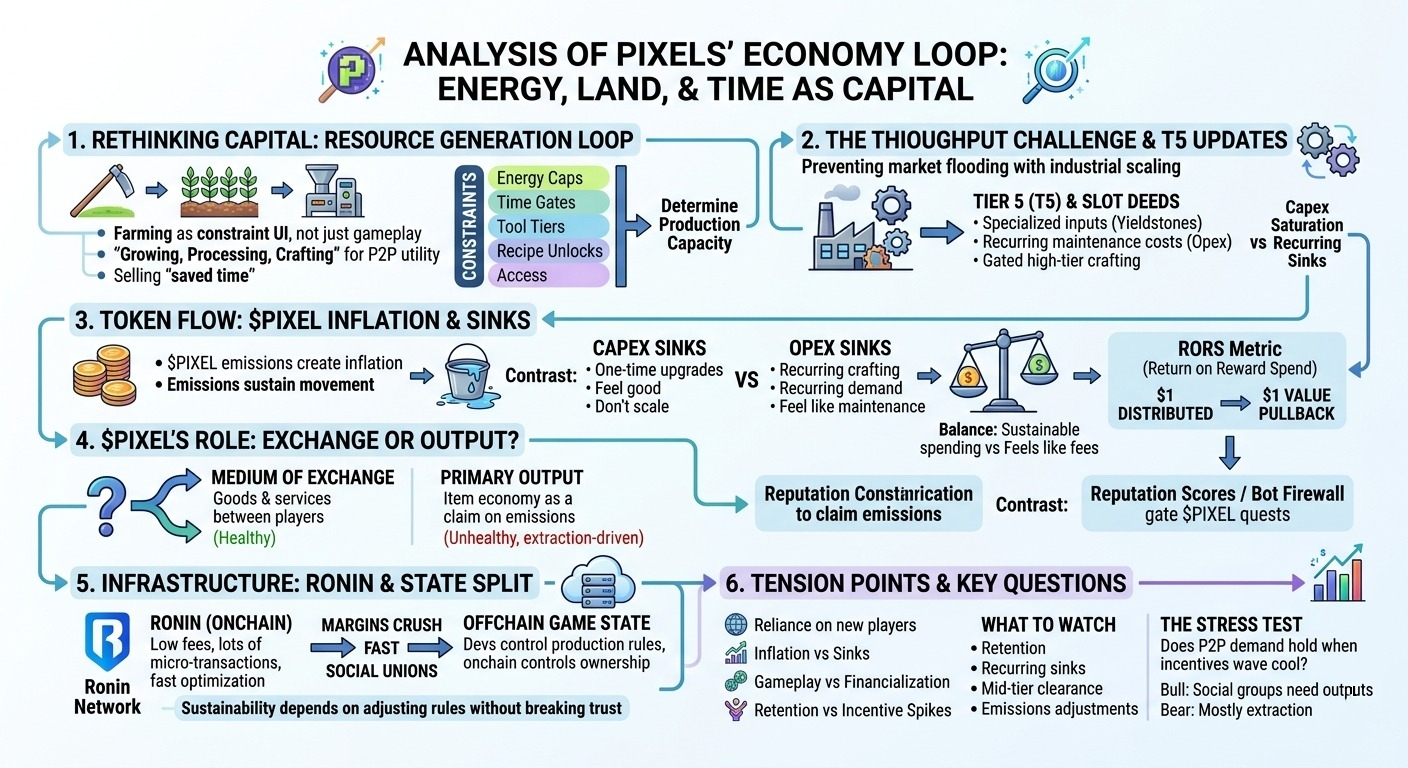
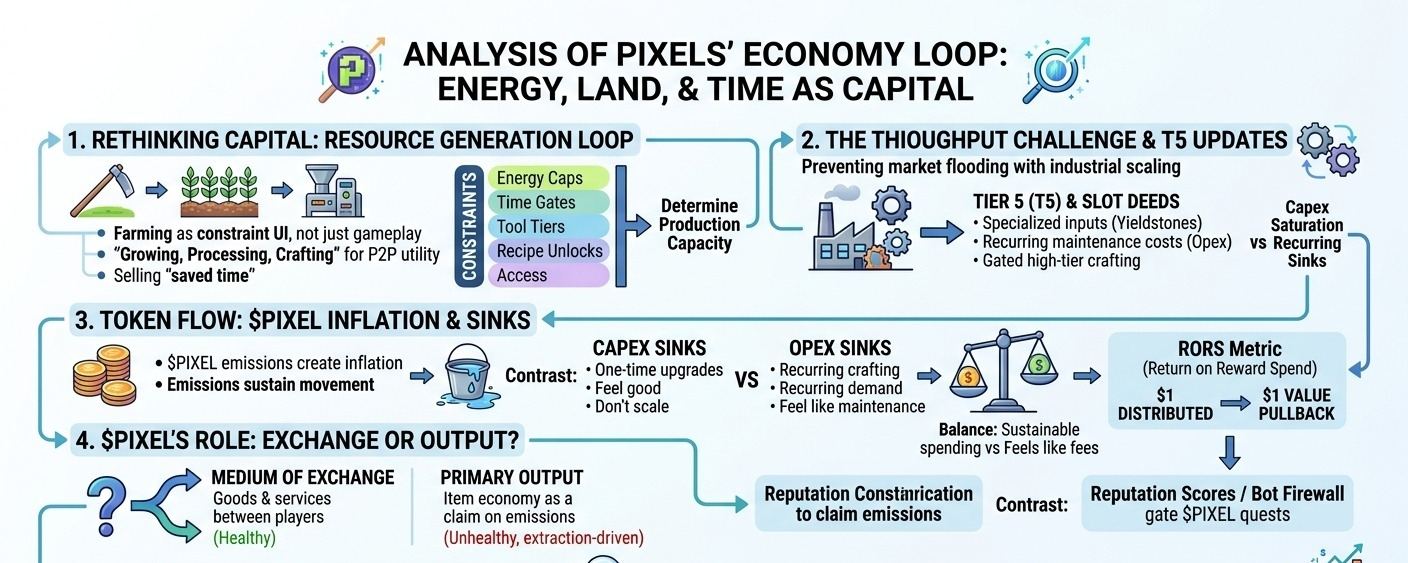
resource generation: the loop is simple but kind of tight. you’ve got farming/gathering producing base mats, then crafting turns mats into stuff other players (or the quest system) want. the example i keep coming back to is the boring one because it’s the most revealing: grow a crop → process it into an ingredient → craft a consumable → sell it to someone who needs it for a quest turn-in / recipe chain. when that works, it’s real p2p utility: i’m selling you saved time. but what stands out is how quickly this becomes a throughput problem. if the game lets everyone ramp production too freely, the market becomes a dumping ground. so pixels leans on energy caps, time gates, tool tiers, recipe unlocks, and access constraints. honestly, i’m starting to see those as “economic capital requirements” more than progression. they determine who can produce, at what volume, and how fast supply hits the market.
token flow: $pixels is the part i’m still suspicious about, mostly because emissions are easy and sinks are hard. emissions keep people moving, and they also smooth out the “my crafted goods aren’t selling today” frustration. but emissions create inflation pressure by default, so the real question is whether sinks behave like opex (ongoing, repeatable) or capex (one-time upgrades that saturate). if sinks are mostly capex—pay for an upgrade, pay for access once, buy a thing and you’re done—then they don’t scale with the long-term emission stream. and here’s the part i’m thinking about: a lot of web3 games accidentally build capex-heavy sinks because they feel good (permanent progress), but then they’re shocked when sell pressure returns after everyone is “upgraded.”
opex-style sinks (recurring crafting costs, repeated consumable demand, maintenance-like costs) are more stabilizing, but they can also make players feel nickeled-and-dimed if the gameplay isn’t strong enough to justify it. so pixels is walking a line: make spending frequent enough to matter, but not so mandatory that the game feels like a job with fees.
also, i keep asking whether the token is a medium of exchange or the primary output. if $pixels mostly circulates between players for goods and services, fine. if $pixels is what players want to extract, then the whole item economy risks becoming an intermediate step to justify claiming emissions. same mechanics, totally different end-state.
infrastructure: ronin makes a lot of this feasible in a very practical way. low fees mean you can have lots of small transactions (buying ingredients, listing stacks, moving assets) without players thinking about gas as a gameplay mechanic. that matters because pixels’ economy is micro-transactional by nature. but ronin also means the economy gets optimized quickly. if there’s a profitable chain—inputs cheap, crafted outputs in demand, emissions juicy—people will scale it fast. cheap rails make “economic reflexes” faster, not slower.
and there’s another infrastructure-ish thing i can’t fully confirm but can’t ignore: the split between offchain game state (instant gameplay) and onchain settlement (assets/tokens). that means the devs control the production rules centrally (rates, gates, recipes), while ownership and transfer are enforced onchain. so sustainability isn’t only tokenomics; it’s whether the game can keep adjusting the rules without undermining trust or making players feel like the floor moves every patch.
so how sustainable is this loop? i’m still undecided. i can see a stable mode where players genuinely specialize, goods get consumed repeatedly, and $pixels spending stays “natural.” i can also see the mode where value is mostly extracted, and the system depends on continuous new user growth (new buyers, new liquidity, new demand for starter-tier goods) plus event-driven demand rotation to keep markets clearing.
tension points i keep circling:
reliance on new players, token inflation vs sink quality, gameplay vs financialization, retention vs short-term incentive spikes.
watching:
retention in quiet weeks, evidence of recurring sinks (not just one-time spends), market clearance for mid-tier crafted goods when there’s no event, and how often emissions/gates need adjustment to keep any one route from dominating.
i don’t have a clean conclusion yet. if $pixels price went flat and ronin-wide attention cooled for a while, do players still buy each other’s outputs because they need them… or because they’re hoping the next incentive wave restarts the machine?