

I’ve been around long enough to know when something smells off. You look at Pixels (Web3 game) and the pitch sounds familiar—open world, player ownership, blockchain-powered economy. The usual story. Everything important on-chain, fully transparent, yada yada. I’ve heard that pitch more times than I can count.
And almost every time, it falls apart the moment you ask a simple question: “Okay, but how does this actually run in real time?”
Because let’s be honest—blockchains are terrible at real-time anything. I don’t care if it’s Ethereum or something faster like the Ronin Network. You’re still dealing with latency, throughput ceilings, and the occasional “why is this transaction stuck?” moment that will absolutely ruin a game loop. I’ve seen teams try to brute-force this. It never ends well. You either get a slideshow or a system so expensive no one can afford to use it.
So when Pixels feels smooth—when you move around, plant crops, interact without waiting three seconds for confirmation—that tells you everything you need to know. The real game? It’s not on-chain. Not even close.
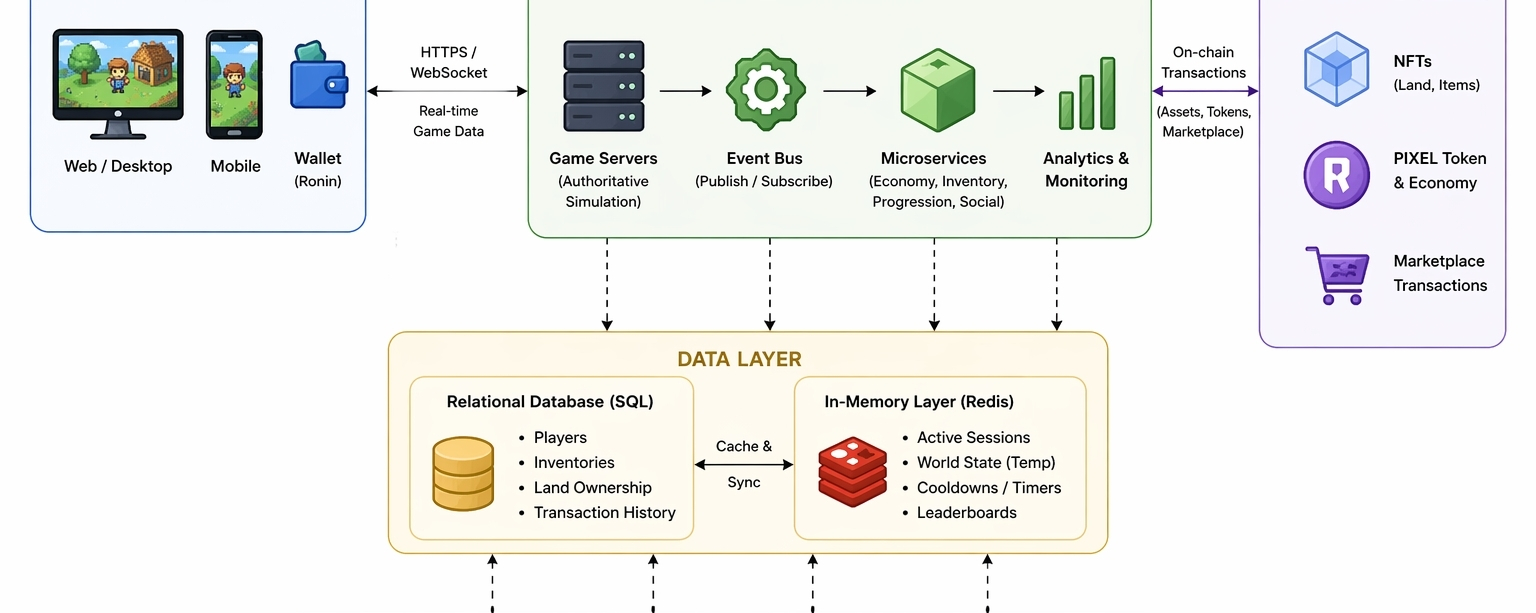
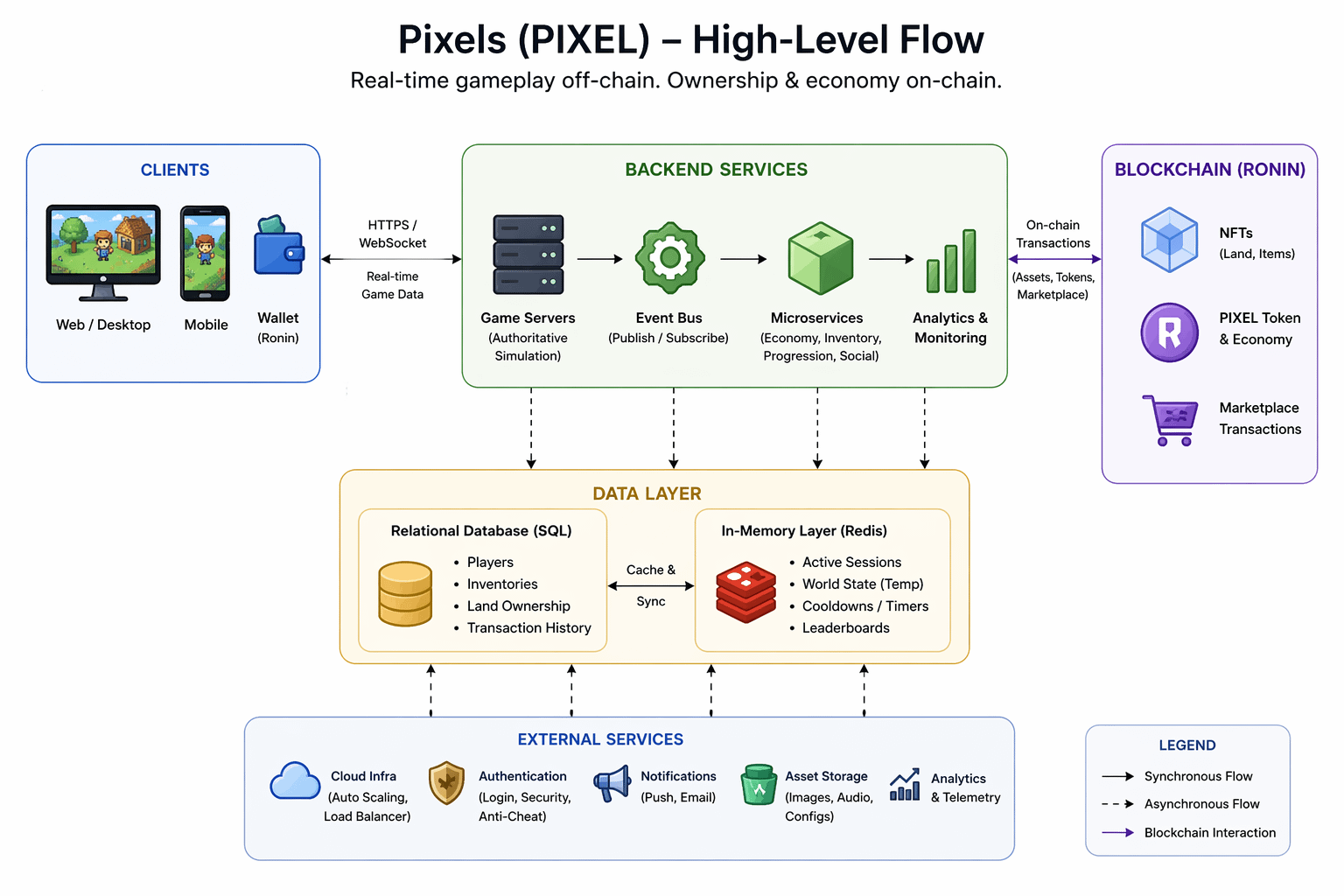
What’s actually happening is the same pattern I’ve seen in every live-service game that survived more than six months. You’ve got centralized game servers acting as the source of truth. They handle movement, interactions, progression. They decide what’s valid and what isn’t. And yeah, that means trust—something Web3 folks like to pretend they’ve eliminated—but without it, your game turns into a cheat-fest in about a week.
Behind that, there’s probably an event system quietly doing the heavy lifting. Every action a player takes turns into some kind of event—planting, crafting, harvesting—and those events get pushed through queues to other systems. Economy balancing, analytics, progression tracking… all the stuff players never see but will absolutely feel when it breaks. And it does break. Usually at the worst possible time. I’ve spent nights chasing down bugs caused by one delayed event in a queue that backed up half the system. It’s never as clean as the diagrams make it look.
The data layer is where things get even more pragmatic. You don’t get to be idealistic here. Some data has to be correct, no excuses. Player inventories, ownership records, transaction logs—that’s your relational database. Slow-ish, but reliable. You protect that thing like your life depends on it, because sometimes it does.
Then there’s everything else—the stuff that actually makes the game feel responsive. Session data, cooldown timers, temporary states. That lives in memory. Redis or something like it. Fast, disposable, occasionally a little dangerous if you’re not careful. I’ve seen teams lose chunks of in-memory state and suddenly half the player base is asking why their crops reset. Fun conversations.
Latency is the real enemy, though. Always has been. You can have the cleanest architecture in the world, and it won’t matter if your game feels sluggish. So you cheat. Everyone cheats. The client predicts what should happen and shows it immediately. The server catches up later and either agrees or corrects it. Most of the time, players never notice. When they do, you get those weird rubber-banding moments and support tickets start piling up.
You spread servers geographically to shave off milliseconds. You cache aggressively—sometimes too aggressively—and hope you’re not serving stale data in a way that breaks something important. You tune tick rates, you tweak networking, you make compromises. There’s no perfect solution. Just a series of trade-offs you learn to live with.
And then there’s the blockchain piece. This is where the marketing and the engineering usually diverge. In Pixels, it’s pretty clear they’re using the chain for what it’s actually good at—ownership and settlement. NFTs, tokens, marketplace transactions. Stuff that benefits from being verifiable and persistent outside your servers.
Everything else? Off-chain. Has to be.
I’ve seen teams try to push more onto the chain than they should, chasing this idea of purity. It always backfires. Either the game becomes unplayable, or they quietly move things off-chain later and hope no one notices. Pixels skips the theater and just builds the system the way it needs to be built. I respect that.
Of course, none of this is free. You end up with a hybrid system that’s… let’s call it “fun” to maintain. APIs everywhere. Services talking to other services, sometimes synchronously, sometimes through event streams. Versioning headaches. One small change in the wrong place and suddenly your client, backend, and blockchain layer are all disagreeing about reality. I’ve lived through those rollouts. You don’t forget them.
And when things fail—and they will—you find out very quickly how well you designed your system. Player spikes hit, servers struggle, queues back up. Maybe your auto-scaling keeps up, maybe it doesn’t. Databases start sweating under load, caches get hammered, and somewhere in the middle of all that, you’re trying to figure out why a subset of players can’t harvest their crops without triggering an error you’ve never seen before.
Blockchain congestion? That’s its own kind of chaos. Transactions slow down, confirmations lag, and suddenly your “instant” marketplace feels anything but. The only saving grace is that gameplay itself doesn’t depend on it. If it did, you’d be dead in the water.
What’s interesting is that this architecture will scale—at least for a while. You can add more servers, shard your systems, optimize your pipelines. But the complexity doesn’t go away. It compounds. Every new feature adds another layer, another edge case, another potential failure point.
And underneath all of it, there’s this tension that never really resolves. You’re running a centralized system to deliver a decentralized promise. Speed on one side, trust on the other. You can balance it, but you can’t eliminate the gap.
I’ve seen a lot of teams pretend that gap doesn’t exist. Pixels doesn’t. It just builds around it and moves on.
Maybe that’s the real takeaway. Not that it’s perfect—it’s not—but that it’s honest about what it takes to make something like this actually work. And if you’ve ever been the person staring at logs at 3 AM wondering why your “scalable” system just fell over, you know that honesty counts for a lot. #pixel @Pixels $PIXEL
