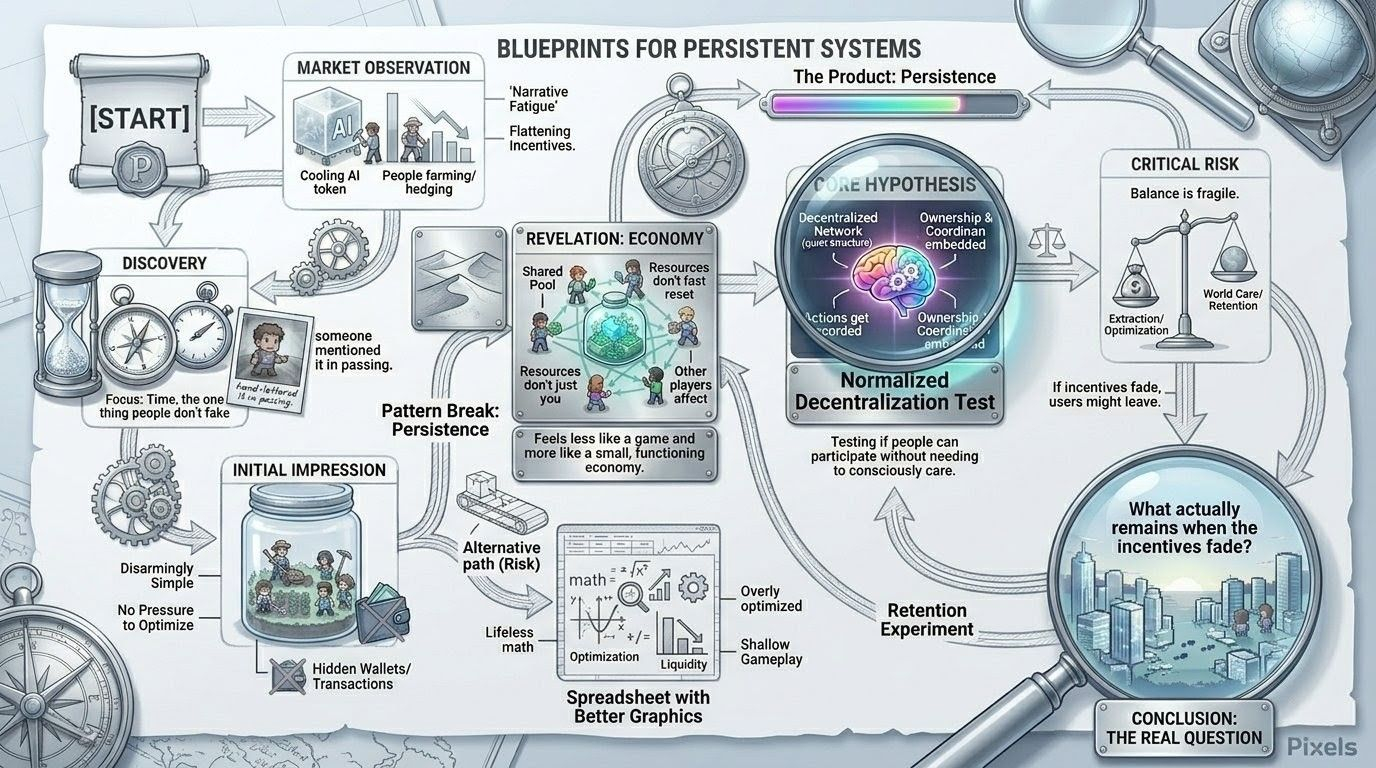
I found Pixels at a weird moment in the cycle.
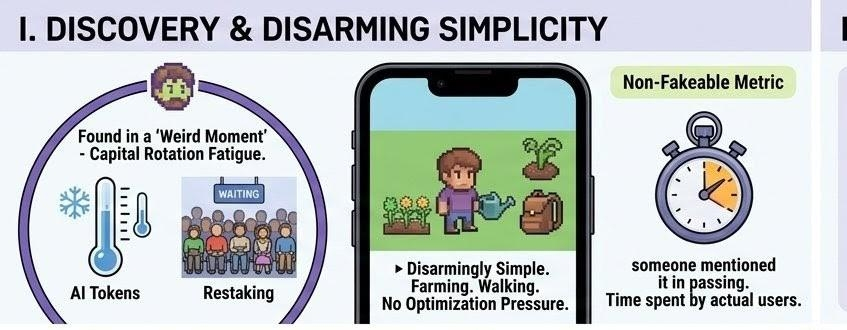
AI tokens had just cooled off after that aggressive run where everything with a vague connection to compute got repriced overnight. Restaking was starting to feel crowded. You could sense the fatigue capital rotating faster, conviction getting thinner. It’s that phase where narratives still exist, but they don’t hold attention the same way. People are farming, flipping, hedging. Not really believing.
I wasn’t looking for a game. I was trying to understand where actual user activity still exists when incentives start flattening out.
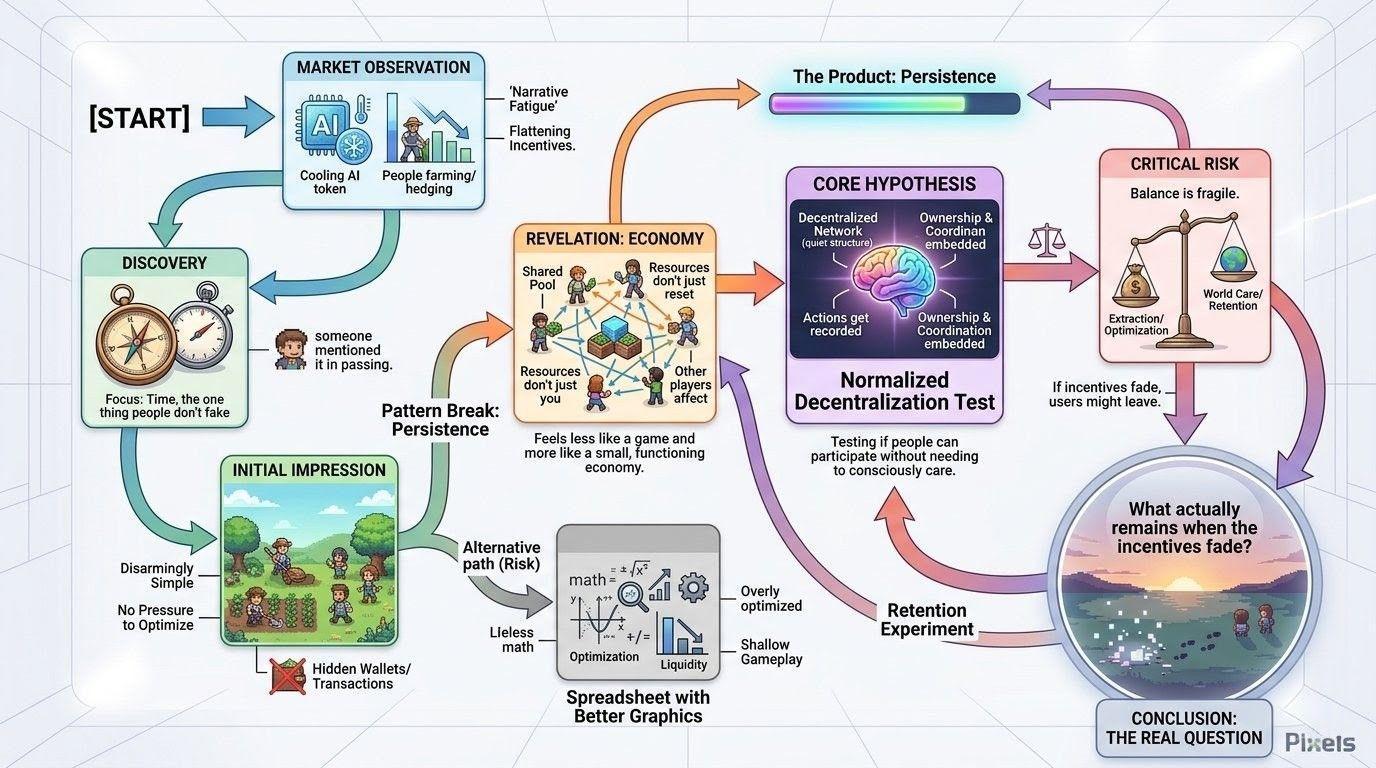
Pixels showed up almost accidentally. Someone mentioned it in passing not with hype, just as something they’d been spending time on. That caught my attention more than any chart ever could. Time is the one thing people don’t fake in this market.
So I opened it
At first, it felt disarmingly simple. Farming, gathering, walking around a pixelated world that doesn’t try too hard to impress you. No immediate pressure to optimize. No complicated onboarding flow. It doesn’t scream “this is crypto.” And that’s probably intentional.
But after a while, I started noticing something that didn’t quite fit the usual pattern.
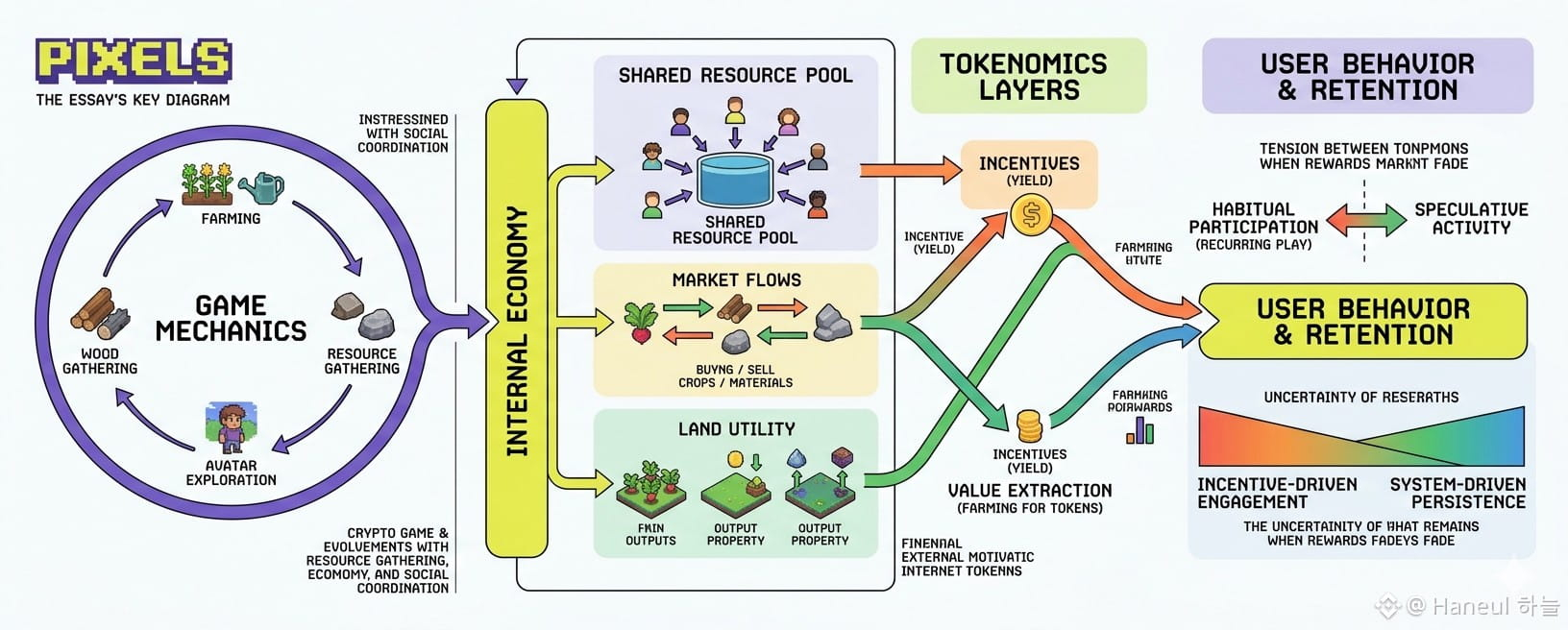
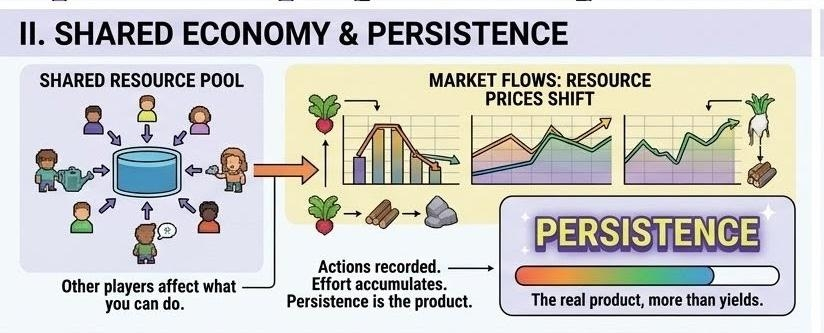
The world doesn’t revolve around you. It keeps moving. Resources aren’t just there for you to click they’re part of a shared pool. Other players are doing their own thing, and somehow that affects what you can or can’t do. Prices shift. Land matters. Effort accumulates in ways that don’t reset.
It starts to feel less like a game and more like a small, functioning economy.
And that’s where it gets interesting.
Because most crypto games don’t really solve anything. They just wrap token incentives around shallow gameplay and hope liquidity sticks around long enough to create the illusion of activity. We’ve all seen how that ends.
Pixels is trying something slightly different. It’s not chasing complexity. It’s trying to normalize participation in a shared system where ownership and coordination are embedded into the experience itself. You don’t think about wallets or transactions constantly, but they’re there, quietly structuring everything.
Underneath the surface, there’s a network doing the heavy lifting. Actions get recorded. Assets actually belong to players. The world isn’t controlled by a single server that can rewrite outcomes at will. It’s closer to a distributed environment where data, compute, and user behavior all interact in a way that feels persistent.
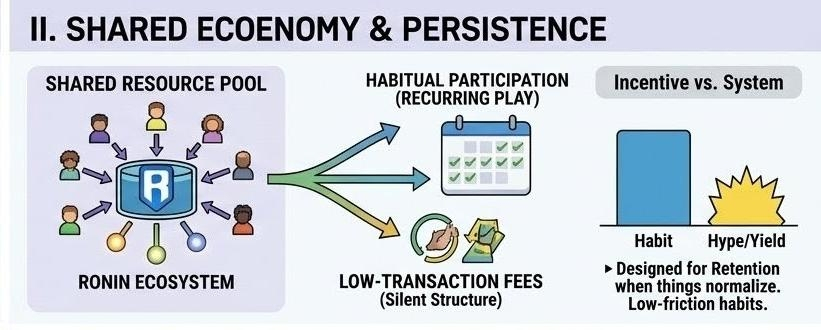
That persistence is the real product.
And it matters more than people realize.
Right now, crypto still struggles with retention. We’re good at attracting users when yields are high or narratives are hot. We’re terrible at keeping them when things normalize. Pixels seems designed around that exact problem. It doesn’t demand attention through hype it builds habits through low-friction interaction.
The Ronin ecosystem plays a role here. Transactions are cheap enough that they disappear into the background. That’s not a technical achievement people talk about much anymore, but it’s critical. If every action felt like a decision, no one would stay.
Still, the incentives are there. They always are.
You can earn. You can optimize. You can treat it like a system to extract value from. And some people clearly do. You can feel it in how certain resources are farmed, how land gets used, how efficiency starts creeping into what initially felt casual.
That’s where the balance gets fragile.
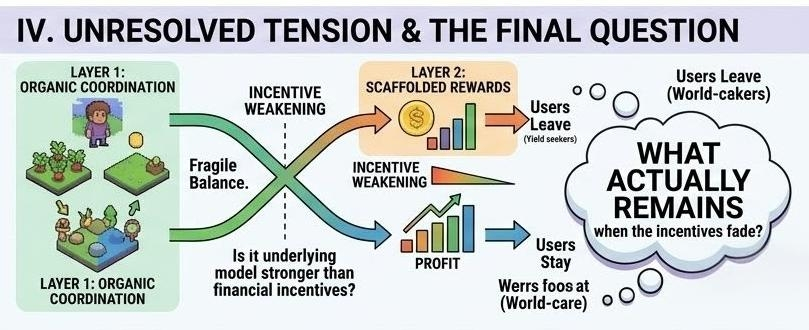
If the economy leans too far toward optimization, the experience risks becoming another spreadsheet with better graphics. If incentives weaken too quickly, the users who were there for yield will leave. And then you find out whether the remaining players actually care about the world itself.
I’m not fully convinced yet.
There’s organic behavior here, but it’s still partially scaffolded by rewards. You can sense both layers existing at the same time. That tension isn’t a flaw it’s just unresolved.
What does stand out is how coordination happens without feeling forced. People contribute to the system simply by playing. Farming isn’t just a task it feeds into a broader economy. Exploration isn’t just cosmetic it connects to resource flows. Small actions stack into something bigger without requiring users to understand the full system.
That’s harder to design than it looks.
Most projects either over-explain or over-engineer. Pixels does neither. It lets the system reveal itself slowly.
But there’s a risk in that subtlety too. In a market driven by attention, quiet systems often get overlooked. They don’t attract the same kind of capital. They don’t trend as easily. And when liquidity tightens, attention usually consolidates around clearer narratives AI, infrastructure, anything with immediate financial abstraction.
A farming game doesn’t naturally fit into that.
Unless it becomes something more.
One thought that keeps circling in my head is this: maybe Pixels isn’t really about gaming at all. Maybe it’s testing whether people can participate in decentralized systems without needing to consciously care about decentralization.
That’s a different kind of experiment.
Because if users stay, not for yield, not for speculation, but because the system feels worth returning to then the underlying model might be stronger than anything driven purely by financial incentives.
But if they leave the moment rewards thin out, then it’s just a softer version of the same cycle we’ve seen before.
I don’t think we’re at the answer yet.
What I do know is that I’ve spent more time in Pixels than I expected to. Not because I’m chasing returns, but because I’m trying to understand what kind of behavior it’s quietly encouraging.
And whether that behavior has any chance of surviving when the market stops paying people to care.
Because that’s the real question, isn’t it when the incentives fade, what actually remains?