
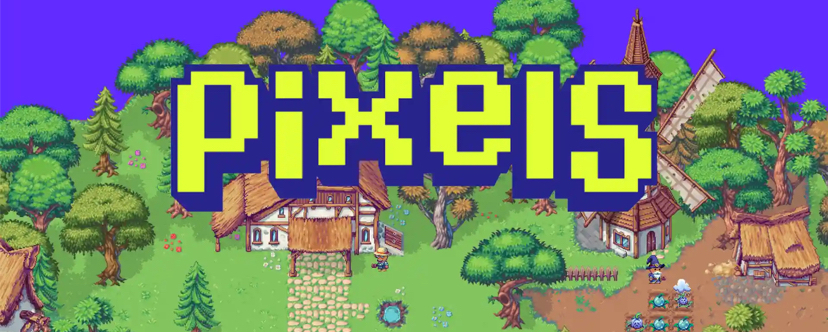
Entire families in the Philippines once covered their bills by grinding through Axie Infinity. When the token price collapsed, the player base drained away in a matter of weeks. No one had been playing for the fun of it. They had been clocking in for the salary. Pixels looked at that pattern and took the opposite bet. It stopped paying players to log on and instead built reasons to play that eventually make you willing to pay.
You can load up Pixels this morning, start farming plots, crafting tools, wandering the pixelated world, or teaming up in a guild, and never once need to know what $PIXEL even is. The game simply works. That was the point all along. The on-chain economy arrives later, as a natural extension of the hours you have already sunk in, rather than the hook that pulls you through the door. And should you choose to mint a pet, commit to a guild upgrade, or stake your holdings, you do it because the experience has you invested not because the numbers on the chart demand it.
This setup has produced concrete outcomes. Pixels generated 20 million dollars in revenue across 2024. It reached one million daily active players during its strongest stretch. What stands out, though, is the retention: even as $PIXEL has lost 95 percent of its value from the all-time high, a solid group of users continues to farm and engage. They are not chasing a quick flip. They are returning because the gameplay itself holds up.
Of course the picture is not complete. Chapter 3 is still coming into focus leaving the end-game systems and new industries without firm dates for the player who simply wants to know what’s next while the bigger transition from one strong title to a true multi-game platform remains the scaling challenge Web3 gaming has yet to prove, one that will require those 2024 revenues to keep growing rather than plateau.
At its core, the experiment asks a question that matters equally to the weekend farmer and the portfolio watcher. Can a Web3 game retain its audience without paying them to stick around? And if Pixels actually succeeds, what does that say about all the projects still relying on yields to prop up their communities?