
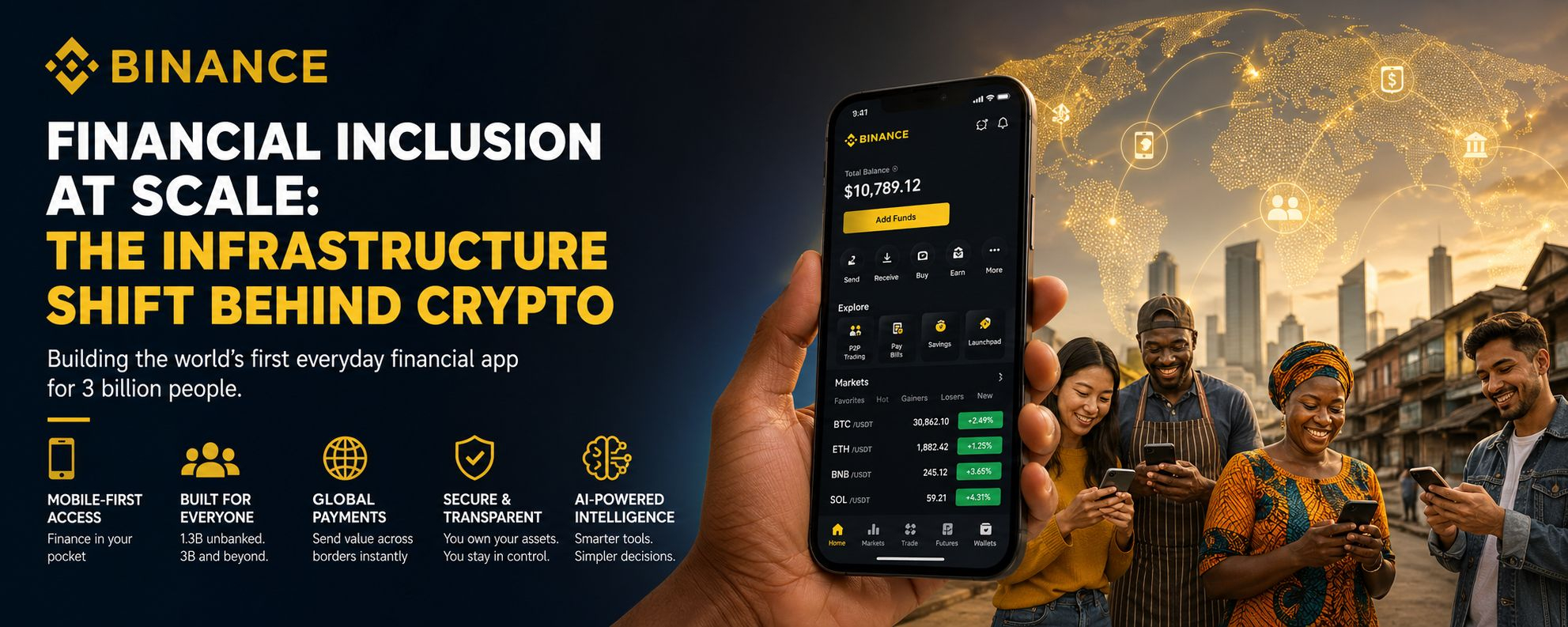
I didn’t fully understand how broken the traditional financial system was until I started noticing who it leaves behind—not traders or investors, but everyday people.
The street vendor who only deals in cash. The freelancer who struggles to receive international payments. The student paying excessive fees just to move money across borders. These aren’t edge cases—they represent a large portion of the global population.
At its core, this isn’t just a finance problem. It’s an access problem. And access, in today’s world, is still unevenly distributed.
Around 1.3 billion adults globally remain unbanked. That’s not just a statistic—it represents individuals operating entirely outside the formal financial system, unable to securely save, build credit, or fully participate in the global economy.
Yet most of them already have something powerful in their hands: a smartphone.
This is where the real shift begins. In many regions, financial development is not happening gradually through traditional banking—it’s being skipped entirely. Much like mobile phones replaced landlines in large parts of the world, mobile-first financial systems are beginning to replace conventional banking infrastructure.
This is the “leapfrog” moment.
Platforms such as Binance sit at the center of this transition. It is no longer accurate to view them simply as exchanges. Instead, they are evolving into broader financial ecosystems that integrate payments, trading, savings, and on-chain access into a single mobile experience.
However, the real impact is not defined by features. It is defined by what those features enable.
Stablecoins, for instance, are often described as digital representations of fiat currencies. In practice, they can serve as a critical financial tool in high-inflation economies, allowing individuals to preserve value directly from their phones without relying on unstable local currencies.
Peer-to-peer systems further extend this accessibility by enabling direct exchange between users using familiar local payment methods. This creates a financial experience that aligns more closely with how people already transact in everyday life.
More recently, AI-driven tools are beginning to reshape usability. Instead of navigating complex interfaces or market structures alone, users may soon rely on integrated assistants that help interpret information, simplify decision-making, and reduce friction—particularly for first-time users.
This matters because the primary barrier to financial participation is not only access—it is usability.
Of course, this space is not without challenges. Volatility, security risks, and the responsibility of self-custody remain significant considerations. Unlike traditional banking systems, there is often no intermediary support structure to recover lost access or reverse mistakes.
But these limitations should be understood as early-stage constraints rather than permanent flaws. The ecosystem continues to mature, with ongoing improvements in interface design, education, and user protection mechanisms.
What is most significant is the scale of adoption. These systems are no longer theoretical—they are actively being used to move money, store value, and enable participation in global markets that were previously inaccessible.
If digital communication transformed distance into something irrelevant, financial systems are now moving in a similar direction: toward a world where transferring value is as simple as sending a message.
No unnecessary intermediaries. No structural barriers based on geography. Less dependence on legacy systems that were never designed for global inclusion.
That is the direction financial infrastructure is moving toward.
And while no single platform defines this shift, the broader trend is clear: finance is becoming more digital, more mobile, and increasingly more inclusive at global scale.