
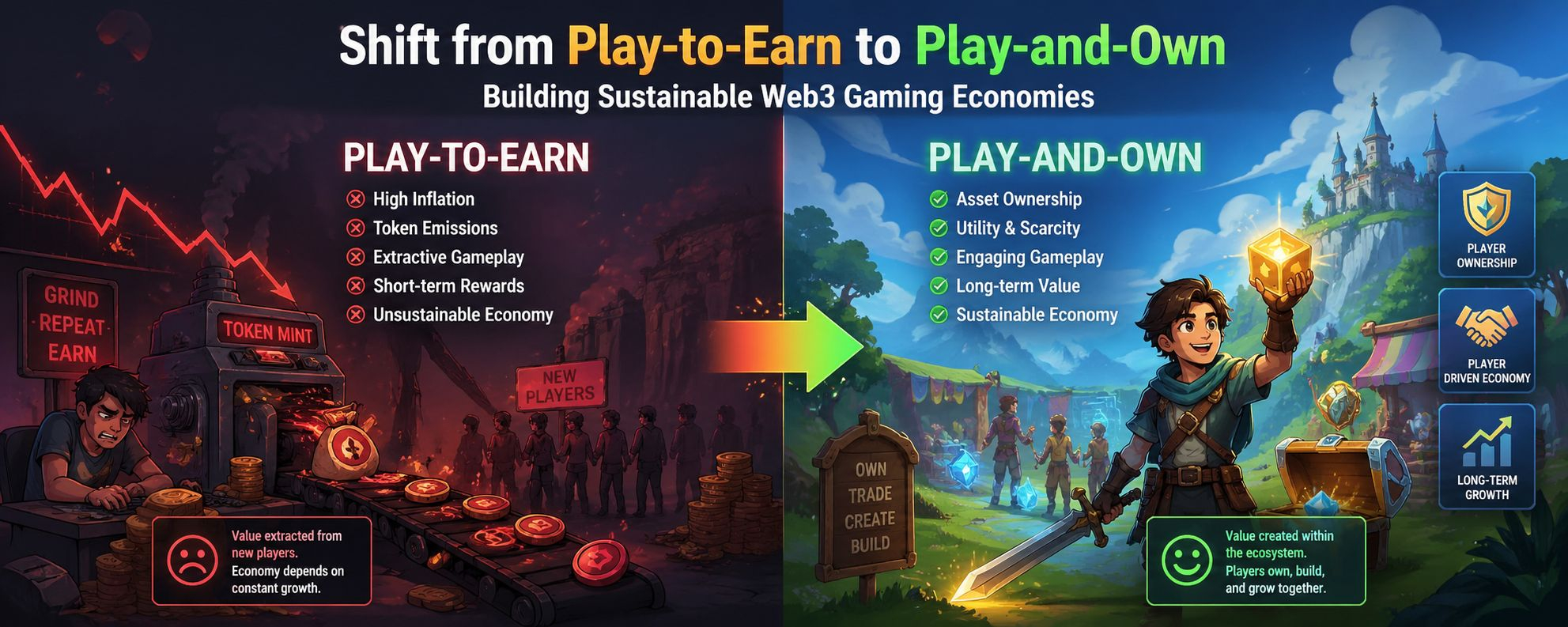
Something quietly changed in Web3 gaming, and if you blinked, you probably missed it. A few years ago, Play-to-Earn felt like a revolution. People were logging in not just to play, but to earn. For some, it even replaced daily income. That moment felt exciting, almost unreal. But underneath that excitement, cracks were already forming. Tokens kept flooding the system, rewards looked good at first, then slowly lost weight. Prices dropped, players left, and what once felt like opportunity started to feel… fragile. That’s where the shift begins. Not loud, not dramatic, but necessary.
Play-to-Earn was built on momentum. New players came in, money flowed, rewards stayed attractive. But here’s the thing—this model needed constant growth just to stay alive. The moment growth slowed, everything tightened. It wasn’t really a game economy. It was more like a cycle trying to sustain itself. Developers started noticing it first. Retention dropped. Players weren’t exploring or enjoying—they were grinding. That quiet disappointment changed the direction of the industry.
Now comes Play-and-Own. It doesn’t scream profits. It doesn’t promise fast money. And honestly, that’s exactly why it feels more real. Instead of rewarding players endlessly, it focuses on ownership. You play, you collect assets, you build something that has use inside the game. That shift sounds small, but it changes everything. Now value comes from what players actually do, not just what they receive. Assets have purpose. Land matters. Items matter. Time spent in the game starts to feel meaningful again.
Look at how current projects are evolving. Games like Pixels on Ronin are leaning into this model. Free-to-play access brings players in, but ownership keeps them there. Developers are designing systems where players interact, trade, and create value inside the game world. That internal loop is what was missing before. It feels calmer, more grounded, less chaotic. Not perfect, but definitely more stable.
From a developer’s perspective, this shift is almost a relief. Instead of constantly managing token emissions and worrying about price crashes, they can focus on gameplay. Better mechanics, stronger worlds, deeper systems. Retail traders, on the other hand, are becoming more selective. They’re no longer chasing hype. They’re looking at utility, player base, and long-term engagement. Institutions are watching too, but carefully. They’re not jumping in blindly like before. They want models that can survive beyond a bull market.
Still, it’s not all smooth. There are challenges. Asset prices can still fluctuate. Early adopters can hold more power. Entry costs can creep up if not managed properly. But compared to the old model, these risks feel manageable. At least now the system isn’t entirely dependent on new money flowing in every day.
What makes this shift important is not just sustainability. It’s trust. Players are starting to trust these ecosystems again, slowly, carefully. And trust, once broken, is hard to rebuild. That’s why this quieter, more thoughtful approach matters.
If you look at the bigger picture, this feels like a maturing phase. Less noise, more structure. Less hype, more intention. Web3 gaming isn’t trying to be a quick income machine anymore. It’s trying to become something people actually want to spend time in.
Personally, this shift feels right. Not exciting in a flashy way, but steady in a way that builds confidence. And in markets like this, steady often wins.
#pixel @Pixels $PIXEL $ORCA $AXS
