
The Web3 gaming space has a familiar texture by now.
It often begins with movement new worlds, new tokens, new loops that promise ownership instead of access. Early users arrive with curiosity, sometimes with conviction, and often with a quiet expectation that this time the cycle will hold. But the pattern has repeated enough times to feel almost procedural. Early attention, rapid farming behavior, rising token pressure, then a slow shift where activity becomes less about play and more about extraction. Eventually, engagement thins, not always because the game fails, but because attention moves on to the next surface.
In that environment, fatigue is not a reaction it is a baseline.
Against that backdrop sits Pixels (PIXEL), a social casual Web3 game built around farming, exploration, and creation, operating within the orbit of Ronin Network. At first glance, it belongs to the same category as everything else: open world, resource loops, progression systems, and an economy layered on top of interaction. It would be easy to dismiss it as another iteration of a familiar structure.
But the more interesting question is not what it presents, but how it behaves under sustained observation.
There is a difference between a system that is played and a system that is inhabited. Many Web3 games collapse into the former. Players optimize, extract, and exit. Activity becomes mechanical. The world is not explored; it is processed.
Pixels resists that classification only partially, and that partial resistance is what makes it worth examining.
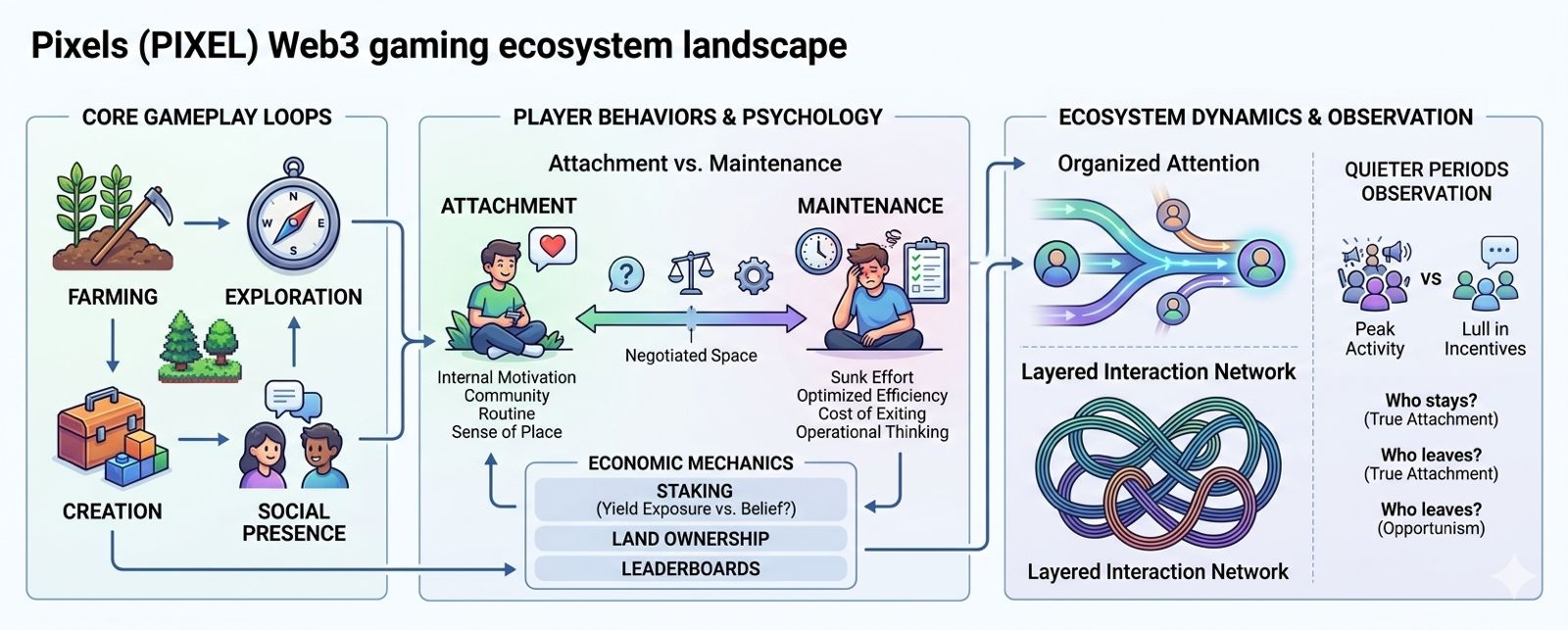
On the surface, it is simple enough to understand. Farming produces resources. Exploration expands access. Creation adds optional depth. Social presence connects everything through visibility and shared space. Layered on top are economic mechanics staking, land ownership, leaderboard campaigns, and reward structures that tie participation to output.
Yet beneath that simplicity sits something more ambiguous: a constant negotiation between habit and hype.
In early phases of engagement, behavior is usually driven by novelty. Players enter loops because they are new, not because they are meaningful. Over time, novelty fades, and what remains determines the actual identity of the system. In Pixels, what remains is not just gameplay it is routine. And routine is where most Web3 games reveal their real structure.
Routine can evolve in two directions. It can become attachment, or it can become maintenance.
Attachment implies that the system has created a reason to return that is not purely economic. Maintenance implies the opposite that participation continues because exiting feels costly in time, sunk effort, or perceived efficiency loss.
Pixels sits somewhere between these two states, and the boundary is not always clear.
The economy is central to this ambiguity. Staking, for example, is often framed as belief locking value into a system in expectation of long-term alignment. But in practice, it frequently behaves more like structured yield exposure. The question is whether belief is actually present, or whether belief is simply a narrative overlay on optimized behavior.
Inside the game loop, this distinction matters less than it appears to from the outside. A player staking assets may not be expressing conviction. They may simply be optimizing idle capital within a system that rewards inactivity as much as activity. Yet even that choice produces attachment, because once participation is embedded in structure, disengagement becomes another form of decision-making cost.
The same ambiguity exists in gameplay itself. Farming and exploration appear playful, but over time they can shift toward operational thinking. Players stop behaving like participants in a world and begin behaving like small operators managing efficiency curves. Time is allocated, routes are optimized, returns are calculated in implicit cycles.
The world still looks like a game, but the behavior resembles management.
Social systems complicate this further. Presence in Pixels is not purely aesthetic it affects perception of activity, legitimacy, and sometimes opportunity. A world populated by others always feels more alive, but “alive” is not the same as “meaningful.” High population density can create the illusion of depth even when interactions remain transactional.
This leads to a quieter question: is the ecosystem generating engagement, or simply organizing attention?
The distinction is subtle. Engagement suggests that players are internally motivated by experience. Organized attention suggests that players are being distributed efficiently across systems designed to retain activity.
Neither interpretation is entirely fair on its own. Pixels does something that many similar projects fail to do: it maintains layered interaction. Farming connects to economy. Economy connects to land. Land connects to visibility. Visibility connects back to social behavior. It is not a single loop, but a network of loops.
However, interconnected systems do not automatically produce meaning. They can also produce density without depth more places to act, but not necessarily more reasons to care.
The most revealing aspect of systems like this is not peak activity. It is what happens in quiet periods. When incentives flatten, when campaigns pause, when leaderboard pressure softens. During those intervals, the difference between habit and extraction becomes visible.
If players remain, it may suggest attachment. If they leave, it may suggest pure opportunism. If they hover in between logging in, checking systems, maintaining minimal presence it may suggest something more interesting: a transitional relationship where the game is neither fully world nor fully economy, but a negotiated space between the two.
That in-between state is where Pixels currently feels most observable.
It is neither fully resolved as a game nor fully reducible to a financial system. It behaves like an ecosystem that is still learning what kind of behavior it is meant to sustain. And in that uncertainty, players mirror the same ambiguity. They are not entirely gamers, but not entirely operators either.
They exist somewhere in between participating, optimizing, waiting.
There is no clear endpoint to this observation. Only a gradual accumulation of patterns: who stays when rewards weaken, who returns when cycles restart, who treats the world as a place and who treats it as a mechanism.
Over time, what matters is not whether the project succeeds in a traditional sense, but whether the behaviors it produces begin to stabilize into something self-sustaining beyond incentive structures.
For now, Pixels remains in motion. Not entirely stable, not entirely speculative. A system still negotiating its identity through the people interacting with it.
And like most systems of this kind, its most honest version is not visible during its loudest moments, but during the quieter intervals when participation becomes optional, and the decision to stay or not starts to mean something more than yield.