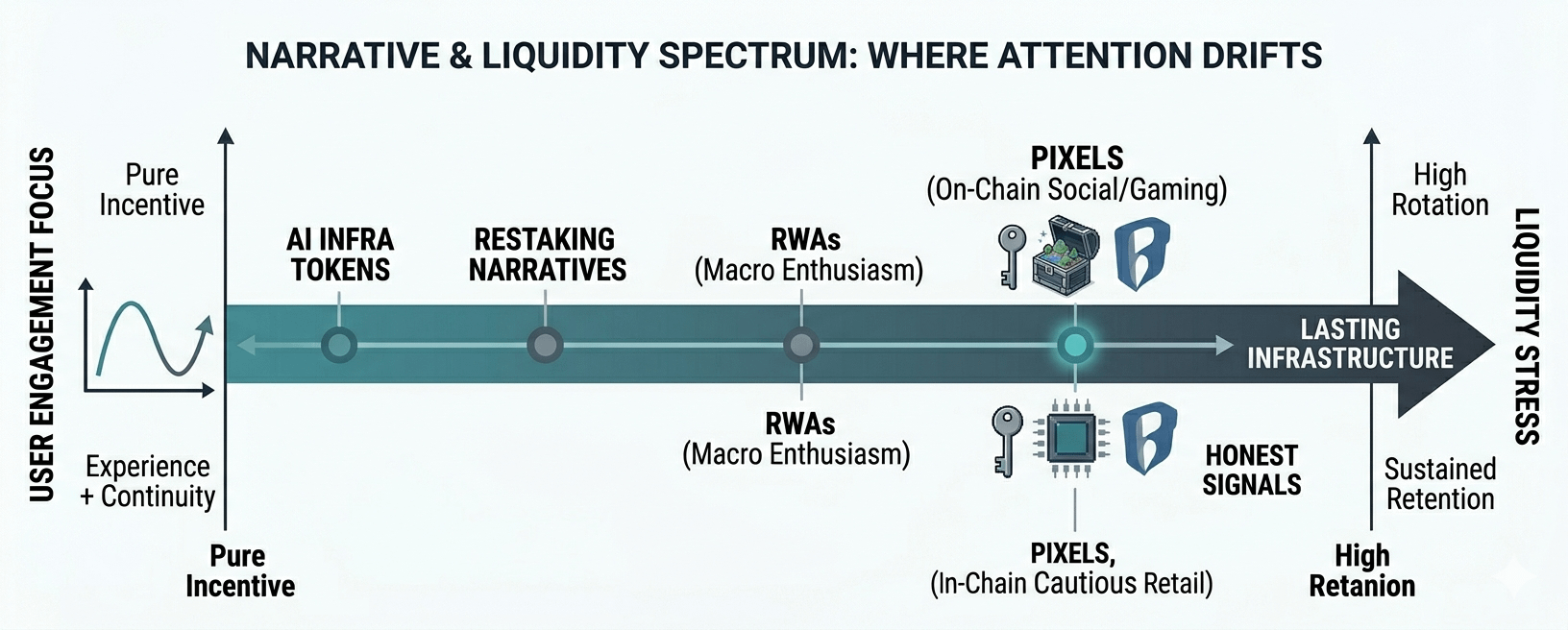
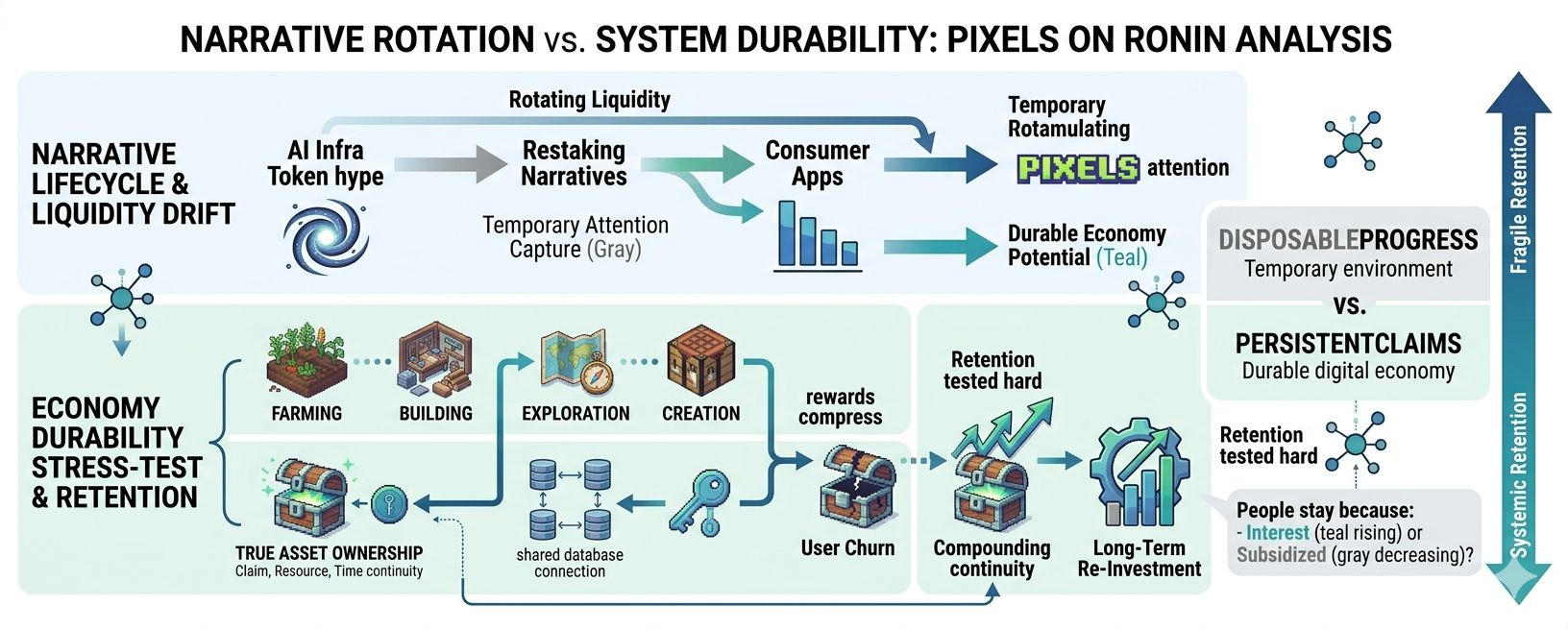
I came across Pixels while doing what I usually do these days watching where attention and liquidity are drifting after yet another rotation in this market that refuses to sit still. One week it’s AI infra tokens, then restaking narratives, then suddenly RWAs get another wave of enthusiasm as macro sentiment loosens for a moment. Retail follows selectively now. Not everything runs together anymore. It feels more segmented, more cautious, like everyone is waiting for something to actually stick.
So when Pixels showed up again in my feed, I didn’t think much of it at first. A social casual Web3 game on Ronin. Farming, exploration, creation. We’ve seen versions of this story before. Games trying to bootstrap economies, economies trying to become ecosystems, ecosystems trying to become narratives strong enough to survive a liquidity cycle.
But I clicked in anyway.
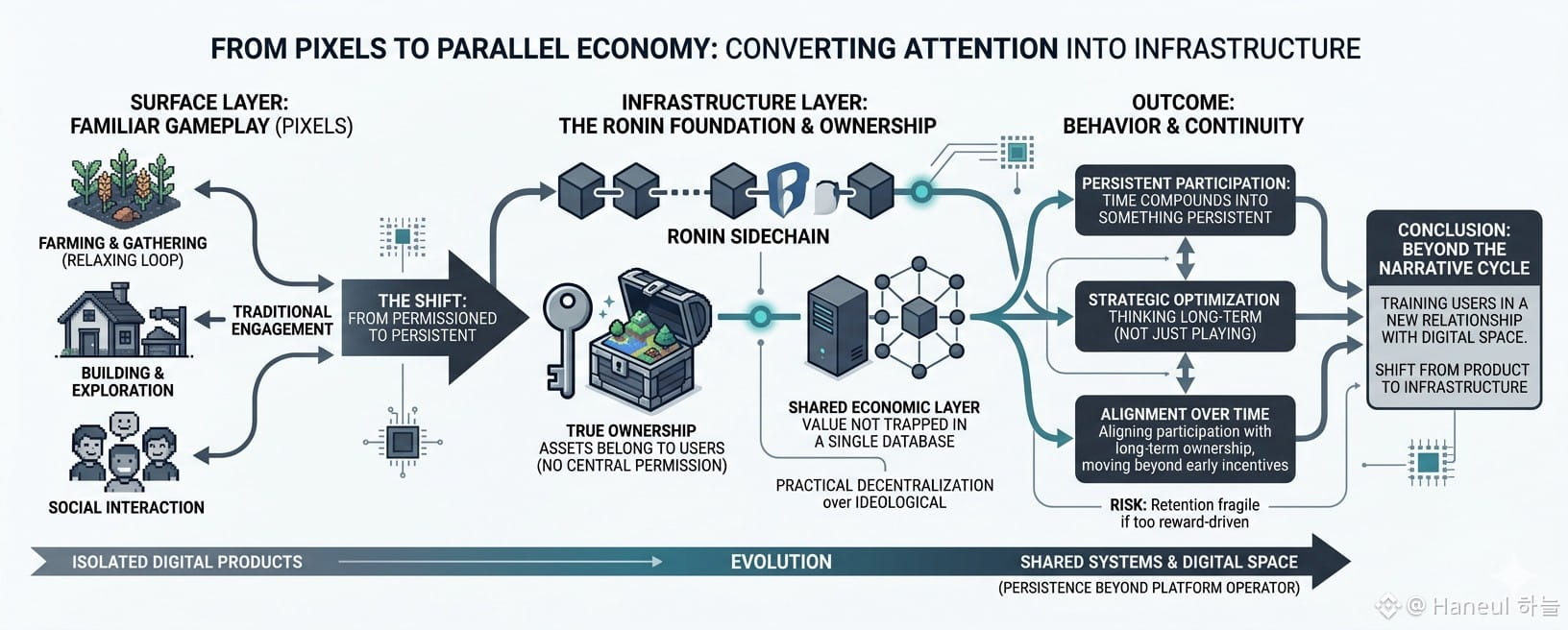
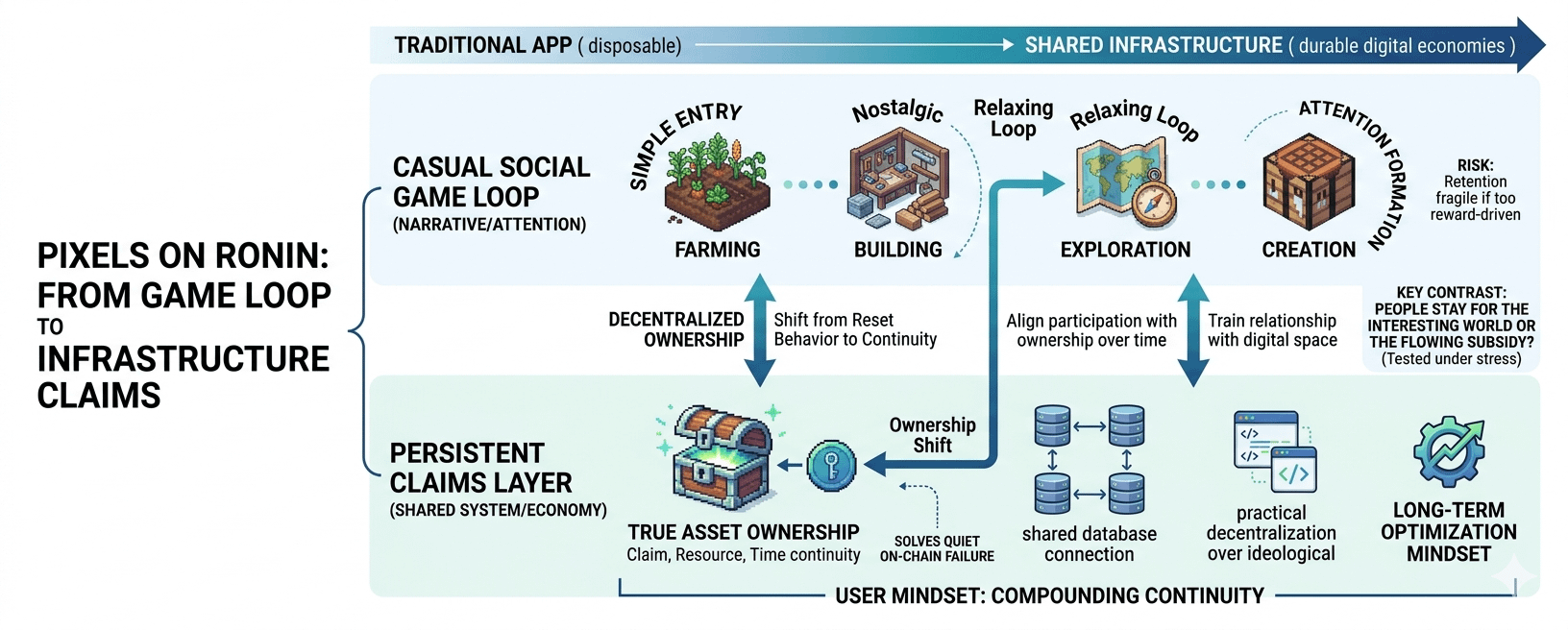
At the surface level, Pixels looks familiar almost intentionally so. You farm, you gather, you build. There’s a loop that feels relaxing, almost nostalgic. But the longer I stayed around, the more I noticed the strange seriousness underneath it. People weren’t just “playing.” They were behaving like participants in a small, parallel economy where time actually compounds into something persistent.
What pulled my attention wasn’t the gameplay. It was ownership.
In most traditional games, everything resets emotionally even if it persists technically. You stop playing, you lose relevance. But here, assets feel like they belong to you in a way that doesn’t depend on permission from a central server. That shift sounds small when you say it quickly, but in practice it changes how people act. They optimize differently. They think longer-term, even if subconsciously.
Pixels runs on Ronin, which already signals something important about where it sits in the broader crypto stack. Ronin was built for scale in gaming environments where cost and friction actually matter. That alone solves a quiet but real problem: most on-chain games fail not because the idea is wrong, but because the experience is too heavy for normal users to sustain.
Under the hood, what Pixels is really trying to do at least how I interpret it is connect simple user actions to a shared economic layer where value isn’t trapped inside a single company’s database. That’s the decentralization piece everyone talks about, but here it doesn’t feel ideological. It feels practical. Like a design constraint that accidentally produces a different kind of behavior.
And behavior is where things get interesting in this market.
Because right now, crypto isn’t just about technology. It’s about attention formation under liquidity stress. Narratives don’t just emerge; they compete. And games like Pixels are essentially trying to compete for sustained attention in an environment where users are constantly pulled toward the next incentive-heavy protocol.
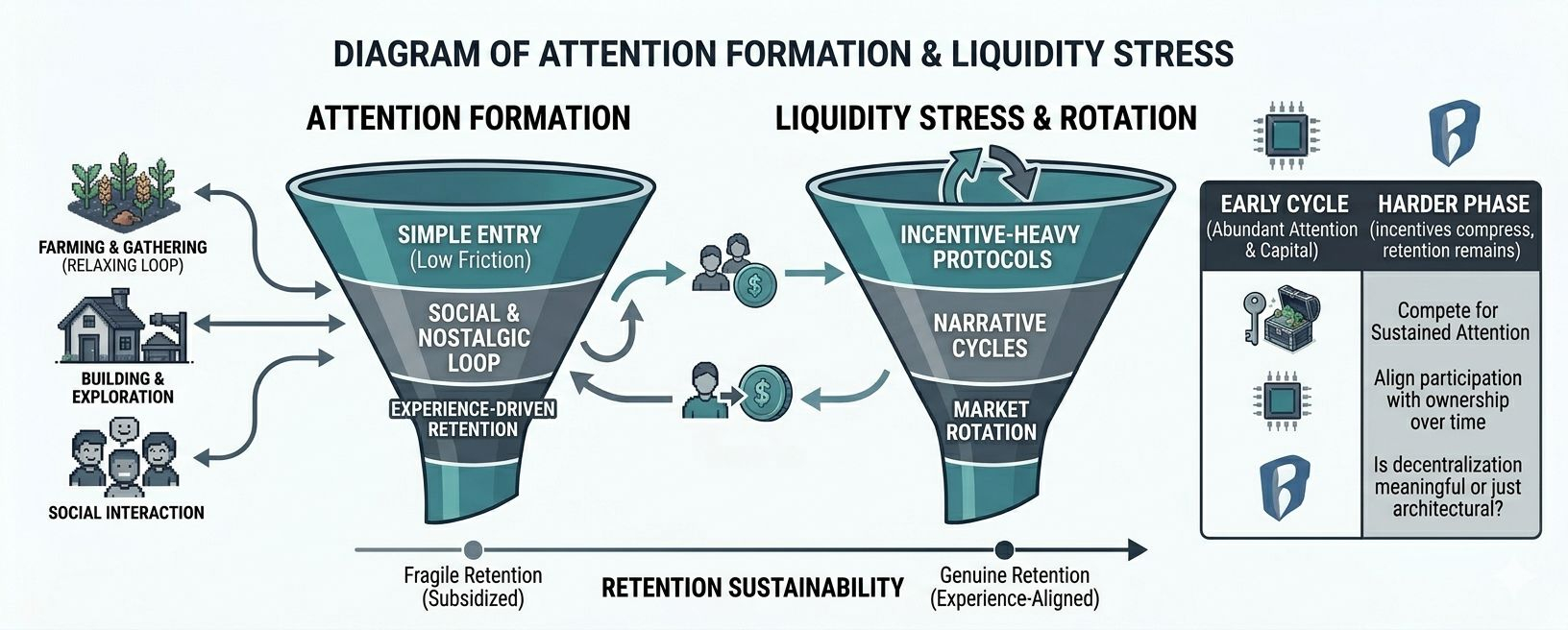
The incentive design here is subtle. It’s not purely about token rewards in the way early play-to-earn experiments were. It feels more like trying to align participation with ownership over time. Whether that alignment holds without external subsidies is the real question. Most of these systems look good in early cycles when attention is abundant and capital is willing to experiment. The harder phase comes when incentives compress and only genuine retention remains.
What stands out to me as a strength is that Pixels doesn’t overcomplicate its entry point. It doesn’t demand that users understand blockchain mechanics to participate. That matters more than people admit. Every additional cognitive step is a leak in the funnel.
But I also can’t ignore the risks. Gaming narratives in crypto have a history of inflating quickly and then fading just as fast once incentive structures shift or liquidity moves elsewhere. If user engagement is heavily reward-driven rather than experience-driven, retention becomes fragile. And fragility is something the market eventually prices in, even if it takes time.
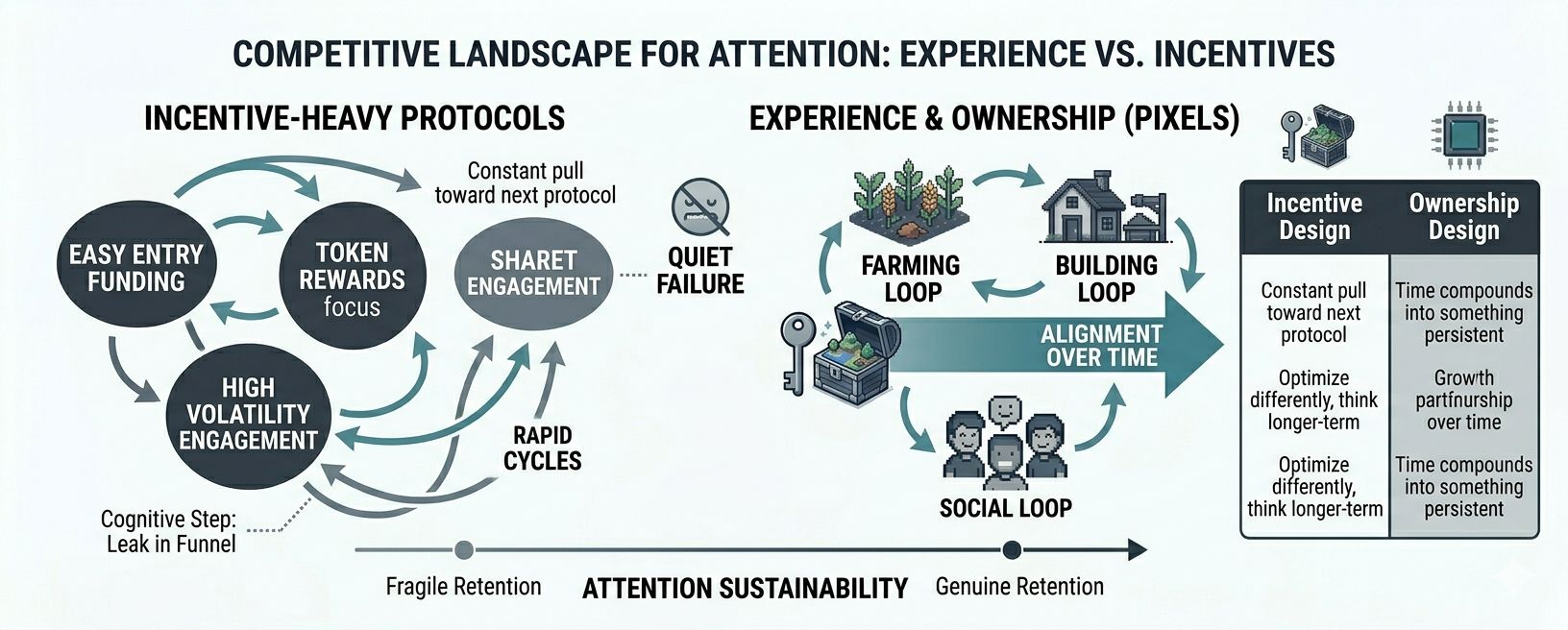
There’s also the broader question of whether decentralization here is meaningful or just architectural. Many projects claim shared ownership, but in practice, governance and value flow still concentrate in predictable ways. The difference between “decentralized in design” and “decentralized in effect” is where most of these experiments are quietly judged over time.
Still, the part I keep circling back to is not the token model or even the gameplay loop. It’s the way these environments slowly train users into a different relationship with digital space. When people start treating virtual land, resources, and time as something with continuity beyond a single platform’s control, something subtle shifts in how value is perceived.
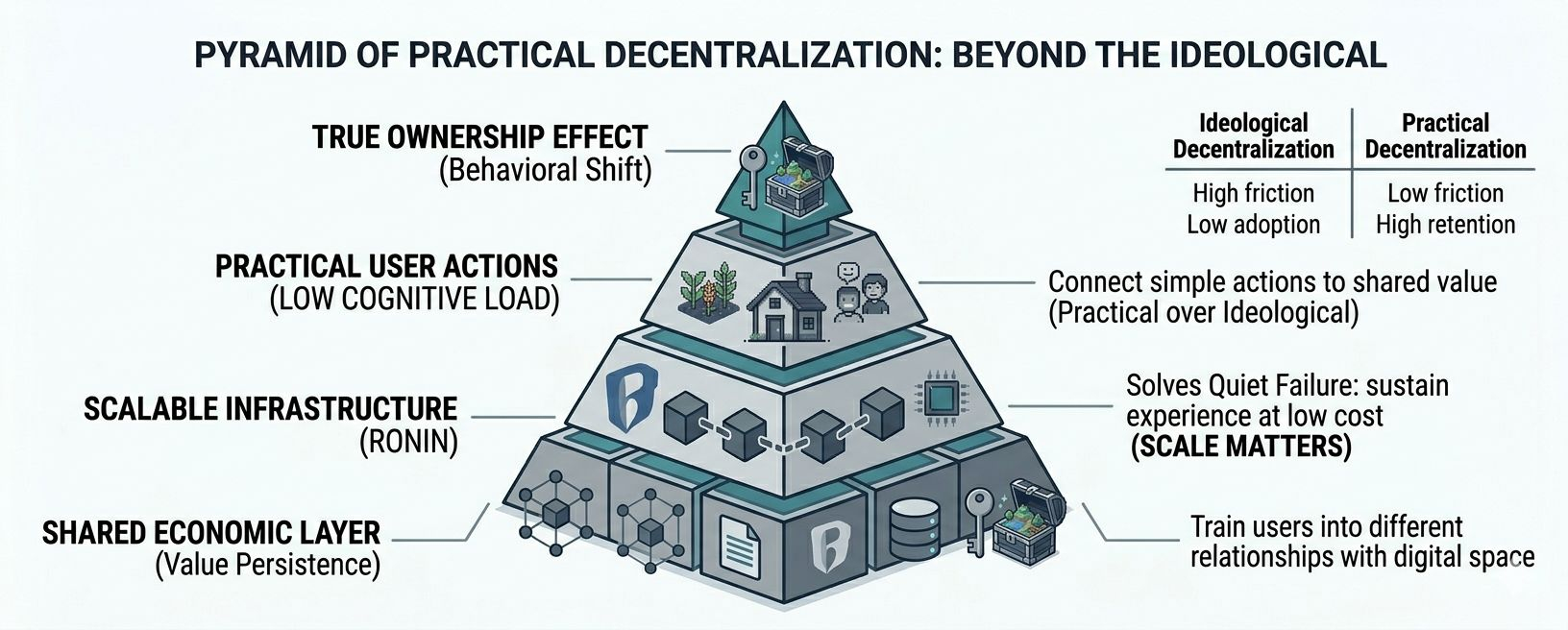
Maybe the more interesting angle isn’t whether Pixels becomes a dominant game. It’s whether it represents a step toward infrastructure where user activity, data, and economic participation are no longer isolated inside closed systems. Where digital environments behave less like products and more like shared systems that persist beyond any one operator.
But then I catch myself. The market has seen convincing versions of this story before. Some faded quietly. Some survived longer than expected. Most ended somewhere in between, absorbed into the next narrative cycle without a clear verdict.
So I keep watching it, not because I’m convinced of its destination, but because it sits in that uncomfortable middle space where experimentation meets real user behavior.
And in a market like this, that’s often where the most honest signals appear.
Still, I find myself wondering if attention keeps fragmenting and liquidity keeps rotating across narratives like this, are we actually building lasting systems or just refining better-designed experiments that compete more efficiently for the same limited attention span?