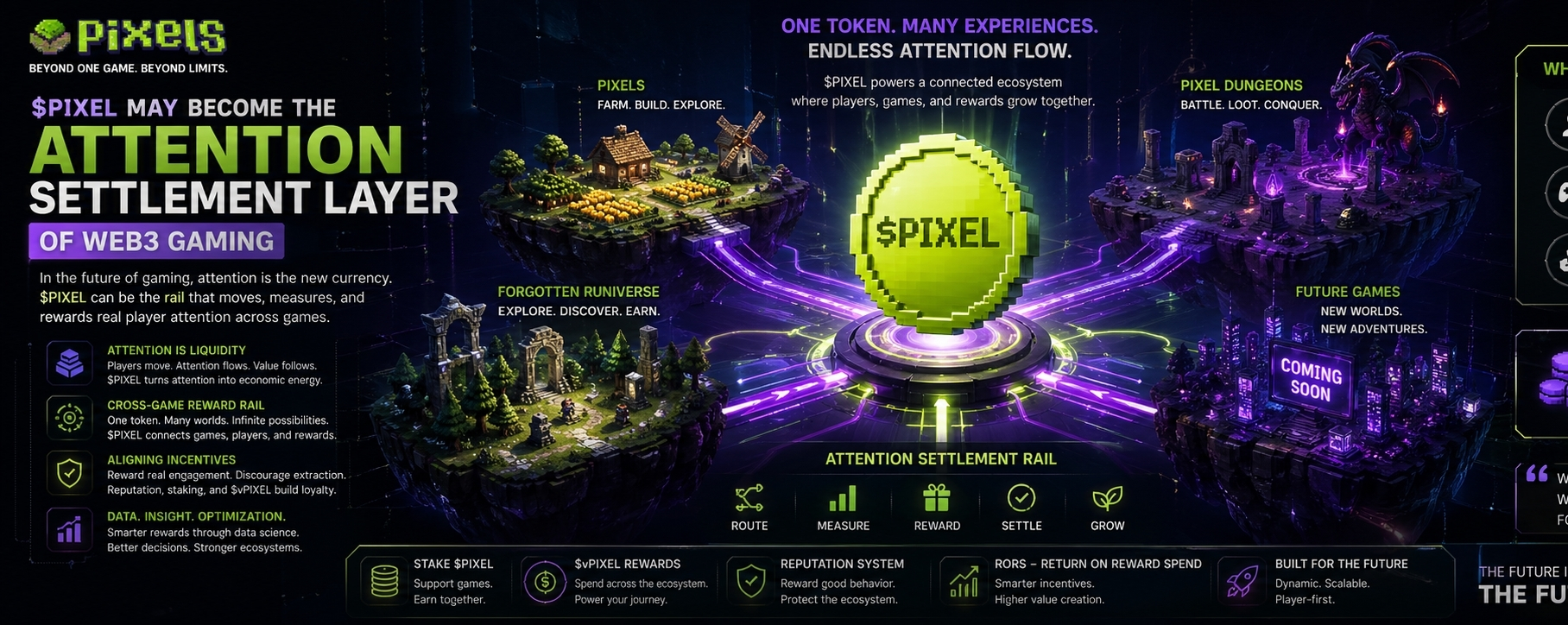
Most people still look at $PIXEL like a simple game token.
I think that is too small.
Way too small.
Because when I look at where Pixels is moving now, I do not just see a farming game with a token attached to it. I see something more layered. More dangerous in a smart way. Pixels may be slowly building a system where player attention can be routed, measured, rewarded, and settled across different games.
That sounds heavy.
But the idea is simple.
In the old gaming world, studios buy attention through ads. They pay TikTok. They pay YouTube. They pay Google. They pay influencers. A player clicks, installs, plays for a few minutes… and maybe disappears forever.
That is the dirty little problem behind gaming growth.
Attention is expensive.
Retention is weak.
User acquisition burns money like dry paper.
Pixels seems to be asking a different question.
What if a game did not need to rent attention from outside platforms all the time? What if attention could move through an ecosystem itself, guided by rewards, staking, reputation, and spending loops?
That is where PIXEL starts becoming interesting.
Not just as a token.
As a rail.
A reward rail.
A loyalty rail.
Maybe even an attention settlement layer.
Pixels’ own whitepaper frames the project around targeted rewards, better incentive alignment, data science, and long-term player engagement, not just blind play-to-earn emissions. That matters because it shows the project is not trying to repeat the old GameFi mistake of paying everyone for every click. It is trying to reward the actions that actually matter.
And this is where my thinking changes.
In traditional play-to-earn, rewards often behave like loose water. They leak everywhere. Farmers enter, drain the pool, sell the token, and leave. The game is left holding an empty bucket.
Pixels is trying to build pipes.
That is the difference.
With PIXEL staking, players can stake into different game projects, supporting development and expansion while gaining potential future benefits tied to those projects. This makes PIXEL more than a passive holding asset. It turns it into a signal.
A player is not only saying, “I own PIXEL.”
They are saying, “I want attention and rewards to flow here.”
That is powerful.
Because if multiple games exist inside the Pixels ecosystem, staking becomes a kind of economic compass. It points toward the games players believe deserve support. It can help decide where incentives move. It can help shape which game gets more visibility, more reward energy, and more player curiosity.
This is not classic staking.
Classic staking is boring. Lock token. Earn yield. Repeat.
Pixels staking feels closer to a publishing machine in disguise. Games compete for attention. Players stake toward games. Rewards follow the signal. Attention moves. Data comes back. The system learns.
That loop is the real story.
And then comes $vPIXEL.
This piece is very important because it changes the emotional texture of rewards. Liquid rewards often create sell pressure. A player earns, claims, sells, and exits. No loyalty. No memory. No relationship.
$vPIXEL can push rewards into a more internal ecosystem loop. Instead of every reward immediately becoming an exit door, it can become spending power inside the Pixels environment. That makes it feel closer to gaming loyalty credit than pure cash.
Think airline miles, but for games.
Not exactly money.
Still valuable.
Still useful.
Still sticky.
That stickiness is what most Web3 games never had.
They gave users rewards, but they failed to give them reasons to stay. Pixels is trying to make rewards feel less like a paycheck and more like a passport. A player can move between experiences, stake into games, spend inside the ecosystem, build reputation, and maybe become more valuable over time.
That is not just token utility.
That is behavioral design.
And yes, it is still early. It can break. It can become too complex. It can attract farmers. It can fail if the partner games are weak. I do not want to romanticize it like some magic machine.
But the structure is thoughtful.
Pixels’ staking FAQ also adds another sharp layer: Farmer Fees are based on Reputation Score, and 100% of Farmer Fee revenue goes back to reward stakers in the Pixels ecosystem. That means extraction is not only discouraged. It is partly redirected back toward longer-term participants.
That is clever.
A low-quality player tries to pull value out quickly.
The system charges friction.
That friction supports stakers.
Reputation lowers the pain for better participants.
It is like the economy has a immune system.
Not perfect. But alive.
Now connect this to the bigger cross-game thesis.
If PIXEL only powers Pixels the farming game, its ceiling is tied to one world. One content cycle. One economy. One player base.
But if PIXEL becomes useful across multiple games, the story changes.
Then PIXEL can become a shared reward infrastructure. A game could use Pixels’ ecosystem to attract players, test incentives, reward real engagement, and recycle attention back into the network. BlockchainGamer reported that Pixels launched ecosystem staking across games using the PIXEL token, including Pixels, Pixel Dungeons, and Forgotten Runiverse.
That matters because it proves the model is not only theoretical.
It is already leaning outward.
And when attention starts moving across games, PIXEL becomes less like a single-game currency and more like the road system between cities. Each game is a city. Each reward campaign is a traffic signal. Each staker is a voter with capital. Each player action becomes a small vehicle moving value across the map.
That is why I call it attention settlement.
The system is not just asking:
Did someone play?
It is asking something better:
Did this attention create value?
Did the player stay?
Did they spend?
Did they return?
Did they support the ecosystem?
Did their behavior justify the reward?
That is a much more mature question.
And it fits where gaming is going.
The next generation of Web3 gaming will not survive by shouting “play-to-earn” louder. That phrase is tired. Players have heard it. Investors have heard it. Farmers have abused it.
The stronger future is reward efficiency.
Rewards must act like fuel, not sugar.
Sugar gives a quick rush. Then comes the crash. Fuel keeps the engine moving.
Pixels’ focus on Return on Reward Spend fits this idea. Recent coverage of Pixels’ Stacked rewards infrastructure describes RORS as measuring how much profit or value is generated from distributed rewards, moving rewards closer to investment logic rather than pure cost.
That is the professional angle.
If rewards bring back more ecosystem activity than they cost, then rewards stop being inflationary noise. They become a growth engine.
That is what every game wants.
Not empty traffic.
Not bot clicks.
Not mercenary farming.
Real attention.
The kind that stays, spends, joins events, talks, trades, stakes, and comes back again tomorrow.
This is where PIXEL’s Binance Square narrative becomes very strong. Many people will still write about price, charts, unlocks, and basic utility. Fine. Those things matter. But the deeper thesis is different.
PIXEL may be turning into a coordination asset for gaming attention.
It can coordinate players.
It can coordinate stakers.
It can coordinate games.
It can coordinate rewards.
It can coordinate loyalty.
That is much bigger than “a token used in a farming game.”
Of course, the risk is real.
If the games are not fun, no reward rail can save them. If $vPIXEL feels too restrictive, players may reject it. If reward targeting becomes too opaque, trust can suffer. If the system rewards the wrong behavior, farmers will smell it like sharks in blood water.
So execution matters.
A lot.
But I like the direction because it feels grounded in a real problem. Gaming does not need another empty token. It needs better distribution. Better retention. Better reward discipline. Better ways to separate real users from short-term extractors.
Pixels is quietly building around that problem.
Not perfectly. Not magically.
But seriously.
And that is why I think $PIXEL’s biggest future may not be inside one game at all.
It may be in the space between games.
The invisible layer where attention moves, rewards settle, and player behavior becomes economic signal.
That is the part many people are still missing.
PIXEL is not only trying to reward players.
It may be trying to decide where gaming attention should flow next.$ORCA #pixel @Pixels