
I’ll start with the part I’m not supposed to say out loud: I expected to hate Pixels. Not casually dislike it hate it in that very specific, battle-worn way you develop after cycling through enough “player-owned economies” that quietly translate to “you are the yield.” I assumed it was another liquidity funnel dressed up as cozy gameplay. Log in, optimize, become exit liquidity for someone earlier in the curve. Close tab. Repeat.
So yeah. I came in tilted.
And the first few minutes didn’t help. No dopamine cannon. No flashing APR cosplay. Just crops. Movement that feels almost too slow. Systems that don’t immediately explain themselves. It felt like a product that forgot it was supposed to impress me. Which, weirdly, is what kept me there. Suspicion turned into observation. Observation into time spent. That’s usually how it starts, and I should’ve recognized the pattern earlier, but I didn’t. Or maybe I did and ignored it.

What threw me off wasn’t what the game showed it’s what it didn’t push.
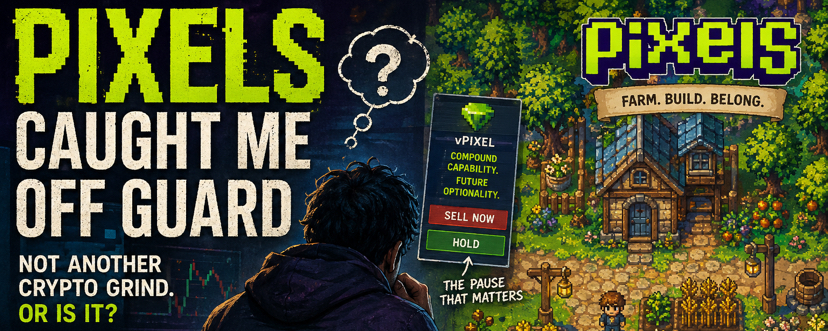
Most crypto games hard-code your behavior from minute one. Earn → dump → scale → repeat. It’s not even a loop anymore, it’s muscle memory. Here, that loop gets… interrupted. Softly. Indirectly. There’s this layer vPIXEL that doesn’t scream for attention but quietly rewires your incentives. And I don’t mean in a “tokenomics diagram” sense. I mean in the moment where your cursor hovers over “sell” and you pause.
That pause matters.
Because suddenly you’re not just extracting. You’re negotiating with yourself. If I sell, I get immediate liquidity. If I don’t, I compound capability. Future efficiency. Optionality. It’s not enforced. There’s no lock screaming “you can’t.” It’s worse than that it’s a nudge. Behavioral design doing its thing. You feel slightly stupid for dumping, even when it might be rational. That’s new. Or at least, newly effective.
I caught myself doing the thing I usually mock. Rationalizing why holding made sense. Not because of some grand belief in the token, but because the system made short-term extraction feel suboptimal. Not forbidden. Just misaligned. That’s a different flavor of control.
And then there’s the chain underneath it all, the RONIN Network, which is doing something rare in this space: staying out of the way. No friction spikes. No “oh right, this is still experimental infrastructure” moments. It’s just there. Transactions go through. Actions resolve. You don’t sit there negotiating with gas fees like it’s 2021 and you’re debugging your own patience. It feels like something that already broke once, publicly, and then got rebuilt with fewer illusions.
You don’t think about it. That’s the point.
Which leaves the actual gameplay, and this is where I tripped over myself a bit. Because I should’ve optimized. That’s the instinct. Find the most efficient loop, compress time, maximize output. Instead, I burned no, wasted an embarrassing amount of time rearranging my land. Not even for a major gain. Marginal improvements. A tile here, a path there. I knew it wasn’t optimal. I knew the ROI on that hour was probably terrible.
Still did it.
And here’s the uncomfortable part: it felt better than running a clean grind loop.
There’s something about inefficient agency that hits differently. When you’re not just executing the obvious strategy, but poking at the system, bending it slightly, making it yours in small, almost irrelevant ways. It’s not rational. It doesn’t scale. But it sticks. I remembered that session more than any “perfect” farming run.
That’s not how these games usually land.
Normally, you feel the grind loop tightening. Time in, tokens out. A treadmill with a wallet. Here, the loop is still there don’t get it twisted but it breathes a little. You drift between tasks. You misallocate time. You correct. You iterate. It feels less like labor extraction and more like low-grade problem solving with a side of farming aesthetics.
I’m not romanticizing it. There are moments where it absolutely flattens into repetition. You catch the pattern. You see the ceiling. You realize that if enough people decide to just extract aggressively, the same old pressures will show up. Supply overhang. Attention decay. The usual suspects. None of that is magically solved.
But right now, it’s balanced. Uncomfortably so.
Not perfect. Not revolutionary. Just calibrated enough that you don’t feel immediately farmed the moment you log in. And that’s a low bar, but also a rare one.
I still don’t fully trust it. That reflex doesn’t go away. But I’ve noticed something I can’t easily dismiss I keep logging back in. No grand strategy. No spreadsheet open on a second monitor. Just small adjustments. Minor decisions. Time passing without me aggressively accounting for it.
That’s either a good sign or a very well-designed trap.
I’m not sure which yet.