
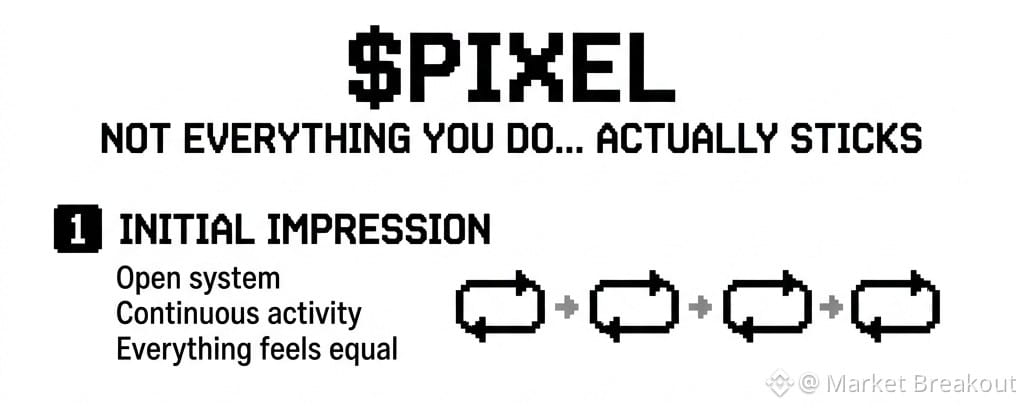
At first, Pixels doesn’t feel restrictive at all.
You log in, move around, complete tasks, earn small rewards. Everything works the way you expect. Nothing feels blocked, nothing feels gated. It gives the impression that progress is simply a matter of time.
But that impression doesn’t hold for long.
After spending more time inside the system, you start noticing something subtle. Not every action carries the same weight. Some things move you forward in a lasting way, while others just… keep you occupied. The difference isn’t explained anywhere. You just feel it over time.
That’s where things start to shift.
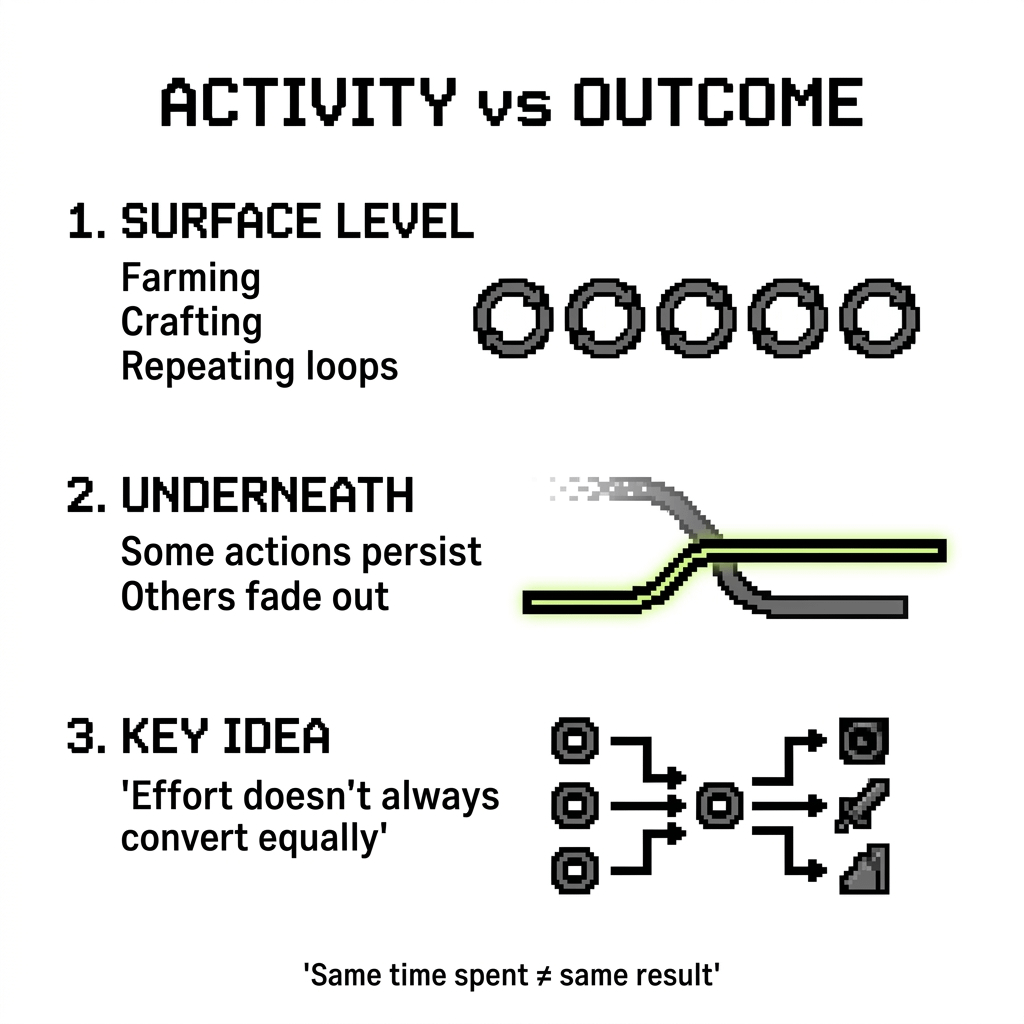
In most games, effort and outcome are loosely connected. You do more, you get more. Even if the system isn’t perfectly balanced, the relationship feels straightforward. Pixels doesn’t quite behave like that. Two players can put in similar time, complete similar loops, and still end up in very different positions.
At first, it’s easy to dismiss that as randomness. Or timing. But the pattern repeats too consistently for that.
Some actions seem to “stick.” Others don’t.
That’s when $PIXEL starts to feel less like a reward, and more like a filter.
It’s not obvious. The game doesn’t force you to use it. You can stay entirely within the basic loops and keep progressing at a normal pace. But when certain moments appear, upgrades, opportunities, points where progress can lock in, the system behaves differently. It tightens.
And that’s where the distinction shows up.
If you’re prepared, if you have $PIXEL, ready, you move through those moments cleanly. If not, you stay in the background. You don’t get blocked. You just… don’t convert in the same way.
That difference is small in isolation. But it compounds.
I’ve seen this kind of structure outside of games. In markets, not every action matters equally either. Most activity is just noise, trades that circulate without changing anything meaningful. But certain moments, entry points, liquidity shifts, timing windows, are where outcomes actually get decided.
Pixels feels like it’s creating something similar.
A layer where most actions exist, and another layer where some of them get recognized as “final.”
$PIXEL, seems to sit between those layers.
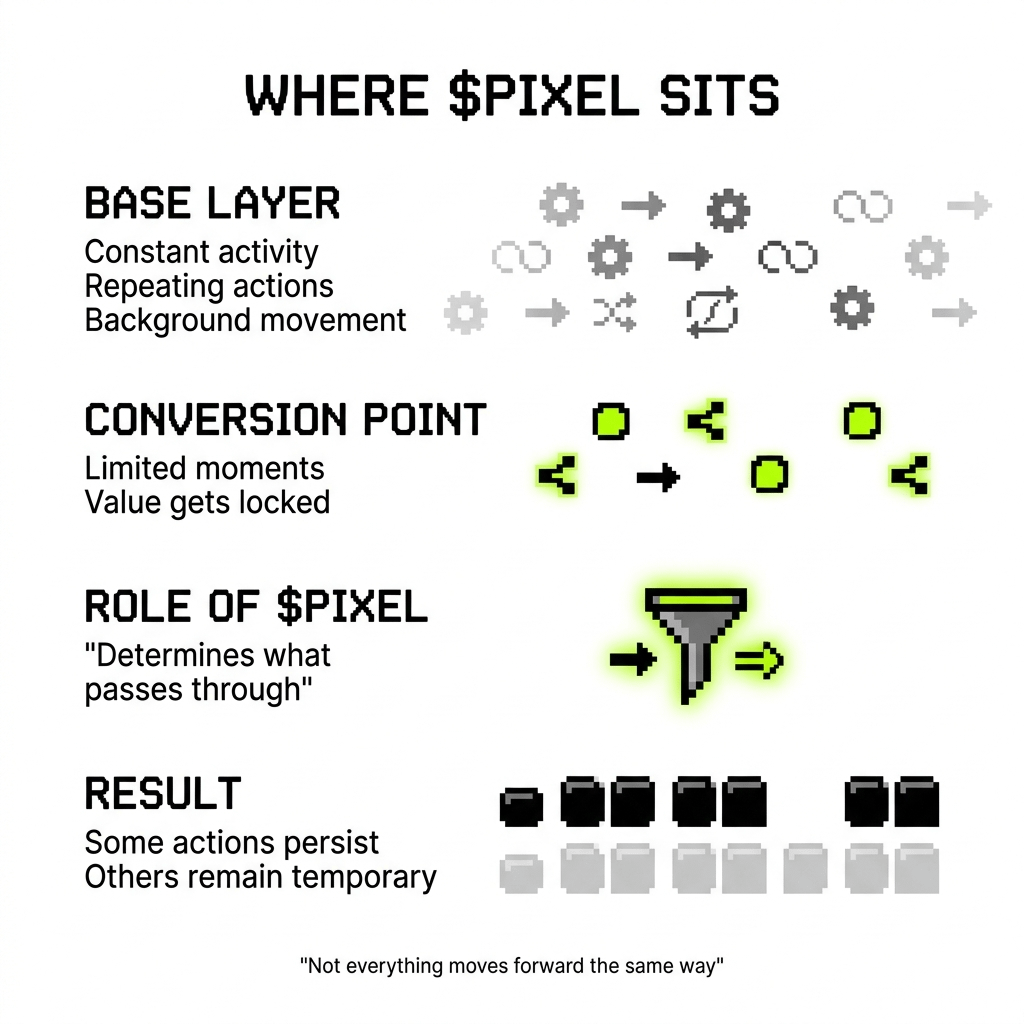
It doesn’t change what you can do. It changes whether what you did actually counts in a meaningful way. That’s a different kind of role than most tokens play.
What makes it interesting is how quiet the system is about it.
There’s no clear signal saying, “this is important, this is not.” You have to infer it from behavior. You start noticing which actions tend to lead somewhere, and which ones don’t. You begin adjusting without realizing it. Less random movement, more intentional steps.
Over time, that changes how the entire system feels.
It stops being about participation and starts becoming about selection.
Not every player is filtered out. But not every player gets the same visibility inside the system either. Some actions rise, others circulate. Some outcomes persist, others fade.
And that’s where things get a bit uncertain.
Because once players recognize that only certain paths lead to meaningful outcomes, behavior shifts. Optimization takes over. People move toward whatever consistently “sticks.” That’s natural. Every system eventually drifts in that direction.
The question is whether the system can handle that shift.
If too many players converge on the same conversion points, those moments become more competitive. More selective. The gap between being prepared and not prepared becomes wider. And at that point, $PIXEL, isn’t just smoothing the experience anymore. It’s defining who gets through.
That’s a delicate balance.
On one side, it keeps the economy from becoming flat. Not everything needs to matter equally. On the other, it risks creating layers that aren’t immediately visible, but very real in terms of outcomes.
I don’t think the system is fully settled yet. It still feels like it’s finding that balance.
But one thing keeps standing out to me.
Pixels doesn’t seem focused on rewarding everything you do. It seems focused on deciding which parts of what you do are worth carrying forward.
And that’s a much harder thing to price.