
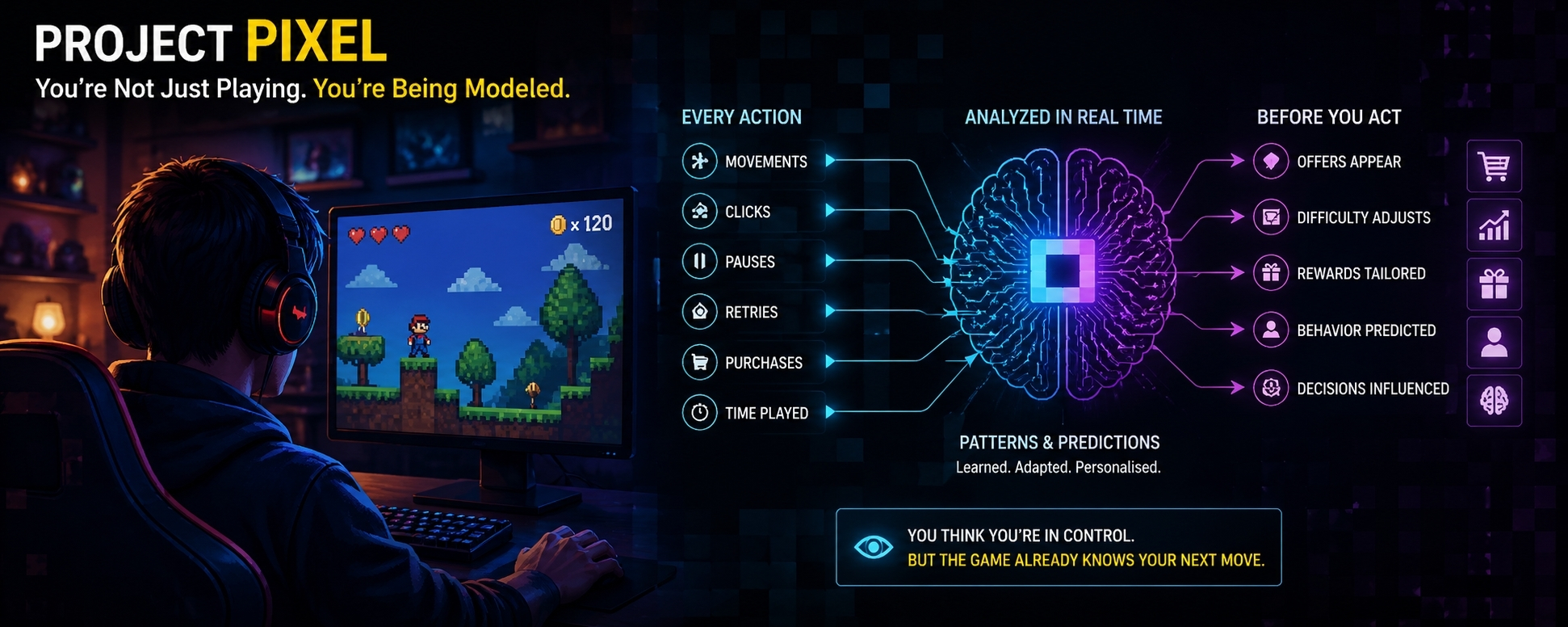
You open the project thinking you’re about to play.
That’s the plain version of the story. You sit down, load in, maybe adjust the brightness because the screen looks a little too harsh, maybe check your rewards, maybe jump straight into a match or mission because you don’t have much time. Ten minutes, you tell yourself. Fifteen at most.
Then the project starts speaking in its own quiet language.
A timer is running.
A reward is waiting.
A level is almost complete.
A rare item is leaving soon.
Your progress bar is sitting there, annoyingly close to the next milestone.
Nothing screams. Nothing grabs you by the collar. It’s all soft. Polished. Normal. That’s what makes it work.
Because while you’re looking at the pixels, the project may be looking at you.
Not with eyes, obviously. Not in some ridiculous movie-villain sense. It’s not sitting there thinking, Ah yes, Salma is tired tonight, now we strike. It doesn’t need that kind of drama. It only needs signals.
How long did you stay after losing?
Did you open the store after getting stuck?
Did you come back when the event timer was low?
Did you quit when progress slowed down?
Did you spend after frustration, or after excitement?
Did you chase the reward because you wanted it, or because leaving it unfinished felt irritating?
That’s the uncomfortable bit. The project doesn’t have to know you deeply. It only has to know your patterns well enough to make a decent guess.
And a decent guess, repeated thousands of times, becomes power.
You’re not just playing through the project. You’re teaching it how you behave.
Every retry leaves a mark. Every pause tells a small story. Every almost-purchase says something. Even ignoring an offer is information. The project learns from yes, from no, from hesitation, from boredom, from impatience.
A human friend might say, “You seem frustrated.”
The project says, in its colder way, “Players in this state often respond to this.”
That difference matters.
A friend may care why you’re frustrated. The project only needs to know what frustration makes you do.
Maybe you keep trying.
Maybe you leave.
Maybe you buy the shortcut.
Maybe you suddenly decide the paid upgrade doesn’t look so bad after all.
None of this means you’re weak. That’s a lazy take. People love saying, “Just don’t click,” as if the entire system wasn’t built to make clicking feel natural at exactly the wrong moment.
That’s like putting sweets at a child’s eye level, testing the packaging, adjusting the lighting, watching which shelf position works best, and then acting shocked when the child reaches out.
Self-control exists, yes.
So does design.
And design has been studying people for a long time.
The older idea of a game was simpler. You bought it, played it, got better, maybe beat it, maybe didn’t. The project responded to your actions, but mostly in straightforward ways. Press jump, the character jumps. Miss the timing, you fall. Learn the boss pattern, win the fight.
There was honesty in that.
Modern projects can still have that honesty inside them. Many do. The combat can be sharp. The story can be beautiful. The world can be rich. The fun can be completely real.
But around that core, another machine often grows.
Progress systems.
Daily rewards.
Streaks.
Timed events.
Limited offers.
Upgrade paths.
Seasonal tracks.
Ranking pressure.
Locked cosmetics.
Soft walls.
Hard grinds.
And somewhere behind all that, measurement.
The project watches where players stop. It watches what makes them return. It watches what makes them stay longer than they planned. It watches which rewards feel satisfying and which ones create a tiny itch. It watches who spends, who nearly spends, who never spends, and who might spend if the pressure arrives from the right angle.
That’s where the project stops being just a playground.
It becomes a behavioral mirror with a cash register attached.
A harsh sentence, maybe. But not an unfair one.
Think about the word “almost.”
Almost upgraded.
Almost finished.
Almost ranked up.
Almost rare.
Almost gone.
That word is everywhere because it’s sticky. The brain hates unfinished business. A completed task lets you leave. An incomplete one keeps tugging at your sleeve.
One more match.
One more claim.
One more chest.
One more mission.
One more tiny push and then you’ll stop.
Except the project is very good at placing the next “one more” right after the last one.
That’s not an accident. That’s architecture.
And the architecture can become personal, or at least personal-looking. Not personal like a handmade letter. Personal like a vending machine that remembers which buttons you press when you’re thirsty.
The project might learn that some players love status. Show them rare items.
Some players hate slow progress. Show them boosters.
Some players fear missing out. Show them timers.
Some players come back for routine. Give them streaks.
Some players need social pressure. Remind them others are ahead.
Some players are close to quitting. Drop a reward at the exit door.
You still choose. Of course you do.
But the room has been arranged before you walked in.
That’s the part people often miss. Influence doesn’t need chains. It only needs placement, timing, and repetition.
A store button after a calm moment is just a store button.
A store button after three failed attempts feels like a solution.
A reward after an ordinary login is nice.
A reward after you almost quit feels like the project understands you.
A countdown timer beside an item is decoration until your brain starts whispering, What if I miss it?
And once that whisper starts, the project doesn’t have to push very hard.
The best pressure rarely feels like pressure. It feels like your own idea.
That’s why these systems can be so slippery. The player experiences the final decision from the inside. “I wanted this.” “I chose this.” “I only played longer because I felt like it.”
Maybe that’s true.
But also, maybe the project shaped the conditions around the feeling.
Both can be true at once, which is annoying but real.
You can genuinely enjoy the project and still be nudged by it.
You can love the art, the mechanics, the sound, the challenge, the little rush of winning, and still be caught in a loop that doesn’t respect your time.
You can spend money happily on something you like and still notice that the project sometimes creates discomfort before selling relief.
That last one is worth sitting with.
If the grind is stretched until the shortcut feels tempting, what exactly is being sold?
If progress slows so much that payment feels like freedom, is that convenience or a toll booth?
If an event timer makes you anxious over a digital item you’ll barely use next week, who benefits from that anxiety?
These are not anti-game questions. They’re pro-player questions.
A good project doesn’t need to make you feel cornered. It trusts its own fun.
A weaker, hungrier project keeps inventing little emergencies.
Come back now.
Claim this before it disappears.
You’re close.
Don’t waste your progress.
Your streak is waiting.
Last chance.
Only today.
Just enough pressure to turn leisure into maintenance.
And once play becomes maintenance, the emotional texture changes. You’re no longer asking, “Do I want to play?” You’re asking, “What happens if I don’t?”
That’s a very different question.
It’s the difference between visiting a place because you love it and checking on a machine because it might punish you for neglect.
The project doesn’t need to trap you forever. That would be too obvious. It only needs to delay your exit by a few minutes, pull you back one more evening, make the unfinished thing feel slightly uncomfortable, turn routine into loyalty and loyalty into data.
That data becomes the map.
And the map gets sharper.
After a while, the project may have a rough idea of what kind of player you are. Not your full humanity, obviously. It doesn’t know your childhood, your private worries, the mood you’re in after a bad day. But it may know something useful about your behavior inside its walls.
Maybe you’re the grinder.
The collector.
The almost-buyer.
The player who returns for timers.
The player who keeps pushing after failure.
The player who spends only when annoyed.
The player who hates falling behind.
The player who can’t leave a reward unclaimed.
These labels don’t appear on your screen. Nobody says, “Welcome back, almost-buyer.” That would ruin the trick.
You just feel the project adjusting.
A different offer.
A different prompt.
A reward at a suspiciously perfect time.
A difficulty curve that seems to bend.
A reminder that lands when you were already halfway tempted.
A bundle that feels designed for exactly your irritation.
Could be coincidence once. Twice.
After a while, you start to feel the shape of the hand.
Not a hand forcing you. More like one guiding the chair slightly closer to the table.
This is why the “just walk away” argument is so thin. Yes, you can walk away. You should, sometimes. But if a project is designed around behavioral pressure, then walking away becomes part of the fight, not a neutral option.
The project has already made leaving feel costly.
You’ll lose the streak.
You’ll miss the reward.
You’ll waste the pass.
You’ll fall behind.
You’ll have to grind again later.
You were so close.
That last one is brutal.
“You were so close” has probably stolen more sleep from players than any boss fight ever could.
And the clever part is that it doesn’t sound like manipulation. It sounds like motivation. It sounds like encouragement. It sounds like your own ambition talking back to you.
That’s how soft cages work.
No lock. No guard. Just a door that feels unpleasant to open.
Now, to be fair, behavioral modeling isn’t automatically dirty. It can do genuinely useful work. A project can learn where players are confused and fix the tutorial. It can notice unfair difficulty spikes. It can improve balance. It can detect cheating. It can make the experience smoother for new players without boring experienced ones.
Used with restraint, data can make play better.
The trouble starts when every human reaction becomes a business opportunity.
Frustration becomes a sales window.
Boredom becomes a retention problem.
Loneliness becomes a social hook.
Impatience becomes a boost offer.
Pride becomes a cosmetic tier.
Habit becomes a daily login target.
At that point, the project is no longer just improving the experience. It’s farming the experience.
And players can feel that, even if they don’t phrase it that way.
They say things like:
“I don’t know, it just feels like a chore now.”
“I’m not even having fun, but I need to finish this.”
“I already paid for the pass, so I might as well.”
“I’ll stop after this reward.”
“I hate this event, but I don’t want to miss the item.”
That’s the language of play turning into obligation.
And obligation is profitable.
That’s the ugly little secret.
A player who is joyfully engaged and a player who is compulsively returning can look similar on a chart. Both log in. Both complete tasks. Both raise engagement numbers. One is alive with interest. The other is dragging themselves through the loop because stopping feels wasteful.
If the project only measures behavior, it may not care about the difference.
Or worse, it may learn that the second player is easier to control.
That’s where a project needs ethics, not just analytics. Because numbers can tell you what works, but they don’t blush. They don’t ask whether the thing that works is decent.
People have to ask that.
Designers have to ask it.
Studios have to ask it.
Players, too, in their own way.
Not with paranoia. Paranoia ruins everything. You don’t need to stare at every menu like it’s plotting against you.
But you can start noticing patterns.
When does the project interrupt you?
When does it show the store?
When does it slow progress?
When does it make you feel behind?
When does it offer relief?
When does it make leaving feel like a loss?
Does the project reward your time, or does it keep stretching your time thinner?
Does it sell you joy, or does it sell you escape from irritation?
Does it respect a stopping point, or does it always keep one unfinished thing dangling?
These questions change how the project feels. Once you see the hooks, you don’t become immune, but you gain a pause. And sometimes a pause is enough.
A pause before buying.
A pause before chasing a timer.
A pause before protecting a streak you don’t care about.
A pause before turning a game into homework.
That pause is small, but small things matter here. The whole system runs on small things.
One more click.
One more login.
One more reward.
One more purchase.
One more night.
So maybe resistance starts the same way.
One less automatic tap.
One ignored timer.
One unfinished pass.
One clean exit.
No speech. No dramatic uninstall. Just leaving when you said you would.
There’s a strange dignity in that.
The future of projects like this will probably become smoother. Less clumsy. Less obvious. The prompts may feel more natural. The rewards may arrive with better timing. The difficulty may bend more quietly. The project may seem warmer, more responsive, almost companion-like.
Some of that could be wonderful. A project that adapts respectfully can make play more welcoming, more accessible, more alive.
But the same intelligence can also learn where you’re easiest to move.
That’s the knife edge.
A project can study you to serve your experience.
Or it can study you to manage your behavior.
From the player’s seat, both may look polished. Both may feel impressive. Both may sparkle.
The difference shows up later, in the aftertaste.
Do you leave feeling satisfied?
Or do you leave feeling used, restless, vaguely annoyed, already thinking about the thing you didn’t finish?
That feeling is data too, even if the project can’t fully read it.
Maybe you can.
Because the pixels aren’t the whole project anymore. They’re the visible skin. Behind them, something is measuring the pressure of your habits, the shape of your patience, the price of your attention.
You’re still holding the controller.
But the room has been watching long enough to guess which door you’ll reach for next.