
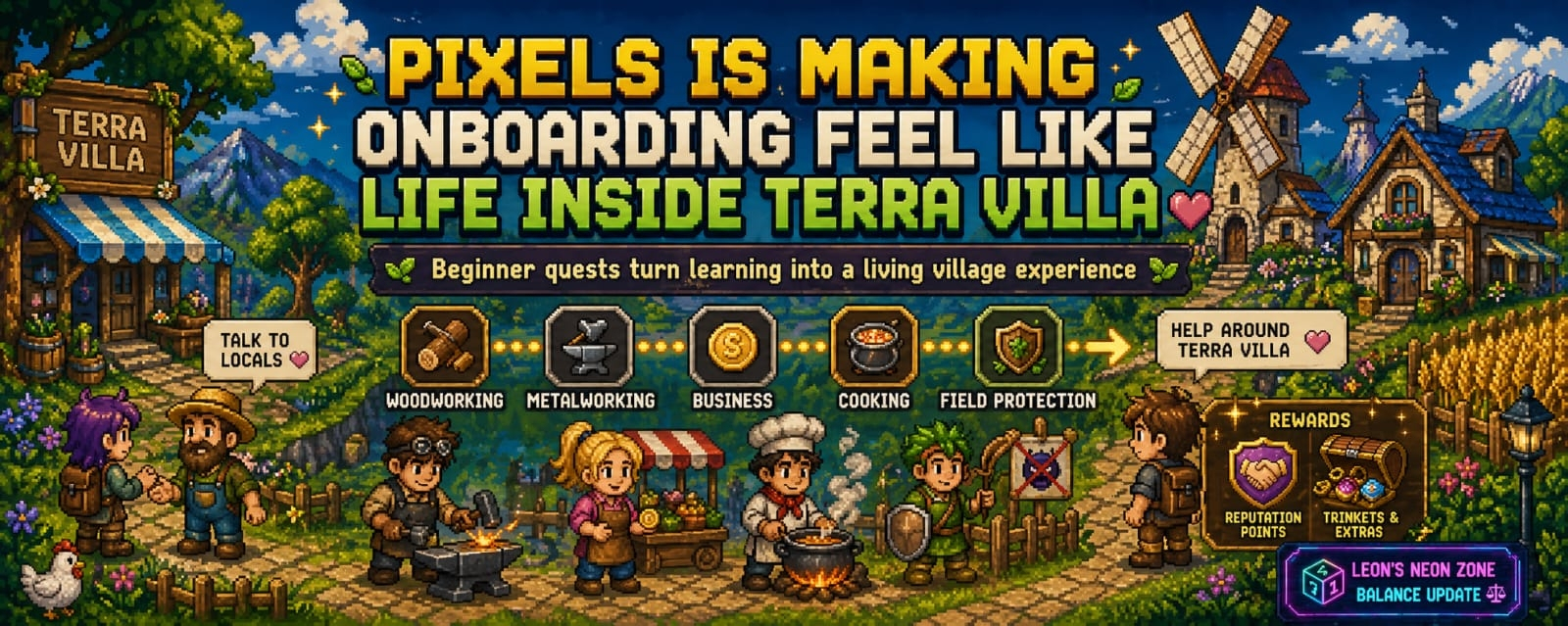

What I like about @Pixels is that it does not always try to teach players through heavy explanations. Sometimes it simply places you inside Terra Villa, gives the town some movement, and lets the learning happen through small conversations. That may sound simple, but for a live game economy, onboarding is one of the hardest parts to get right.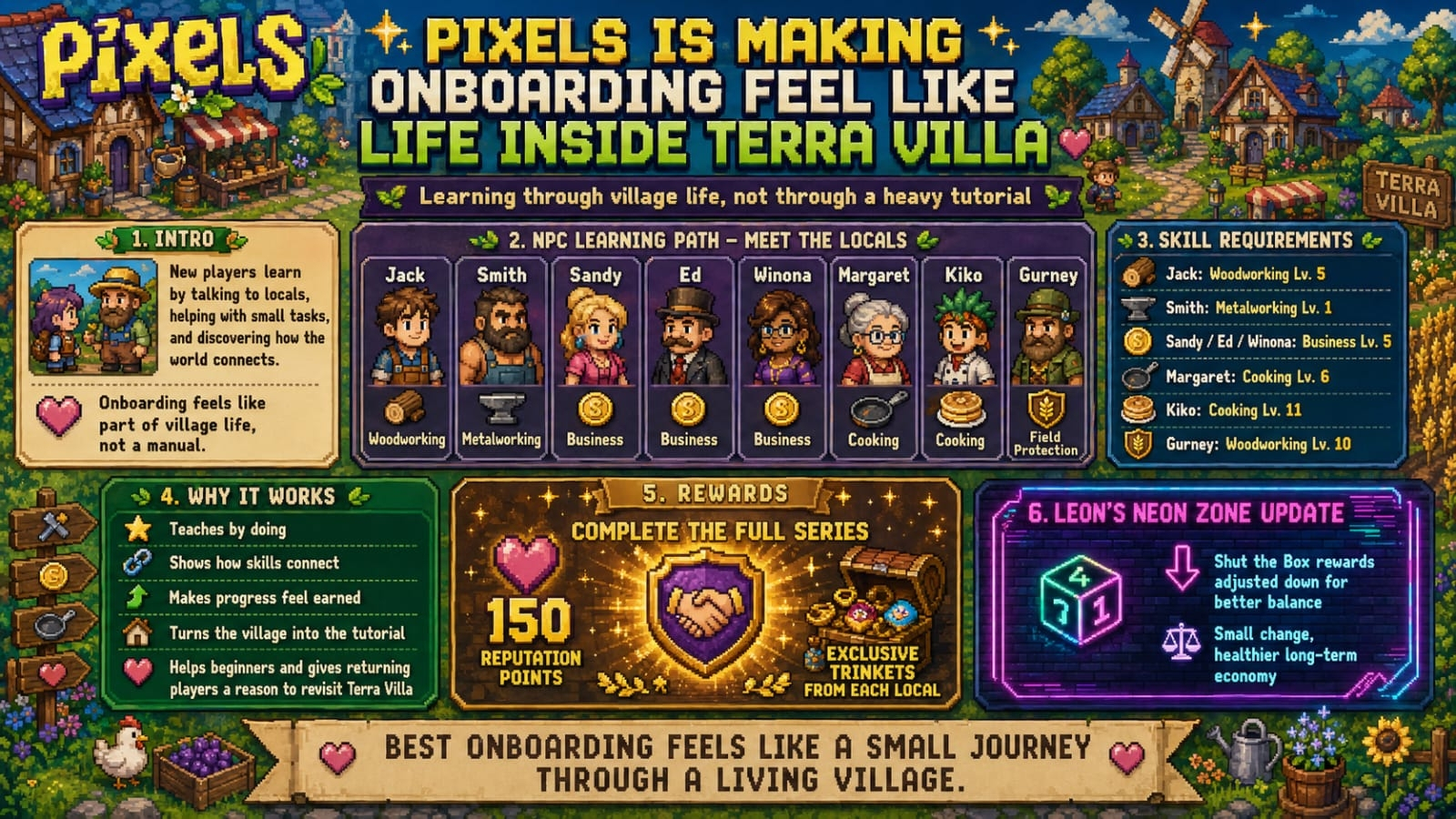
New players do not only need rewards. They need direction. They need a sense of rhythm. Most importantly, they need to feel that the world they are entering has a reason to exist beyond menus, tasks, and numbers.
That is why the new beginner-friendly quest series in Pixels caught my attention. It takes the basic idea of learning the game and turns it into a village experience. Instead of making newcomers feel like they are reading a manual, the game sends them around Terra Villa to talk to locals, help with small tasks, and slowly understand how different parts of the world connect.
Jack, Smith, Sandy, Ed, Winona, Margaret, Kiko, and Gurney are not just NPC names placed on a checklist. Each one represents a different part of the early Pixels experience. Jack brings players closer to woodworking. Smith introduces metalworking. Sandy, Ed, and Winona connect the journey to business activity. Margaret and Kiko move the player into cooking, while Gurney adds the feeling of protecting and caring for the fields.
To me, this is where Pixels understands its own identity well. The game is not only about farming or collecting resources. It is about learning loops. You gather, craft, cook, trade, complete tasks, earn reputation, and slowly understand how your time inside the world turns into progress.
A beginner quest line works best when it teaches these systems without making them feel like homework. This six-quest structure seems designed around that idea. The player is not just told what Pixels is. They are invited to participate in it.
The order of the quests also feels practical. It does not throw everything at a newcomer at once. It gives the player a path. First, they begin with smaller village interactions. Then they move through different skills and requirements. Woodworking, metalworking, business, cooking, and field-related tasks all enter the journey step by step.
That matters because in Pixels, small actions are often connected to bigger systems. A new player may think they are only helping Jack or Margaret with a simple favor, but behind that task they are learning how skill levels work, how quest chains are structured, how progression gates appear, and how reputation fits into the wider village economy.
The skill requirements make this even clearer. Jack’s quest needs Woodworking Level 5. Smith’s quest starts with Metalworking Level 1. Sandy, Ed, and Winona’s quest requires Business Level 5. Margaret’s quest needs Cooking Level 6. Kiko’s quest goes further with Cooking Level 11. Gurney’s quest asks for Woodworking Level 10.
This kind of structure gives the player a reason to build more than one skill. It shows that Pixels is not designed around one isolated activity. Progress comes from understanding how different parts of village life connect. You cannot simply rush through everything without engaging with the systems. You need to spend time with the world.
I think that is healthier than instant completion. When a game gives players everything too quickly, progress can start to feel empty. But when the player has to build a skill, return to a task, and slowly unlock the next step, the experience becomes more memorable. It feels earned.
The prerequisites also give the series a stronger sense of direction. Jack’s quest connects to “Should-a, Wood-a, Could-a,” while Smith’s quest connects to “That’s so METAL!” On top of that, each quest needs the previous one to be completed before the full series can move forward. That makes the update feel less like six random errands and more like a proper guided path through Terra Villa.
For new players, this can reduce confusion. For returning players, it creates a reason to revisit basic systems with a clearer purpose. That is important because live games need both groups. They need fresh players who can enter without feeling lost, and they need older players who still find small reasons to stay connected to the world.
The reward design also feels fitting. Completing the full series gives 150 Reputation points, while each local gives an exclusive trinket as a token of appreciation. I like that combination because it balances measurable progress with personal memory.
Reputation gives the player something clear to track. Trinkets make the experience feel more human. A reward from Jack, Margaret, or Gurney is not just another item. It becomes a reminder that the player helped someone inside the village. That small emotional layer is important because without it, every action can start to feel like a spreadsheet.
Pixels works best when the world feels lived in. The charm of Terra Villa is not only in the tasks themselves, but in how those tasks make the player feel connected to the place. Talking to locals, helping them, receiving small tokens, and moving through different skills makes onboarding feel warmer than a standard tutorial screen.
Kiko’s “Patience Meets Pancakes” especially feels like the kind of quest name that fits this world. It sounds playful, but it still connects to progression through cooking. By the time a player reaches that point, they are not just clicking through early tasks anymore. They are beginning to understand how preparation, skill-building, and patience matter inside Pixels.
Gurney’s “Guardians of the Fields” also feels like a strong part of the chain because it brings the player back to one of the most recognizable parts of the game: the land. In Pixels, fields are not just background decoration. They are tied to production, routine, and the overall feeling of village life. Ending with a field-related quest makes the series feel grounded.
There is also a small but important update around Leon’s Neon Zone. Rewards for the next leaderboard cycle have been adjusted down, bringing Shut the Box more in line with other games. This may not sound like the most exciting part of the update, but balance changes matter in a live economy.
If one activity becomes too rewarding compared to others, player behavior can quickly become distorted. People naturally move toward the most efficient reward path. Over time, that can make the wider game feel less balanced. Adjusting rewards is not always popular in the short term, but it can be necessary for healthier long term design.
From my perspective, this update feels less like a flashy expansion and more like careful village maintenance. That is not a weakness. It is actually the kind of update that helps a live game stay readable, fair, and welcoming.
The beginner quests help players learn by doing. The reputation rewards give direction. The trinkets add personality. The NPC interactions make Terra Villa feel active. The leaderboard adjustment shows that Pixels is still paying attention to balance across different activities.
What stands out most to me is that Pixels is not treating onboarding as a separate layer outside the game. It is making onboarding part of the world itself. You learn woodworking by helping Jack. You learn metalworking through Smith. You explore business, cooking, pancakes, and field protection by interacting with people who already feel like part of the town.
That is a more natural way to introduce players to a game economy. It does not say, “read this and understand everything.” It says, “walk through the village, talk to people, help where you can, and learn as you go.”
For me, that is where Pixels feels strongest. Progress does not need to feel loud to be meaningful. Sometimes the best kind of onboarding is not a tutorial at all. It is a small journey through a living village, where every local teaches you something and every task makes Terra Villa feel a little more familiar.
