
When first time I watched a project throw rewards at users like cheap flyers in a wet street, I had the same thought I get when retail celebrates unlocks: this is not growth. This is panic with a budget. People don’t stay because they got free tokens once. They stay when the product keeps hitting the right nerve at the right time, and @Pixels ’ Stacked idea sits right on that nerve.
I’m not looking at this as another reward layer. That word has been beaten into dust by every campaign that paid farmers to pretend they cared. I’m looking at it as a behavior machine. The real question is simple, can PIXEL learn what a user is likely to do next, then give them a reason to do it without making them feel bought? That gap is where LTV lives. Not in loud drops. Not in fake activity. In repeat action.
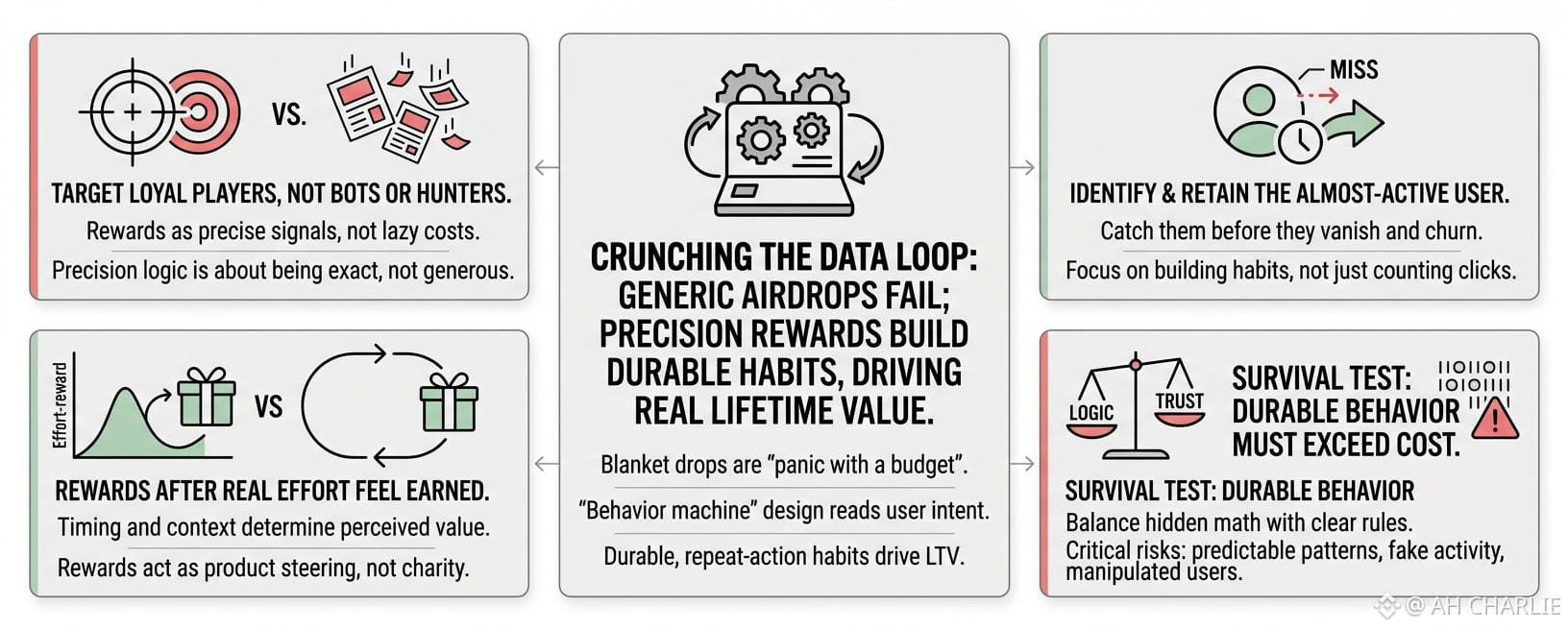
Blanket airdrops feel fair from the outside. They treat a loyal player, a bored wallet, a bot farm, and a one-day hunter like they all carry the same value. They don’t. One user might need a small push after three strong sessions. Another might need a reason to return after fading out. A third might already be hooked and should not be overpaid like a stranger at the door.
This isn't just a whitepaper theory; it is infrastructure built in production. While most projects lie to themselves with colorful dashboards, the receipts for Stacked are hard to ignore: over 200M+ rewards processed across millions of players and more than $25M+ in revenue generated. This data is useful because Stacked can read the "messy" human behavior without turning the whole thing into a coupon machine.
I’d call the best user here the “near-repeat user”. The person who almost comes back, almost builds a habit, almost becomes worth keeping. That person is where smart reward design matters. Better projects catch the almost-active user before they vanish.
If I finish a hard task and get something that helps my next move, I may come back. If I log in once and get a bag for breathing, I learn nothing except that the project is leaking value. Precision incentives aim for more repeat sessions, cleaner spend, and less waste.
Five years out, the endgame is reward routing. Every product with live user data will need a way to price behavior in real time. PIXEL’s Stacked idea points toward that world: a system where rewards act like product steering, not charity. Wait a sec... this thing can fail hard.
If the model rewards fake activity, farmers will eat it alive. If loyal users feel manipulated, trust breaks. If the reward math spends more than the user brings back, LTV turns into a bedtime story for stakeholders.
The survival test is simple, does each reward create more durable behavior than it costs? If Stacked can’t prove that at cohort level, it is just a prettier faucet with extra steps. People tolerate uneven rewards when they believe effort, timing, or need shaped the outcome.
Stacked only matters if it makes @undefined better at reading intent, not just better at spending budget. The right reward is not the biggest one. It is the one that arrives just before the user would have left, or just after they proved they were worth keeping. The reward is not the product. The habit is.
