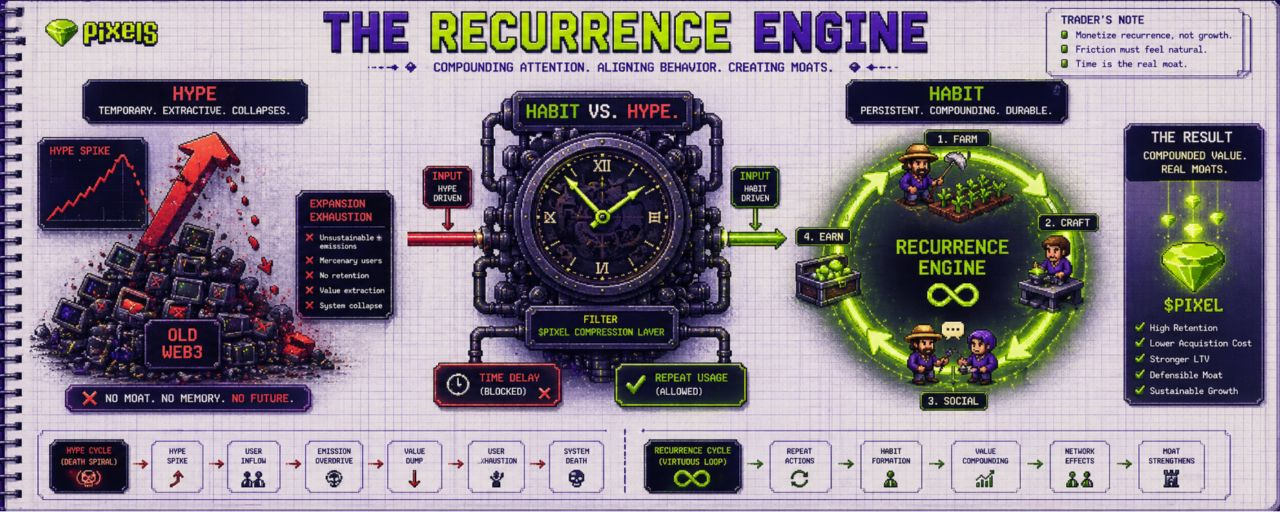
Je me souviens avoir regardé $PIXEL le lancement et avoir supposé que le modèle suivrait la trajectoire Web3 standard : acquisition agressive d'utilisateurs, un pic d'engouement massif, et une recherche désespérée de "nouveau sang" pour maintenir le plancher. Mais après avoir audité le flux comportemental du Chapitre 3, j'ai réalisé que l'équipe a construit quelque chose de beaucoup plus contre-intuitif. Ils ne monétisent pas la croissance. Ils monétisent la récurrence.
Le piège de l'expansion sans fin
La plupart des projets GameFi meurent parce qu'ils reposent sur le "mythe de l'expansion" - l'idée qu'il faut toujours plus de joueurs qu'hier. Cela crée une économie fragile où le token devient une dépense marketing plutôt qu'une utilité.
Pixels a discrètement changé de cap. Au lieu de se concentrer sur le nombre de nouveaux portefeuilles entrant dans le système, celui-ci est conçu pour mesurer combien de fois un portefeuille existant rencontre une Friction Naturelle. En termes d'UI/UX, c'est le passage de la "Conversion" à la "Formation d'Habitudes". L'objectif n'est pas de vous faire dépenser une fois ; c’est de rendre l'acte de sauter un délai de 30 secondes comme une décision rationnelle et répétable.
Friction en tant que Moteur Économique
Nous voyons souvent "friction" comme un échec de conception. Dans Pixels, la friction est le produit.
Le Cap d'Énergie : Une limite sur votre production.
Le Minuteur de Fabrication : Une limite sur votre vitesse.
La Coordination de l'Union : Une limite sur votre pouvoir en solo.
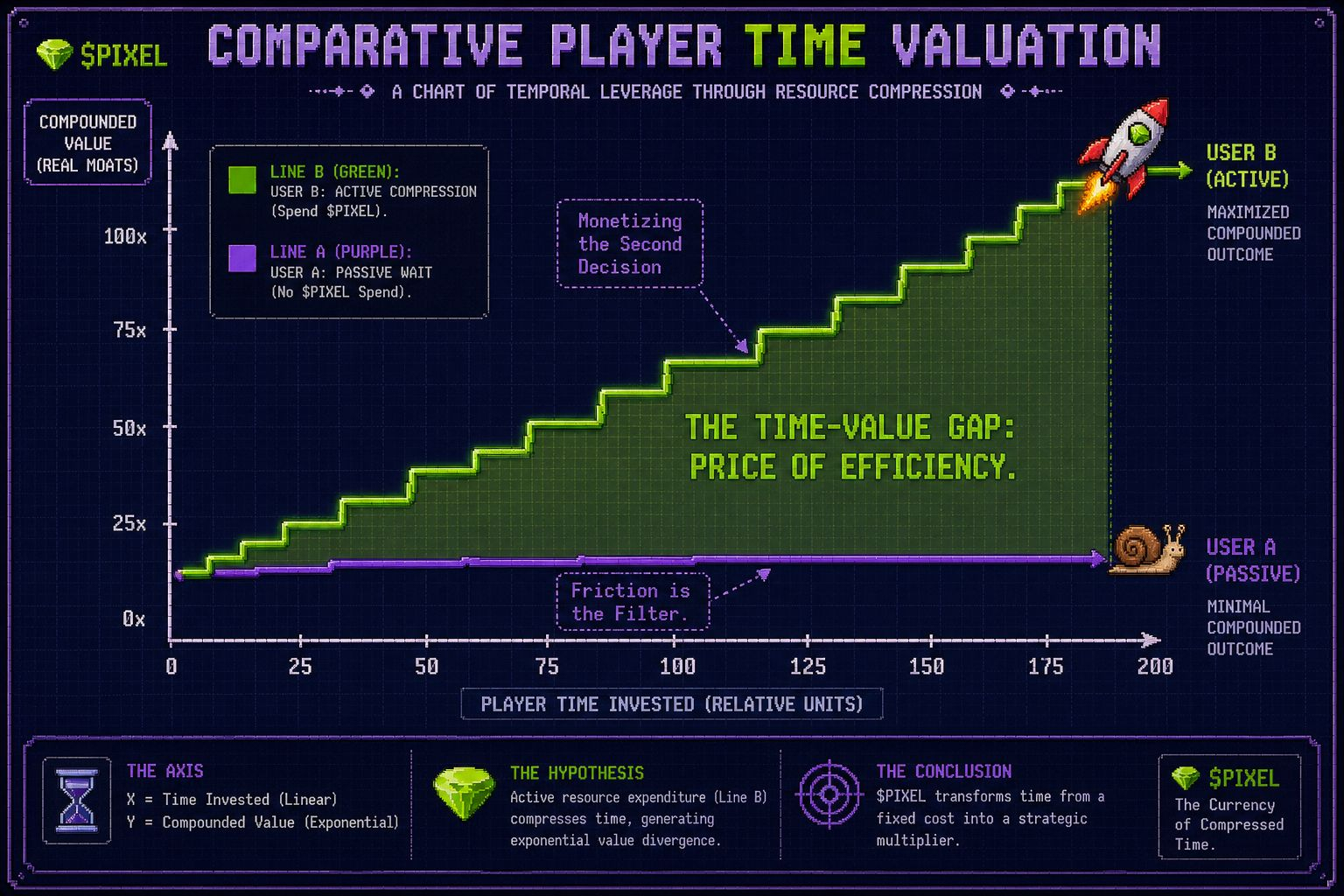
Si le jeu devient trop fluide, la raison de conserver ou de dépenser $PIXEL disparaît. Le "Fossé" ici n'est pas une fonctionnalité technique ; c’est la Calibration Mathématique de l'Inconvénient. Le jeton ne vous vend pas "Succès" ; il vous vend "Compression". Il vous permet de comprimer une session de 2 heures en 15 minutes de jeu à haute efficacité.
De l'Hype à la Routine : Le Plateau de Stabilité
En tant que trader, je surveille la Probabilité de Récurrence. Dans P2E 1.0, dépenser était un "investissement" unique (acheter un NFT). Dans Pixels, dépenser est un "coût opérationnel" récurrent (OpEx).
Cela crée un type de courbe de demande différente, moins explosive mais infiniment plus durable. La valeur du jeton est ancrée à la valeur du Temps Structuré d'un joueur.
Le système marche sur un fil. Si la friction semble artificielle, comme un mur "pay-to-win", la confiance se brise. Mais si la friction semble faire partie naturelle de la physique du monde, le dépense semble être une optimisation. En ce moment, Pixels prouve que l'Habitude est un collatéral plus fort que l'Hype.
L'Économie de la Deuxième Décision
Le succès de $PIXEL ne se trouvera pas sur un graphique d'utilisateurs actifs quotidiens. Il se trouve dans les données de la Deuxième Décision - le moment où un joueur, ayant déjà joué pendant 30 jours, décide que son temps vaut encore la compression.
Pixels ne construit pas un jeu ; ils construisent une Utilité Comportementale. Dans un monde de bruit généré par l'IA infini, un système capable de commander une routine humaine est la seule chose qui reste rare.
Arrêtez de regarder les chiffres d'intégration. Commencez à surveiller les boucles.