
I started noticing that some players seemed to be moving through the same world without really living inside the same system
On the surface everything looked identical
The same fields The same routines The same quiet repetition of planting harvesting walking and returning
From a distance it looked like a simple world built around patience A soft economy of time where progress felt visible enough to trust You spend energy You gather resources You convert motion into something that resembles advancement
That part feels familiar almost intentionally familiar It gives the impression that nothing is being hidden That effort remains visible That time still has a direct relationship with reward
But after staying inside it for a while something began to feel harder to explain
Not broken Not deceptive in an obvious way Just layered in a way that does not reveal itself immediately
Because in Pixels the visible game is not always the system that determines value
The farming loop is easy to understand because it was designed to be Coins move through the world constantly Tasks appear Materials circulate Small rewards arrive often enough to make activity feel meaningful And for a while that is enough to make the environment feel stable
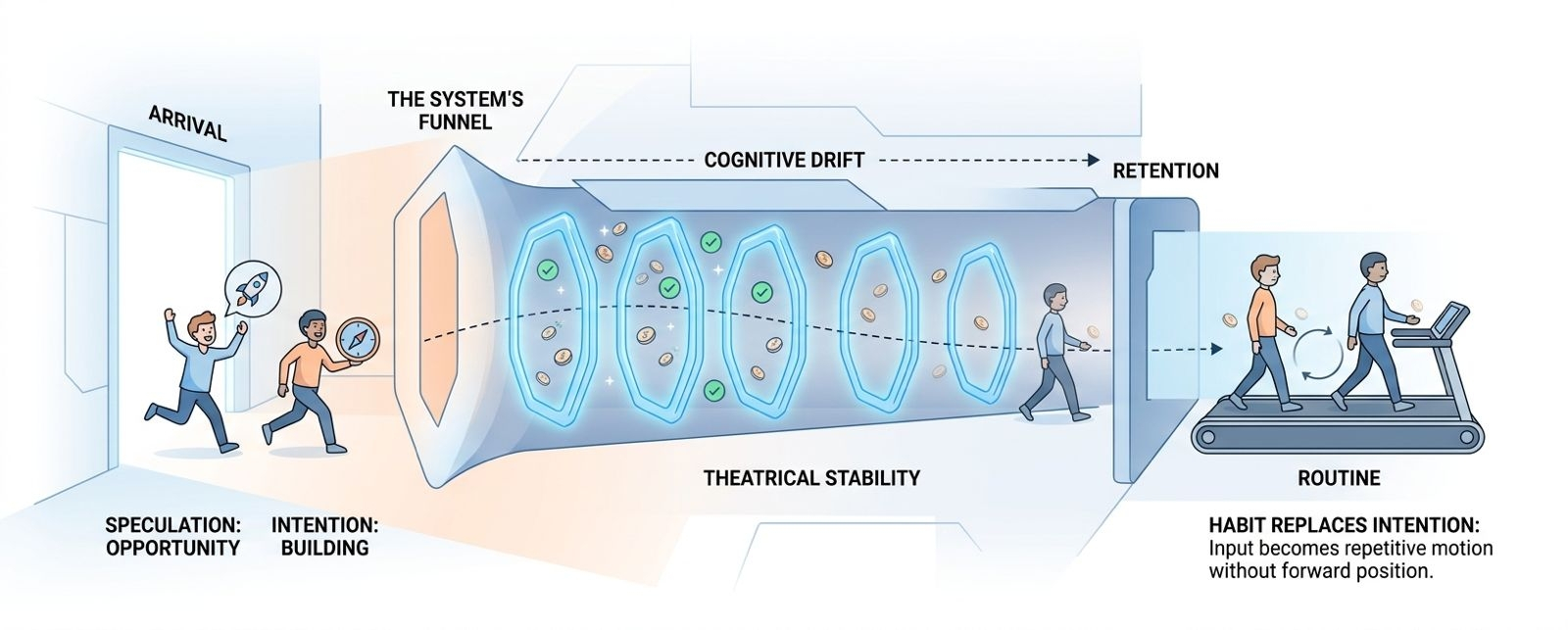
But stability in a system like this can sometimes be theatrical
The more time I spent watching how people moved through the economy the more it became clear that some actions were only execution They created movement without necessarily creating permanence
Players could spend hours inside the same routines and still leave with very different outcomes Not because one worked harder Not because one understood the mechanics better in a traditional sense But because the system seemed to recognize certain behaviors differently
That is where the distinction starts becoming difficult to ignore
There is the world people interact with And then there is the system that decides what that interaction becomes
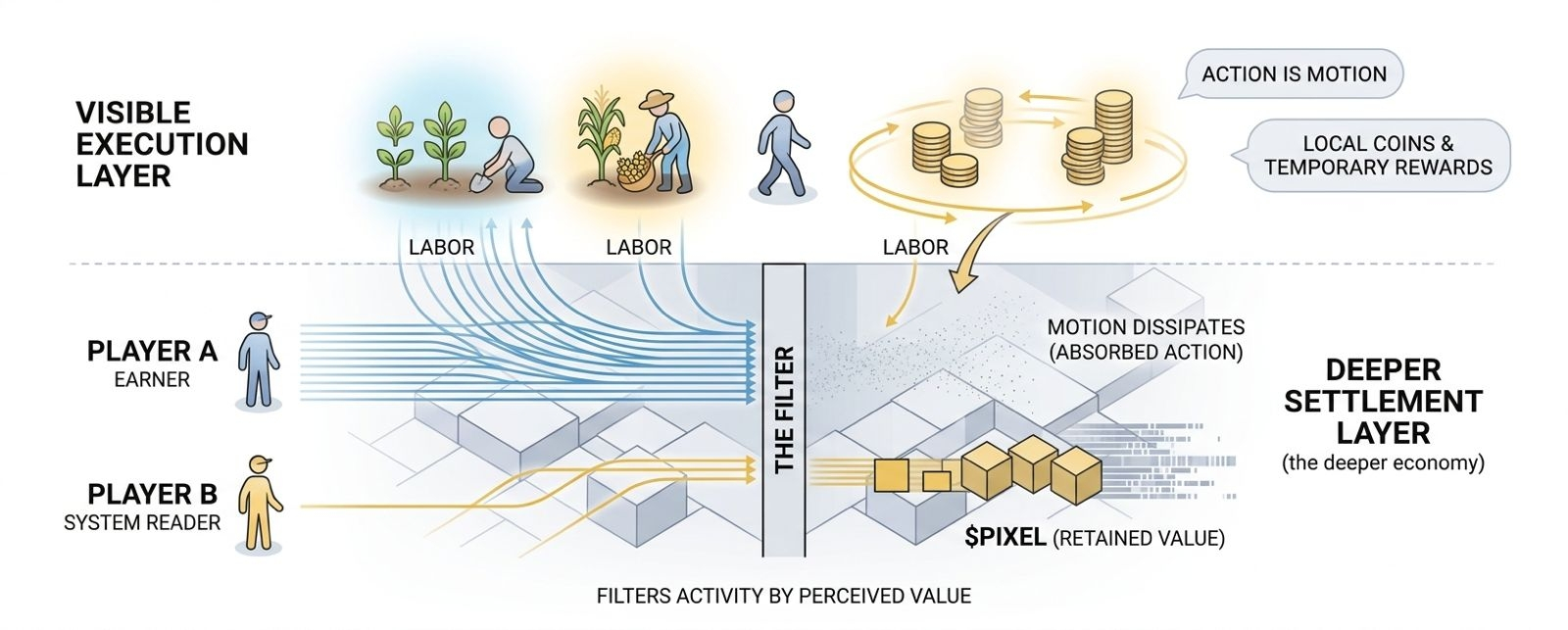
The gameplay itself feels like an execution layer It is where actions happen Where labor is performed Where motion becomes visible
But the deeper economy feels more like a settlement layer That is where certain actions stop being temporary That is where some effort converts into something that can persist beyond the immediate loop
Coins often feel local They belong to the moment They help continue the cycle They maintain participation
PIXEL feels different Not simply because it exists as a token But because it acts like a filter between activity and retained value
That distinction changes the meaning of everything above it
Because once value is filtered through a deeper layer the question is no longer whether someone is active The question becomes whether the system considers that activity worthy of carrying forward
And those are not the same thing
Some players still approach the world as if repetition alone is enough They treat the game as a machine where more input should eventually create more output That logic makes sense in ordinary games It even feels fair
But Pixels does not always behave like a fair machine Sometimes it behaves more like a responsive market
And markets rarely reward effort in a clean way
Two players can spend the same amount of time inside the same environment and still emerge with entirely different forms of value One leaves with motion The other leaves with position
That difference feels small at first But over time it becomes the difference between participation and understanding
Some people are still earning Others are quietly reading
The earners tend to focus on visible loops The next crop The next task The next conversion The next reward
The system readers watch something else entirely
They watch supply They watch timing They watch scarcity before scarcity becomes obvious They notice when demand shifts before the crowd reacts They understand that movement inside the game is only one layer of participation
And slowly it becomes clear that the game may not be rewarding action as much as interpretation
That is where the social side of the ecosystem starts feeling more complicated than it first appears
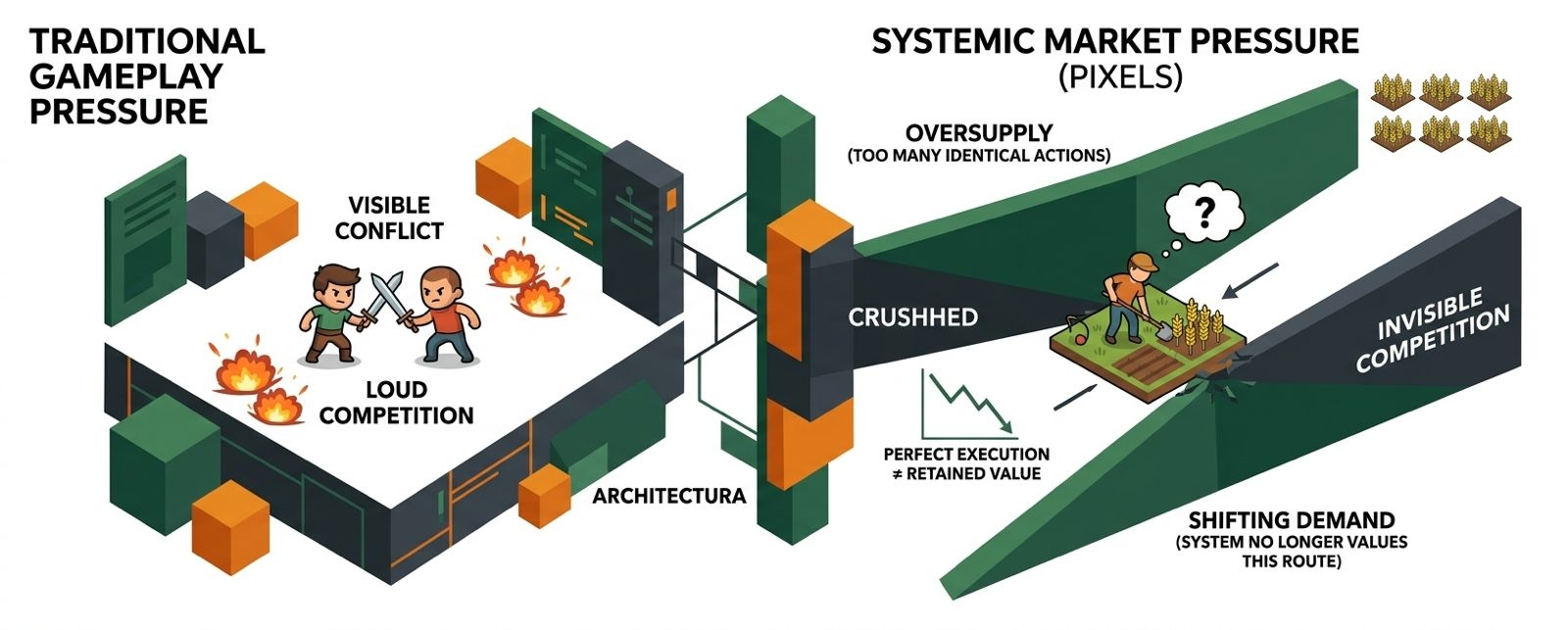
Because competition in Pixels rarely feels loud It often feels invisible
Nobody needs to attack anyone directly Nobody needs to announce that they are competing The economy does that quietly on its own
An oversupplied resource can lose meaning without warning A profitable route can disappear because too many people noticed it at once Prices can soften not because the game changed but because player behavior changed around it
That creates a kind of pressure that does not feel like traditional gameplay pressure
It feels closer to market pressure The kind that comes from being surrounded by other people who are making decisions that reshape the environment you thought you understood
And once that starts happening the world no longer feels like a passive place
It starts feeling selective
That may be the most interesting part of the system
Most actions do not fail in any obvious way The player still moves The task still completes The reward still appears
But some actions seem to disappear into the structure without becoming meaningful
They are absorbed Not rejected Just absorbed
And that creates a different kind of uncertainty
Because a system does not need to punish behavior to discourage it Sometimes it only needs to make certain behavior matter less over time
That subtle difference can completely change how a world feels
At first it feels like a game about farming Then it feels like a game about optimization Then eventually it starts feeling like something harder to define
A place where people arrive looking for opportunity And sometimes remain because routine quietly replaces intention
That transition feels more important than the token itself
Speculation can bring people into a system But habit is what keeps them there
And Pixels seems to be standing somewhere between those two forces Not fully one Not fully the other
There is still a visible question hanging over all of it
Whether the deeper economy can continue absorbing attention at the same pace that it creates supply Whether utility can keep expanding faster than expectation Whether the connective layer beneath the game can remain meaningful if too many people begin treating it only as extraction
I do not think the answer is obvious yet
Because the system still works But there are moments when the logic underneath it feels more revealing than the world itself
And once that becomes visible it is difficult to look at the experience the same way again
At some point it stops being about what you do and starts being about what the system allows to matter