
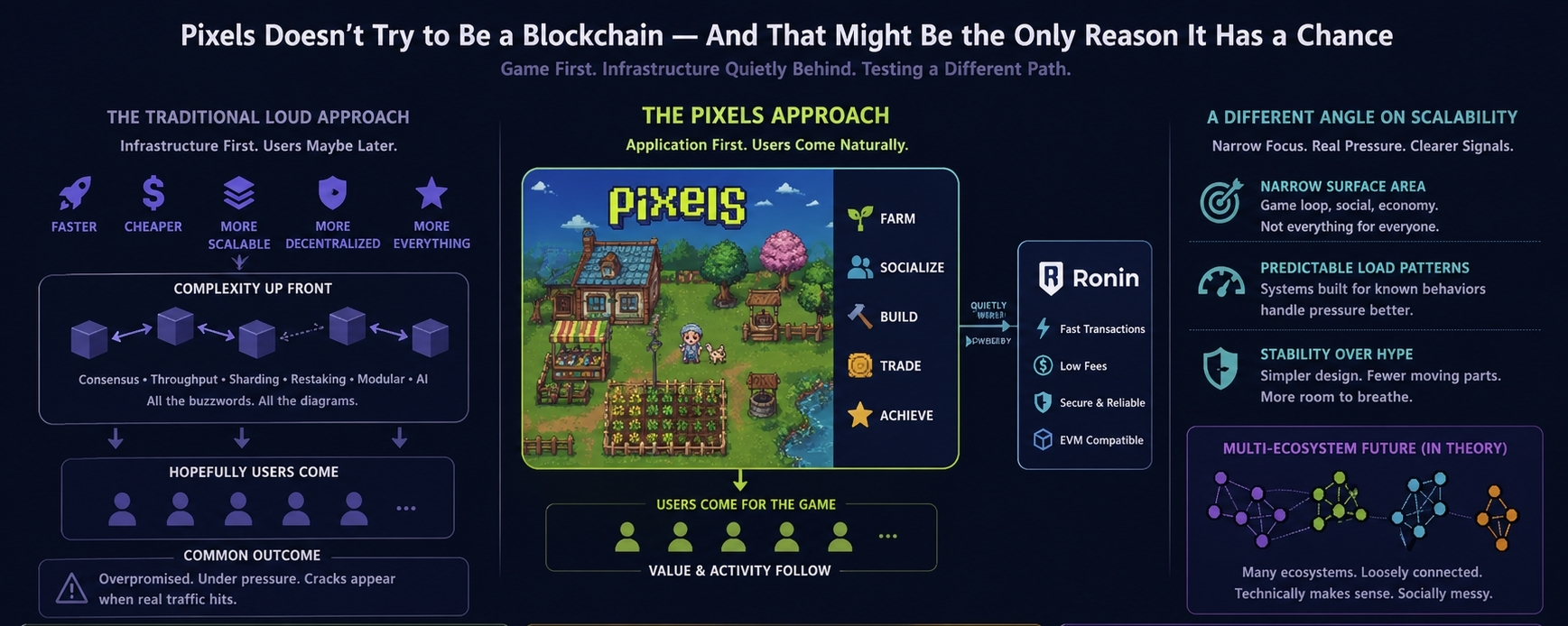
@Pixels The first time I looked at Pixels, it didn’t really register as “a chain thing.” It just felt like a game. That’s already a bit unusual. Most projects that try to position themselves anywhere near infrastructure make sure you feel it—there’s always some emphasis on throughput, consensus, some diagram with arrows moving around. Here, it’s quieter. Farming, wandering, building small loops of activity. It almost hides the fact that underneath, it’s tied into something bigger with the Ronin stack. And maybe that’s the point, or maybe it’s just presentation. Hard to tell at first glance.
I’ve been around long enough to remember when every new Layer 1 came with the same energy. Faster than the last one. Cheaper than the last one. More scalable, more decentralized, more everything. It becomes noise after a while. You start to recognize the pattern before you even finish reading the whitepaper. And now there’s a newer layer on top of that—AI this, modular that, restaking everywhere. It all starts blending together. So when something like Pixels sits slightly off to the side, not screaming “we are the next base layer of the internet,” it catches attention in a different way. Not because it’s louder, but because it’s oddly quiet.
Still, calling anything a Layer 1—directly or indirectly—means it eventually runs into the same problem. Not theory. Not design. Traffic. Real users doing real things at the same time. That’s where systems stop being elegant and start being exposed. It’s easy to look smooth when activity is light and predictable. It’s much harder when everything happens at once, when people pile in because something finally clicks. That’s the moment most chains reveal their weak spots.
You can see it if you’ve watched something like Solana over time. When it’s working well, it feels almost invisible. Fast, responsive, cheap enough that you stop thinking about cost entirely. But it has also had moments where the system just… struggled. Not constantly, not disastrously every time, but enough to remind you that scale isn’t just a number on a roadmap. It’s behavior under pressure. And pressure doesn’t announce itself politely.
Pixels, in a strange way, feels like it’s testing a different angle on that same problem. Instead of trying to be everything at once, it narrows the surface area. A game loop. Social interactions. A contained economy. It’s not pretending to host the entire financial system or every application category at the same time. That constraint might be intentional. Or it might just be the natural shape of a game that grew into something larger than expected. Either way, it changes the kind of load you’re dealing with.
There’s this ongoing idea floating around that the future won’t be one dominant chain, but a patchwork of ecosystems. Each handling its own kind of activity, loosely connected. It sounds reasonable when you say it out loud. But then you think about liquidity, user behavior, habits. People don’t move easily. Capital moves even less easily unless there’s a very clear reason. Fragmentation makes sense technically, but socially it’s messy. Always has been.
Pixels seems to notice something small but important in that mess. Most projects assume users will come because of the chain. Better fees, better speed, better whatever. But here, the chain is almost an afterthought. The draw is the game itself. The loop. The reason to log in. That flips the usual order. Instead of infrastructure pulling users in, the application quietly brings them along. It’s not a new idea, but it’s one that’s been awkwardly executed in most cases. Either the game isn’t good enough, or the blockchain part gets in the way.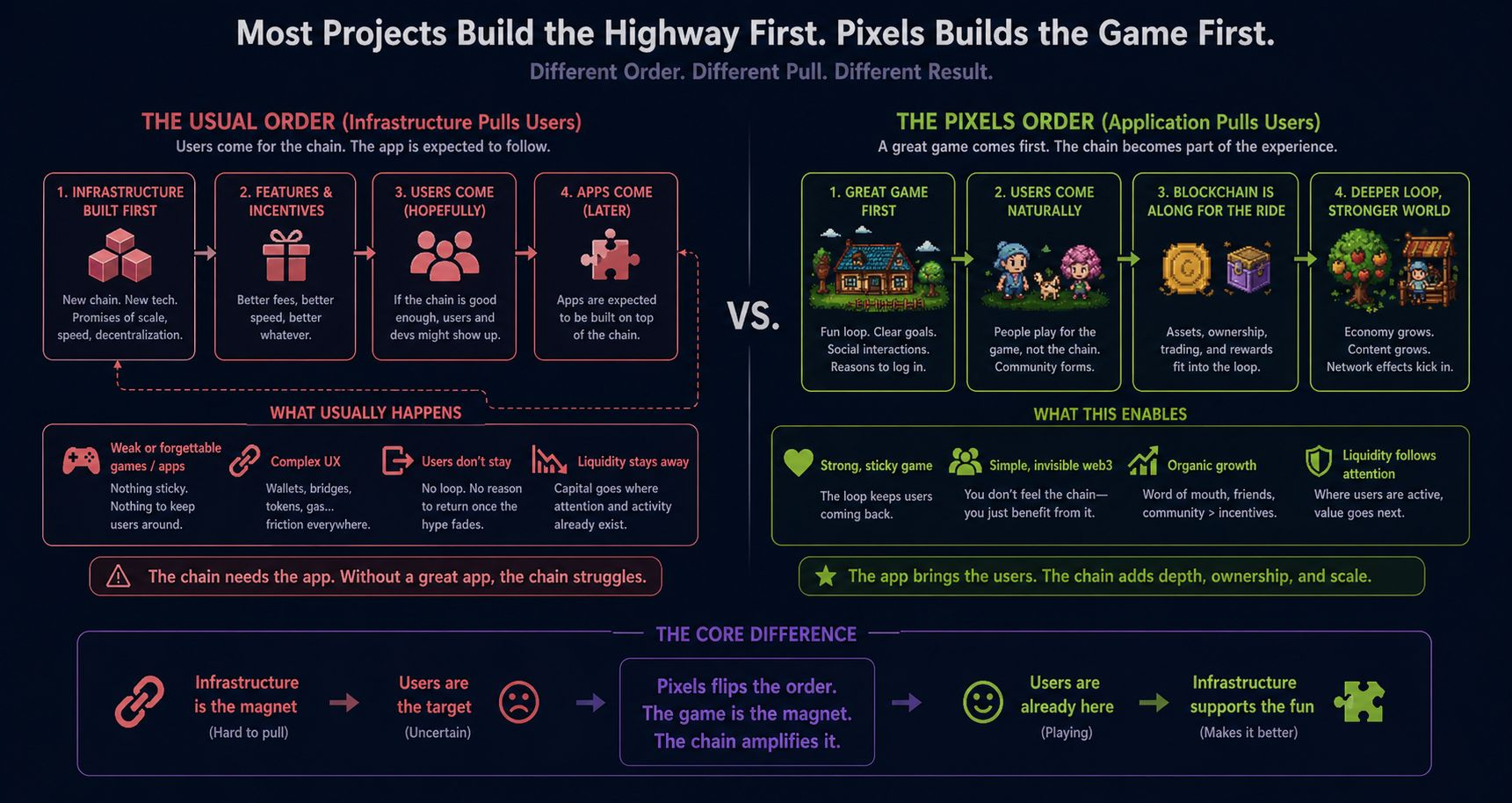
There are trade-offs here, obviously. By focusing on a specific kind of experience, you give up generality. You’re not trying to support every possible use case. You’re not optimizing for infinite composability or abstract financial primitives. You’re simplifying. Maybe even ignoring certain things on purpose. That can look limiting from the outside. But sometimes limitation is what keeps systems stable, at least early on.
The harder question is adoption, and that’s where things usually get uncomfortable. Will people actually move? Not just sign up, not just try it once, but stay. Build habits. Bring value with them. And beyond that, will liquidity follow? Or will it remain where it already sits, circling the same established networks because that’s where everything already is? Switching costs are real, even when they’re not obvious.
I don’t have a clean answer for that. Nobody really does. You can see moments where something like Pixels catches attention, pulls in users, creates activity that feels organic instead of forced. And then you also see how quickly attention shifts in this space. What feels alive one month can feel empty the next if momentum slips even slightly.
Still, there’s a small part of this that feels… grounded. Not revolutionary, not world-changing, just practical. Build something people might actually use, let the infrastructure sit behind it instead of in front of it, and see what happens under real conditions. It’s not a guaranteed path. It might not even be a scalable one in the long run. But it’s at least testing the right kind of pressure.
I don’t think Pixels is trying to be the next big chain in the loud, obvious way. And maybe that’s why it’s worth watching a little more closely than the ones that are.
It might work. Or nobody shows up.
