
Global crypto liquidity is no longer expanding uniformly; it is stratifying. Since the approval cycle of spot ETFs in major jurisdictions, capital has increasingly concentrated into high-liquidity, low-volatility instruments—primarily BTC and, secondarily, ETH. This has created a structural vacuum in mid-cap and long-tail assets, where capital is no longer passively rotating but selectively deploying based on durability of yield, retention mechanics, and narrative alignment. Within this environment, gaming tokens face a higher bar: they must not only attract users but structurally retain capital.
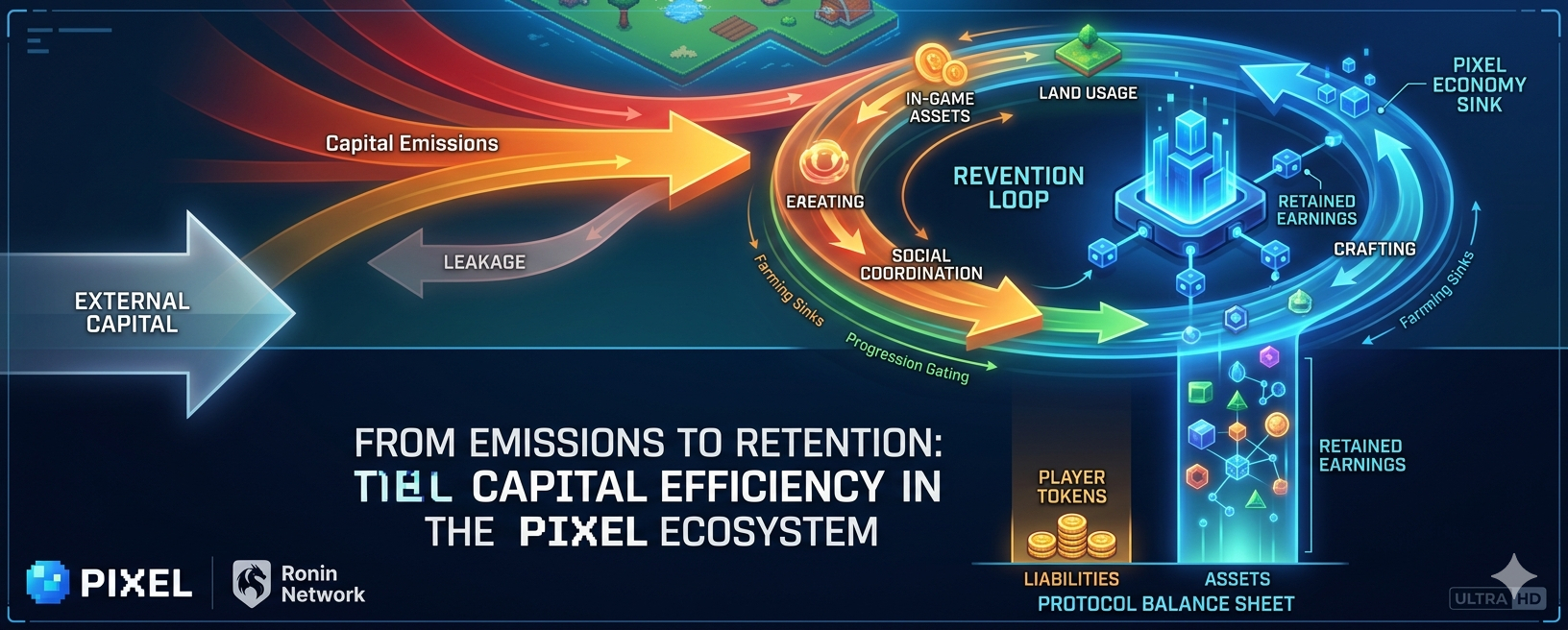
The Web3 gaming sector has historically functioned as a liquidity router rather than a sink. Capital enters through token speculation, distributes via emissions to players, and exits through sell pressure. This “open-loop economy” has defined the failure mode of most GameFi cycles. Pixels (PIXEL), operating on the Ronin Network, attempts to invert this model by constructing what can be described as a closed-loop liquidity sink—an economy where capital is continuously recycled within the system through behavioral incentives rather than extracted.
This structural bottleneck—capital leakage through unsustainable emissions—is the central problem Pixels addresses. Traditional play-to-earn models externalize value too quickly, while Pixels introduces friction layers through farming, crafting, land usage, and social coordination. These mechanics are not merely gameplay features; they are capital retention tools. By requiring time, coordination, and resource reinvestment, the system reduces immediate token velocity.
From a technical architecture standpoint, the choice of Ronin Network is not incidental. Ronin operates as a purpose-built gaming chain with optimized transaction throughput and minimal fees, enabling high-frequency micro-interactions without economic friction. This is critical because the effectiveness of a liquidity sink depends on how often capital is cycled internally. High gas environments break this loop; Ronin preserves it. Additionally, Ronin’s historical association with Axie Infinity provides a pre-existing user base familiar with tokenized gaming economies, reducing onboarding friction and increasing initial liquidity density.
The PIXEL token itself functions as both a medium of exchange and a coordination primitive. Its supply dynamics are structured around emissions tied to gameplay activity, but unlike first-generation GameFi tokens, these emissions are partially counterbalanced by sinks embedded in progression systems. The emission sustainability curve here is not flat; it decays as user progression increases. Early-stage players receive higher relative rewards, but as they advance, capital requirements rise, forcing reinvestment. This creates a pseudo-bonding curve of engagement, where deeper participation locks more capital.
A useful framework to interpret this is the “protocol balance sheet analogy.” In this model, player-held tokens represent liabilities, while in-game assets and locked capital represent retained earnings. Pixels attempts to grow its retained earnings faster than its liabilities expand. If successful, this creates a structurally solvent in-game economy where token price stability is supported by internal demand rather than external speculation.
Incentive alignment across stakeholders is where the design shows both strength and fragility. Players are incentivized to remain active through progression gating and social mechanics, landowners benefit from network effects as more players utilize shared spaces, and developers retain control over emission tuning. However, this alignment is highly sensitive to user growth velocity. If new user inflows slow, the system risks entering a reflexive contraction phase where reduced activity lowers rewards, which in turn reduces engagement.
Comparatively, Pixels positions itself against both legacy GameFi projects and emerging modular gaming infrastructures. Unlike Axie Infinity, which suffered from hyperinflationary tokenomics, Pixels introduces more granular sinks. Against newer modular ecosystems that emphasize composability and interoperability, Pixels trades flexibility for coherence. It is not attempting to be a platform layer; it is building a vertically integrated economy. This limits extensibility but strengthens internal capital loops.
The broader sector context further complicates its positioning. The rise of restaking and yield-bearing primitives in DeFi introduces alternative opportunities for capital deployment with clearer return profiles. Similarly, the AI x crypto narrative is capturing speculative attention, diverting liquidity away from gaming. Pixels must therefore compete not just within GameFi but across all on-chain yield opportunities. Its advantage lies in experiential yield—engagement-driven value rather than purely financial return—but this is harder to quantify and less attractive to institutional capital.
Regulatory pressure also plays a non-trivial role. As token classifications become more scrutinized, gaming tokens that blur the line between utility and financial instrument may face constraints. Pixels mitigates this partially by embedding its token deeply into gameplay mechanics, but the risk remains that external regulation could impact liquidity access or exchange listings.
Reflexivity within the PIXEL economy is likely to manifest through user growth and social virality. As more players join, land values increase, resource scarcity intensifies, and token demand rises. This creates a positive feedback loop. However, the inverse is equally true. A decline in active users can rapidly unwind these dynamics, exposing the system’s dependence on sustained engagement.
Over multiple cycles, the durability of Pixels will depend on its ability to evolve its sinks faster than its sources. Emissions can always be adjusted, but if sinks do not scale in complexity and desirability, capital will eventually leak. The project’s long-term viability is therefore less about initial design and more about iterative economic governance.
In a market increasingly defined by capital efficiency and retention, Pixels represents a deliberate shift from extraction to circulation. Whether this closed-loop system can withstand the pressures of broader crypto capital rotation remains an open question, but structurally, it is a more coherent attempt at solving the core inefficiencies of Web3 gaming economies.
