
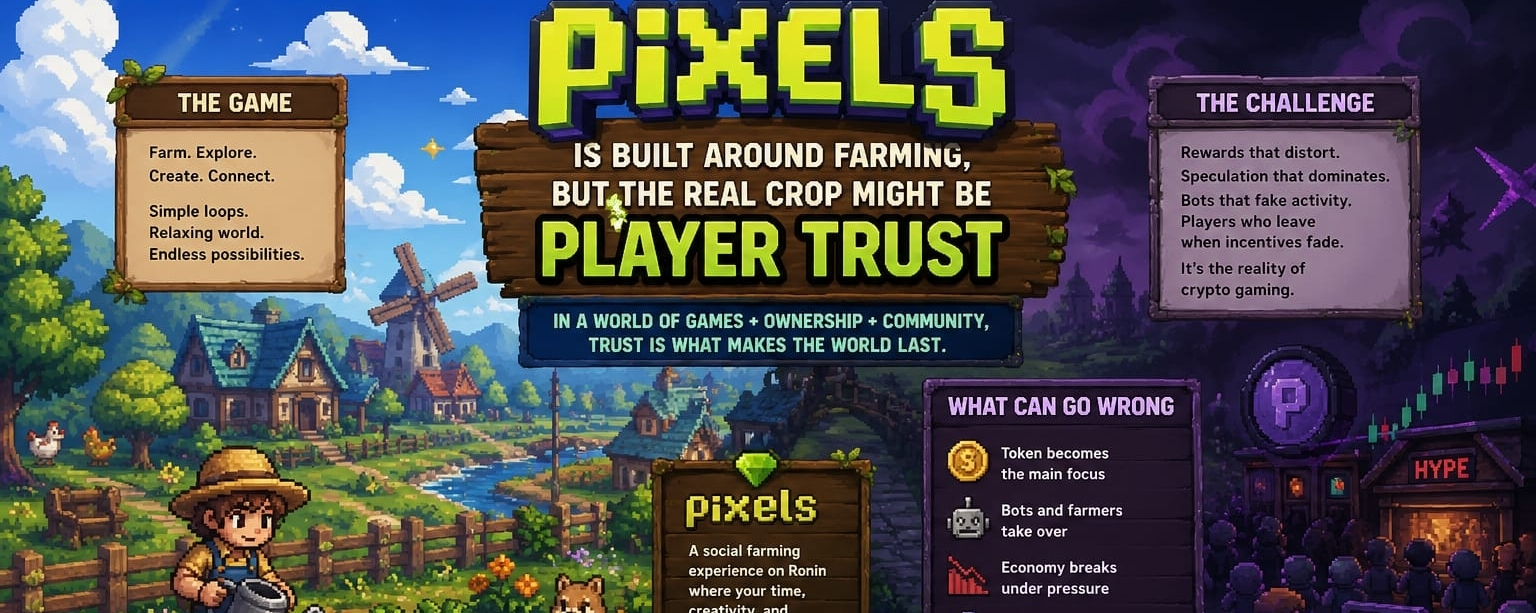

Pixels feels like one of those projects I don’t want to over-romanticize, because crypto gaming has already burned that word “promise” into the ground.
Look, we’ve been here before.
A game launches. There’s farming, land, items, a token, a community, some kind of economy. People start calling it the next big Web3 gaming moment. The timeline gets loud. Everyone suddenly becomes an expert on player ownership.
Then reality shows up.
The game is not fun enough. The rewards dry up. Bots flood the system. Real players get tired. The token becomes the whole conversation. And what was supposed to be a game slowly turns into a second job with worse UX.
That is the trauma Pixels has to deal with.
Not theory. Actual crypto memory.
Pixels is trying to build a casual social game around farming, exploring, creating, and interacting in a shared world. That sounds simple, but honestly, simple is not a bad thing. Crypto has spent years making everything too complicated. Sometimes you just want to plant something, collect something, build a little space, and not feel like you need a spreadsheet open on another monitor.
That part makes sense.
The thing is, gaming is one of the few areas where digital ownership does not sound completely forced. Players already care about digital stuff. They care about skins, land, resources, progress, status, little objects that mean nothing to outsiders but somehow matter when you spend enough time inside a world.
So when Pixels says, in its own way, that players should have more connection to what they build and collect, I get it.
I don’t worship it.
But I get it.
Because we’ve all played games where everything we earned only existed because some company allowed it to exist. One server decision, one policy change, one shutdown, and your little digital life is gone. Crypto people sometimes exaggerate this problem, sure. But the problem is real.
Pixels is trying to make that feel more open.
Not in some shiny “future of gaming” way.
More like: maybe the stuff you spend time on should not be completely trapped under someone else’s floorboards.
That is the good version.
The messy version is also obvious.
Once you add a token, people stop behaving normally. Some play. Some speculate. Some farm rewards. Some bot. Some pretend to care about the game while secretly caring only about exits. This is not an insult. It is crypto. We know how this works.
That is why Pixels has a hard job.
It has to be a game first.
Not a token with crops attached.
Not an airdrop funnel with cute art.
Not another place where people show up, extract whatever they can, and leave the actual players holding the emotional damage.
A casual farming game needs patience. Crypto does not have much patience. Players need steady content, balance, small improvements, reasons to come back. Token holders want noise. They want catalysts. They want announcements. They want the chart to move.
Those two groups are not always friends.
Honestly, that is where I think the real tension is.
Pixels being on Ronin makes sense. Ronin understands gaming better than most chains pretending they care about gaming this week. But Ronin also carries the Axie ghost. Everyone remembers what happened when play-to-earn became less about play and more about survival economics.
That history matters.
It does not mean Pixels fails.
It means Pixels does not get to act innocent.
Every Web3 game now has to prove it is not just another extraction loop wrapped in a nicer interface. Pixels has to prove that people want to be there even when rewards are boring. Especially then.
Because that is the test.
Can people open Pixels without checking the token?
Can they enjoy the world without calculating hourly value?
Can new users join without feeling like they missed the only profitable part?
Can the economy support the game without eating it alive?
These are not small questions. They are the whole mess under the hood.
And yes, the project may take time. Games are hard to build. Social games are even harder because you are not just designing mechanics, you are trying to create habits. A place. A rhythm. A reason for people to return when nobody is bribing them to return.
That is boring work.
Important work, but boring.
The infrastructure around it also has to stay quiet and reliable. Wallets, assets, marketplaces, transactions, onboarding, all that plumbing nobody wants to talk about until it breaks. If that stuff gets in the way, casual players will not care about the philosophy. They will just leave.
Because normal people do not want crypto pain inside a cozy game.
They do not want broken flows.
They do not want confusing tokens.
They do not want to feel like one wrong click turns relaxation into financial homework.
That is the danger.
Pixels has something real at the center of it. A social digital world where players build, farm, collect, and maybe own more of what they touch. That is not a fake problem. That is not empty hype. There is a reason people keep coming back to this idea.
But the execution has to stay honest.
The game has to matter more than the market.
The players have to matter more than the speculators.
The world has to feel alive without needing constant reward injections.
That is easy to say and hard to do.
Look, I’m not here to call Pixels perfect. It could get messy. The token could become too loud. Incentives could distort the user base. Bots could blur the numbers. The game could struggle to keep regular players once the crypto crowd gets distracted by the next shiny thing.
All possible.
But I also don’t think it should be dismissed just because crypto gaming has disappointed people before. Pixels is at least working in a direction that makes emotional sense. Casual play. Social loops. Ownership that could feel natural if it stays in the background.
That “if” is doing a lot of work.
Maybe Pixels becomes a decent example of Web3 gaming that does not feel like a casino wearing overalls. Maybe it becomes another reminder that adding tokens to games is like adding fire to a wooden house and hoping everyone behaves responsibly.
I don’t know.
For now, I’d treat Pixels like a real experiment, not a miracle. It is trying to solve a real pain in crypto gaming: making ownership and game economies feel useful without turning the whole experience into extraction.
That is worth watching.
Not worshipping.
Just watching, with tired eyes and reasonable doubt.