
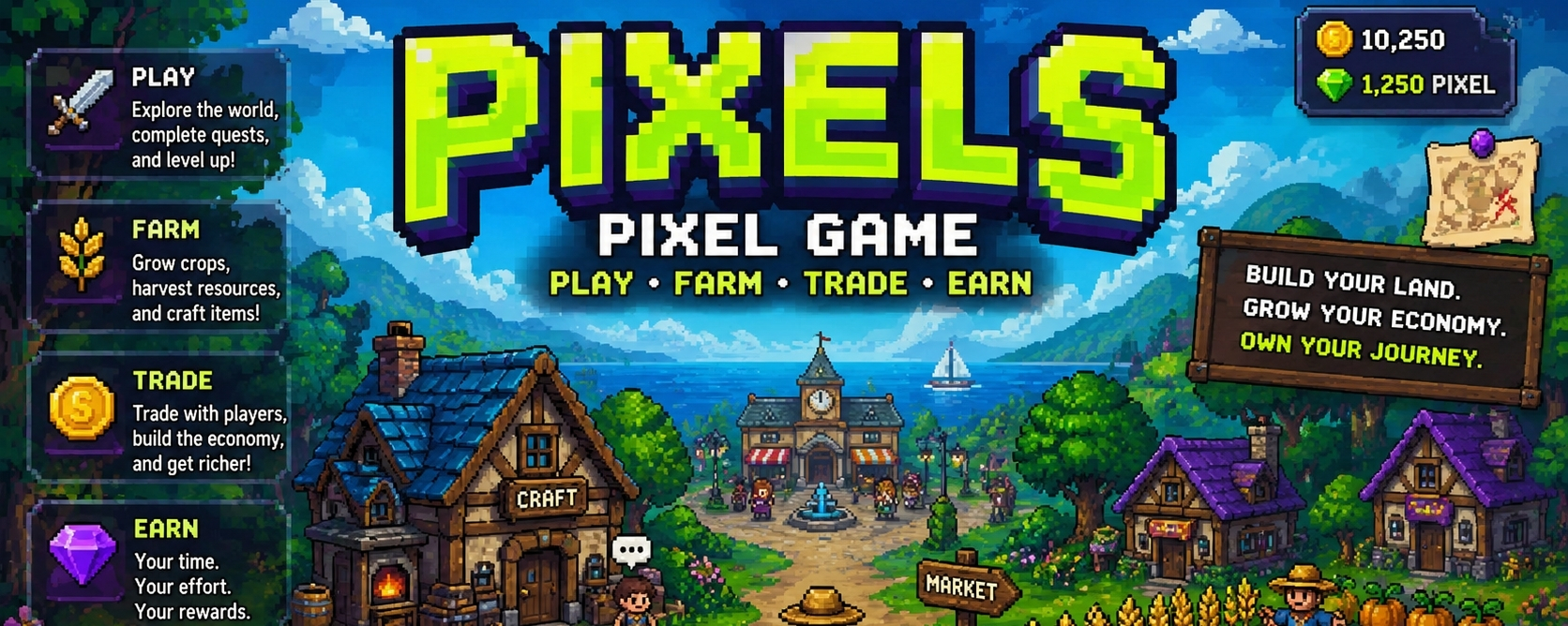

I Will Be Honest.....
I used to believe that if you put in the right effort inside a system, the outcome would eventually make sense. Work harder, optimize better, and results should follow. Simple. But after spending time observing play-to-earn environments, especially Pixels, that idea started to feel incomplete.
Yeah..There’s a strange moment in these systems when effort and outcome stop aligning cleanly. You can follow the same routine, repeat the same optimized loop, and still get slightly different results. Not failure, not randomness. just inconsistency that doesn’t fully explain itself. At first, I assumed it was my own inefficiency. That’s the default mindset in GameFi. If something feels off, you optimize harder.
But optimization only solved part of the puzzle.
The deeper issue is that most people still treat these systems like traditional games, where input leads to predictable output. In reality, many modern play-to-earn environments behave more like evolving economies. And economies don’t just reward activitythey respond to behavior patterns over time.
That’s where things start to get interesting.
In Pixels, the surface experience feels open and fair. You log in, farm, craft, trade, and slowly improve your loop. It doesn’t aggressively push monetization, which creates the impression that all actions carry equal weight. But after watching player behavior closely, I don’t think that’s actually true.
Some actions seem to “stick.” Others quietly fade.
Two players can invest similar time and effort, yet their outcomes feel very different. not just in rewards, but in how their progress compounds. One player’s actions seem to build on themselves, becoming more meaningful over time. Another stays trapped in cycles that look productive but don’t really carry forward.
This is where the typical “on-chain vs off-chain” narrative starts to feel outdated.
We often think of “on-chain” as the final step where something becomes real or valuable. But in practice, most player actions never touch the blockchain at all. And yet, the economy still functions, still evolves, still feels alive. That suggests something else is happening behind the scenes.
Not everything is meant to persist.
There’s a natural constraint here. Recording every action on-chain is expensive, inefficient, and unnecessary. So systems have to make a choice what gets remembered, and what gets left behind. In Pixels, that decision doesn’t feel explicit, but it definitely exists.
And this is where $PIXEL starts to look different.
At first, I saw it as a typical in-game token. a way to speed things up or unlock certain features. But over time, it started to feel more like a filter than a currency. Not a hard requirement, but a soft layer that influences which actions move beyond the immediate gameplay loop.
You can play without it. You can grind, repeat, and progress slowly. But when $PIXEL enters the loop, something shifts. It’s not just about saving time—it’s about increasing the chance that your actions actually matter in a lasting way.
That idea of “recognition” is subtle but important.
In most systems, recognition comes through rewards or visibility. Here, it feels tied to persistence. Whether something stays temporary or becomes part of a broader, more permanent layer. Not necessarily on-chain in every case, but structured in a way that it can be referenced, traded, or built upon later.
It creates a kind of gradient system.
Some actions are cheap, frequent, and disposable. Others require more intention, more resources, and carry more weight. Over time, players naturally start to feel this difference, even if they can’t clearly define it.
From an economic perspective, this changes how we should think about tokens like $PIXEL.
It’s not just about how many players are active or how much they spend. It’s about how often players feel the need to “upgrade” their actions into something more persistent. If that behavior becomes habitual, the token becomes embedded in the system’s core loop. If not, it risks staying peripheral.
That’s a delicate balance.
If everything requires the token to matter, the system starts to feel restrictive. Players will notice, even subconsciously. But if nothing requires it, then its role weakens over time. The real challenge is maintaining that middle ground, where the token enhances meaning without forcing it.
There’s also another angle that I find interesting.
What if most players don’t actually care about persistence?
Some might be perfectly fine staying inside the local loop playing casually, earning small rewards, and not worrying about long-term value. In that scenario, the demand for deeper, more “recognized” actions might never fully develop. The system would still function, but its economic depth would remain limited.
That raises a bigger question about design philosophy.
Are these systems trying to maximize participation, or are they trying to shape behavior?
Pixels, from my observation, leans toward the second. It doesn’t directly tell players what matters. Instead, it lets outcomes subtly guide behavior over time. The system feels less like a fixed rule set and more like something adaptive. something that observes, adjusts, and gradually reinforces certain patterns.
That’s both powerful and risky.
If done well, it creates a more resilient economy where value isn’t easily exploited or drained. But if players start to feel that their effort only matters under certain hidden conditions, trust can erode quickly.
Looking ahead, I think this model. where systems selectively “remember” actions. could become more common across Web3 applications. Not everything needs to be permanent. In fact, selective persistence might be the only way to scale complex digital economies without overwhelming infrastructure.
But it also shifts responsibility onto design.
Projects will need to carefully decide what deserves to last and what can disappear without breaking user trust. That decision won’t just shape economies. it will shape user behavior itself.
From my perspective, Pixels is still experimenting with this balance. It hasn’t fully solved it yet, but it’s clearly exploring a direction where behavior, not just activity, defines value.
And maybe that’s the real shift happening here.
We’re moving from systems that reward what you do, to systems that decide what’s worth keeping.
So the question isn’t just how to earn more anymore.
It’s whether your actions are being remembered at all.
What do you think about this idea?
Do you believe selective persistence is necessary for future GameFi systems?
Or should every action hold equal value regardless of how it’s processed?
From what I’ve seen and tested, the future won’t be about maximizing rewards. it will be about understanding what the system chooses to keep, and why.