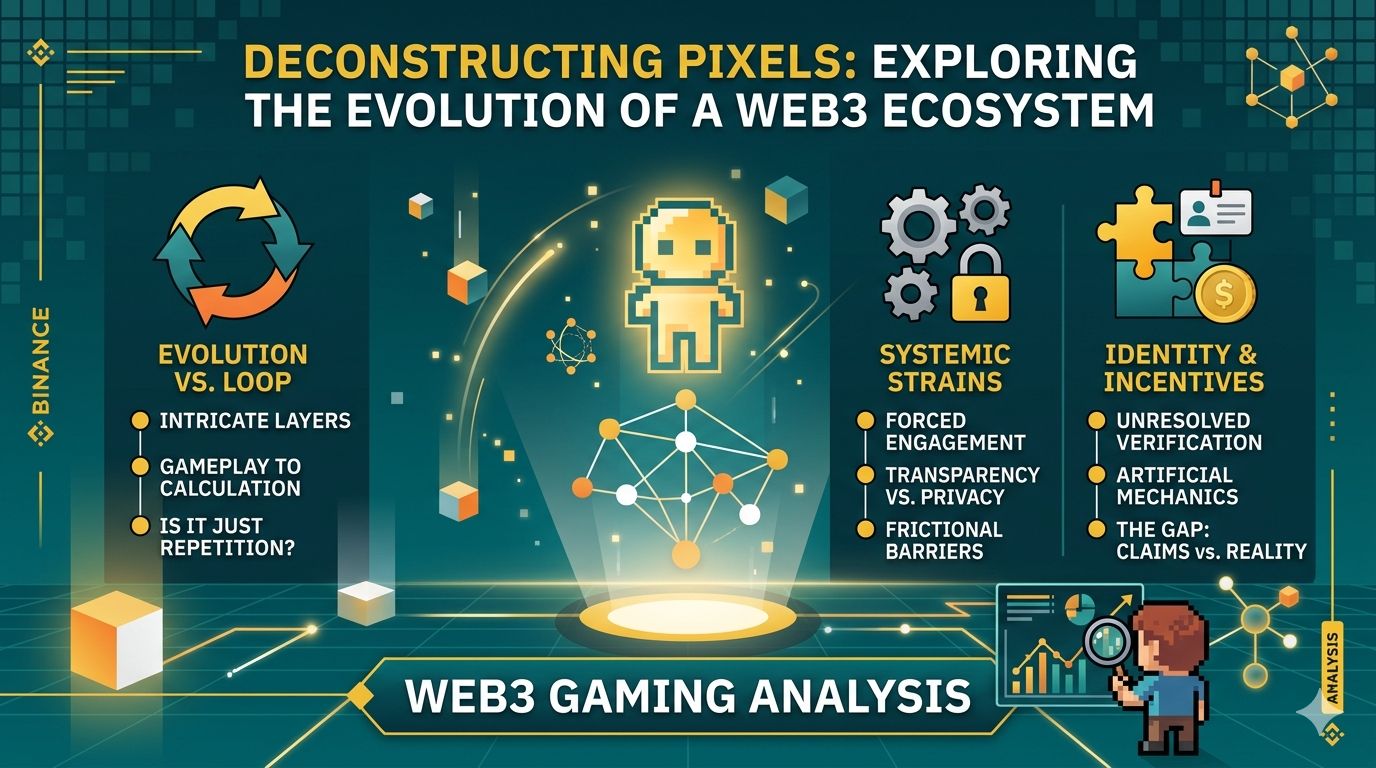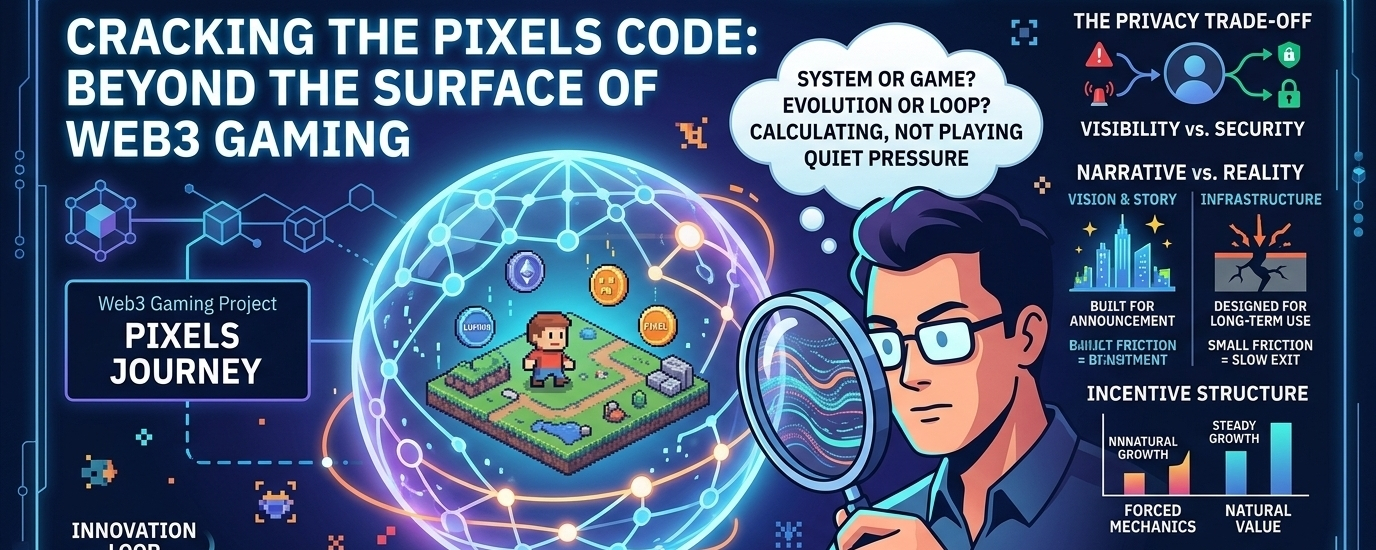
I keep coming back to Pixels, not because I’m convinced by it, but because I can’t quite ignore what it’s turning into. I’ve seen this pattern before—something starts simple, almost innocent, and then over time it layers itself into something much harder to define. And that’s where my thoughts start looping. Am I looking at a game, or am I watching another system slowly reshape itself into something else while still wearing the same label? I’ve asked myself this more times than I can count, and the answer never really settles.
With Pixels, the surface hasn’t changed much, and maybe that’s the point. From a distance, everything still looks familiar, almost predictable. But when I spend more time paying attention, I start noticing the same thing I’ve seen across cycles—new layers get introduced, and suddenly people stop playing and start calculating. That shift always catches my attention. It’s subtle, but it changes everything. And I can’t tell if that’s evolution or just another version of the same loop, dressed differently enough to feel new.
What bothers me isn’t the complexity itself, it’s what comes with it. In Pixels, like in so many other systems I’ve watched, there’s this constant push where you’re expected to engage more, reveal more, optimize more. It’s never just participation. There’s always this quiet pressure underneath, like the system only works if you give it a little more than you’re comfortable with. And that’s where I start questioning things. Why does it always feel like I have to choose between being visible and being secure? Why does transparency come at the cost of privacy almost every time?
I’ve noticed that Pixels sits in that same uncomfortable middle ground. Too much exposure has somehow become normal, almost expected, and yet when something claims to protect privacy, it usually swings too far in the other direction and breaks everything else. Usability disappears, trust gets complicated, and suddenly the solution feels worse than the problem. I’ve seen this trade-off so many times that I don’t even react to it anymore. I just expect it.
And then there’s the storytelling. Pixels doesn’t escape it either. Everything always sounds right when it’s explained. The vision is clear, the direction feels intentional, and for a moment it almost convinces me. But I’ve learned to be careful with that feeling. I’ve watched too many systems where the story carries more weight than the reality. Infrastructure always sounds solid until it’s actually tested. Under pressure, things don’t break loudly—they just quietly stop working the way they were supposed to.
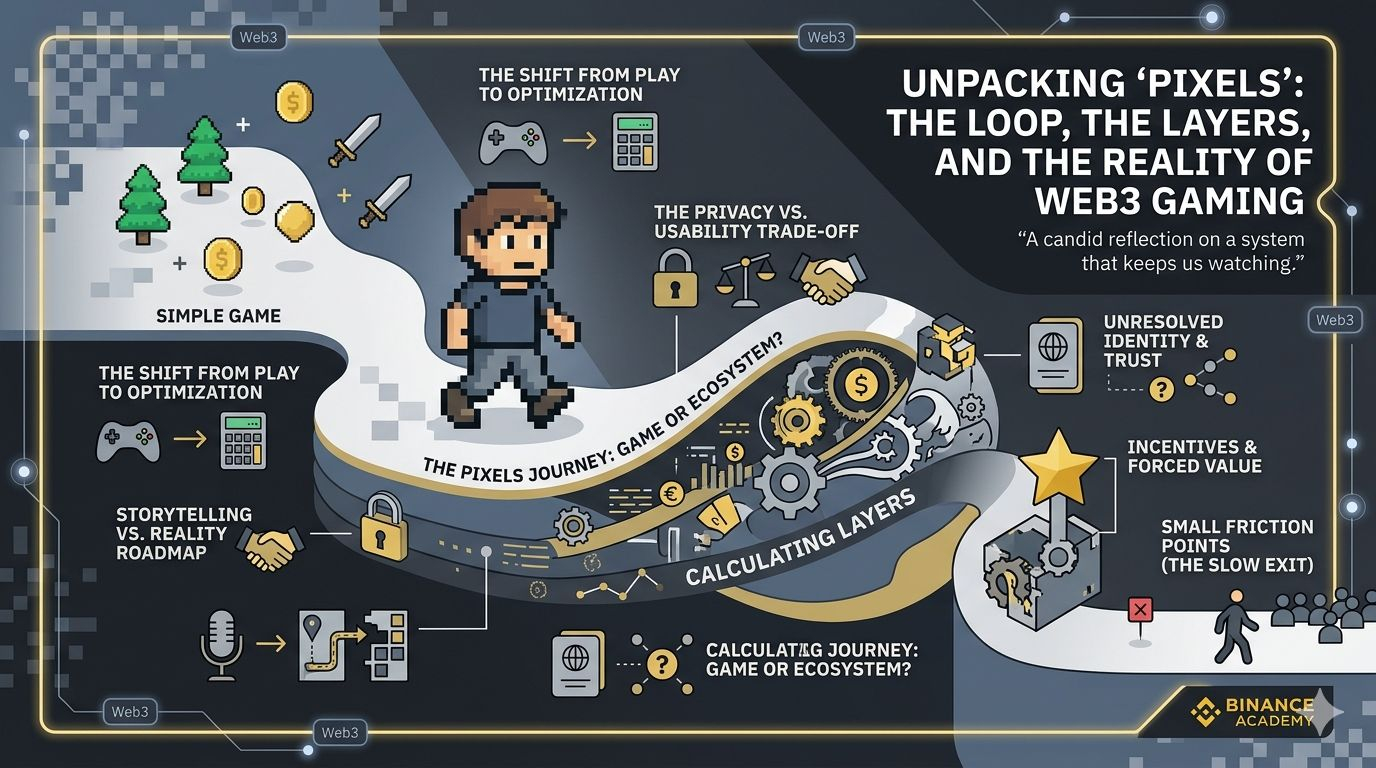
What really gets overlooked, again and again, even in something like Pixels, is the experience of the people building and interacting with it. It’s not the big ideas that fail first, it’s the small friction points that never get fixed. When using something feels harder than it should, people don’t complain, they just leave. And that slow exit is what kills adoption, not some dramatic collapse. But nobody seems to design for that moment. They design for the announcement, not for the long-term use.
I can’t ignore the role of incentives either. In Pixels, like everywhere else, the structure around value feels… forced sometimes. Not always broken, but rarely natural. It’s like systems are trying to justify their existence through mechanics that don’t really need to be there. And when I step back, I start wondering if all of this is actually necessary, or if it’s just another layer added to make things feel more complete than they are.
Then there’s identity and trust, which somehow remain unresolved no matter how many times they’re reintroduced. Pixels touches that same space where everything is supposed to connect, but nothing fully settles. Verification never feels reliable enough, identity never feels fully owned, and trust always depends on something external that can shift at any time. I keep waiting for that gap to close, but it never really does.
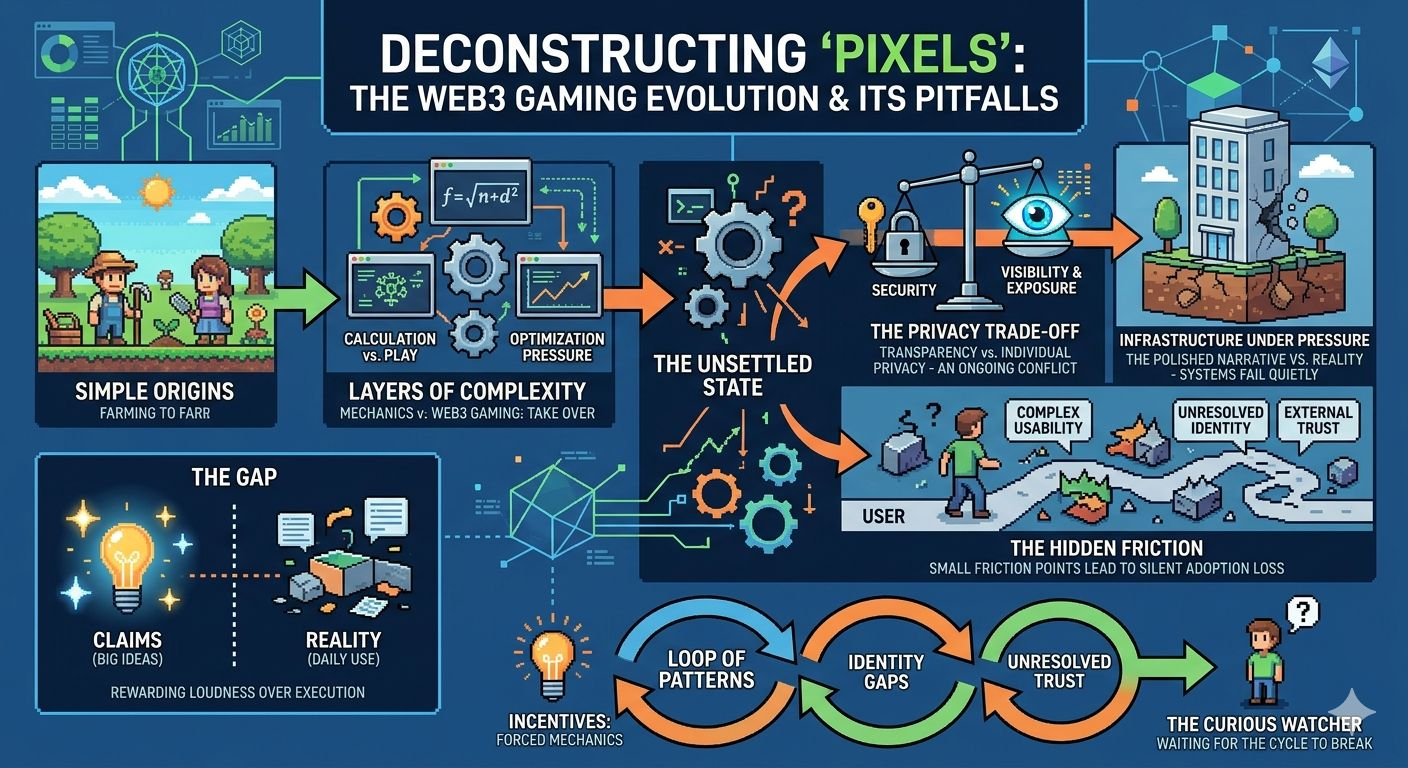
That’s probably what stays with me the most when I think about Pixels. The gap. The space between what something claims to be and what it actually becomes when people use it every day. It’s never as small as it looks at first. Big ideas come in strong, almost convincing, but over time they start to feel like camouflage for weaker execution. And the market doesn’t help. It keeps rewarding whatever is loud enough to be noticed, not what actually works.
So I’ve stopped trusting polished narratives, even in something like Pixels. Not because I think everything is failing, but because I’ve seen how easy it is to make something sound complete before it actually is. Now I just watch differently. I look for where things strain, where they slow down, where people quietly disengage. Those moments tell me more than any roadmap or explanation ever could.
And still, I keep watching Pixels. Not out of belief, but out of curiosity. Because despite everything—the repetition, the unresolved problems, the familiar patterns—there’s always that small chance that something breaks the cycle instead of repeating it. I haven’t seen it happen yet. But I haven’t stopped looking either.