
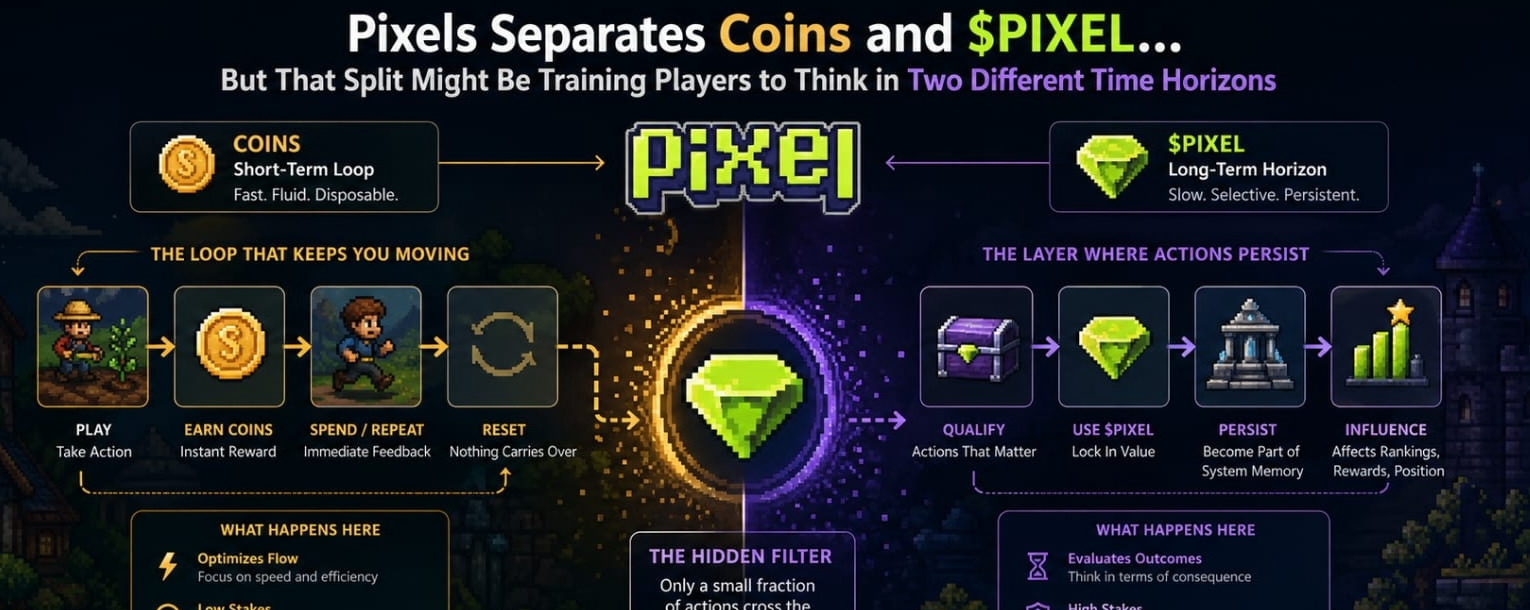

i used to think flexibility inside @Pixels was just part of the comfort of the game. You can adjust routes, delay upgrades, sit on resources, rethink how you use what you have earned. None of that felt especially meaningful at first. It just seemed like ordinary freedom inside a game loop. But lately I keep wondering if that flexibility is doing something much deeper than simply making gameplay feel less rigid. What if reversibility itself is part of how the economy is structured. Not in an obvious tokenomic sense, but in the way value becomes something players gradually commit to rather than something every action produces automatically.
That thought started bothering me because not every action inside Pixels feels equally final. Some actions seem to happen in a kind of provisional state, where you are participating, progressing, even accumulating output, but not necessarily crossing into something irreversible. You can still change your mind. Delay. Re-route. Reallocate. And maybe that matters more than it first appears. Because an action that can still be undone carries a very different weight from one that cannot.
At first I thought that was only psychological. A matter of how decisions feel. But the more I sit with it, the more it starts looking economic too. Because reversibility affects how players behave before value hardens. If I know I can still revise a decision, I experiment more. I tolerate ambiguity longer. I may stay in exploration rather than rushing toward commitment. That changes the character of participation itself.
And maybe systems care about that.
Because if every action immediately carried irreversible consequence, behavior might compress too quickly into optimization. Players would treat every move as something to maximize. But where reversibility exists, there is room for something else. Testing. Hesitation. Exploration. A kind of provisional engagement that does not immediately collapse into extractive logic.
That is where this started feeling less like a gameplay observation and more like a structural question.
Maybe part of the economy is not only organized around rewards.
Maybe it is organized around when actions stop being easily reversible.
That sounds abstract, but I keep seeing traces of it. A lot of activity inside Pixels seems allowed to remain fluid before the system asks players to treat outcomes as fixed. Almost as if value is permitted to stay soft before it becomes something harder.
And that makes me wonder whether reversibility is doing hidden economic work.
Because an action can generate output without yet generating consequence. Those two things are not identical. Activity can be abundant while commitment remains selective. And maybe reversibility is one reason the system can hold that separation.
“some value is produced in motion… some only begins when motion can no longer be undone”
That thought keeps staying with me.
Because it suggests value may not emerge only when rewards appear. It may also emerge when players cross thresholds where optionality narrows.
And thresholds change behavior.
Once reversal becomes costly, decisions begin revealing conviction in a way provisional actions do not. Anyone can participate while everything remains adjustable. Fewer choices survive once consequences start hardening.
That difference feels important.
Because maybe commitment inside a system is not measured only by what players do.
Maybe it is partly measured by what they continue doing once revision becomes harder.
And if so, reversibility is not just convenience.
It shapes the meaning of commitment itself.
I think that is where this feels different from older play-to-earn systems I have seen. Many of those treated activity and commitment almost as the same thing. Do something, earn something, extract something. The path from action to value was immediate. But Pixels sometimes feels like it inserts a softer layer where action can exist before value fully settles.
That may be one reason it often feels less mechanically extractive.
Because not everything done is immediately framed as something final.
There is space where behavior remains exploratory.
And maybe that space matters for sustainability.
Because too little reversibility and systems can become brittle. Every choice carries too much pressure too early. Players stop exploring because consequences feel too immediate.
But too much reversibility creates a different risk. If everything stays provisional forever, commitment can lose meaning. Value may never harden enough to matter.
So somewhere between rigidity and endless optionality there has to be balance.
And maybe that balance is more central to the economy than it first appears.
I keep wondering whether this also changes how the system interprets players. Reversible behavior may carry weaker signals than choices made after options narrow. If so, maybe some forms of participation only become legible to the economy after reversibility begins closing.
That makes the moment where flexibility gives way to consequence feel strangely important.
Not as a dramatic event.
As a quiet threshold.
And thresholds are often where systems reveal themselves.
Not when everything is fluid.
When fluidity starts turning into structure.
That may be why I keep thinking about reversibility less as a player-side feature and more as hidden infrastructure. Something shaping how commitment enters the economy without explicitly announcing itself.
And honestly, I am not fully sure I am right about any of this. Maybe flexibility is just flexibility. Maybe delayed commitments are simply pacing. That is possible.
But the longer I watch these loops, the harder it feels to believe reversibility only exists to make gameplay forgiving.
It seems to be doing something with timing.
Something with consequence
Something with when value stops being easy to take back.
And if that is true, then maybe one of the stranger design questions inside Pixels is not simply how value gets created
It is when the system decides value should stop remaining provisional at all.