
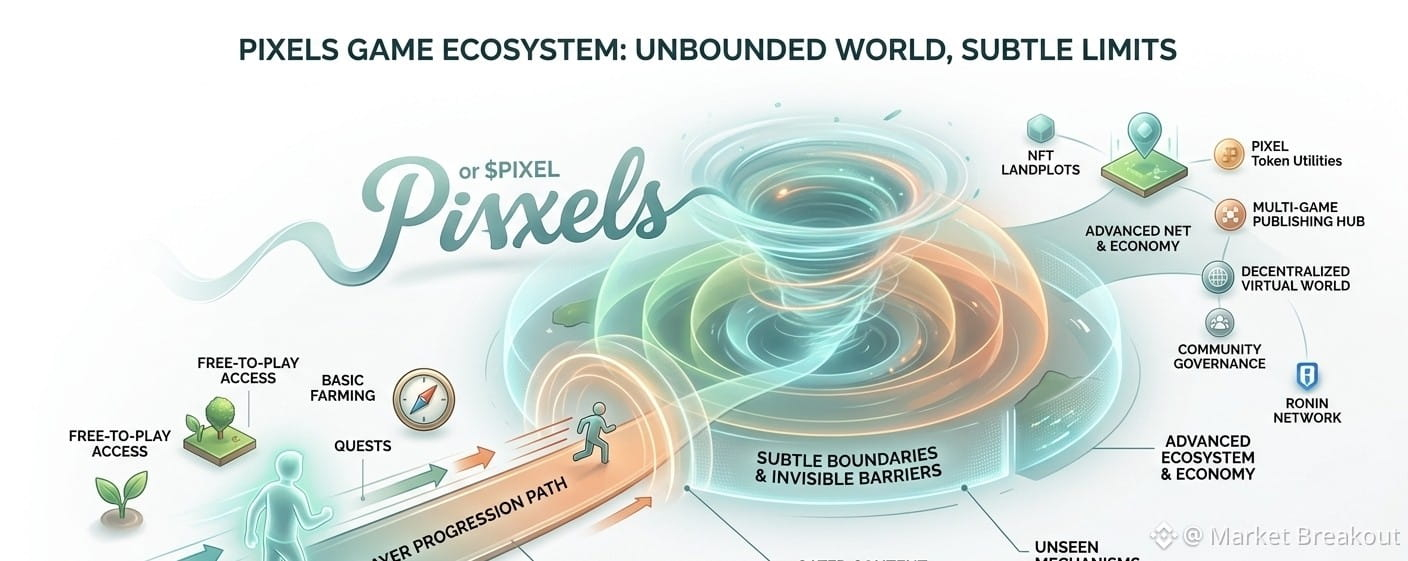
I used to think open systems were easy to understand.
You log in,
you move around,
you do things,
and the system lets you keep going.
No hard stops.
No visible walls.
Pixels feels like that at first.
Everything looks accessible.
You can farm,
craft,
trade,
repeat.
Nothing really tells you to stop.
And that’s what makes it feel open.
But after spending enough time inside it,
I started noticing something that didn’t quite fit that idea.
Not a restriction.
Something quieter than that.
Because even though nothing blocks you directly,
everything doesn’t progress the same way either.
Some things move forward easily.
Others seem to slow down,
without ever clearly telling you why.
That’s the part that’s hard to explain.
Because it’s not a limit you can point at.
It’s something you feel over time.
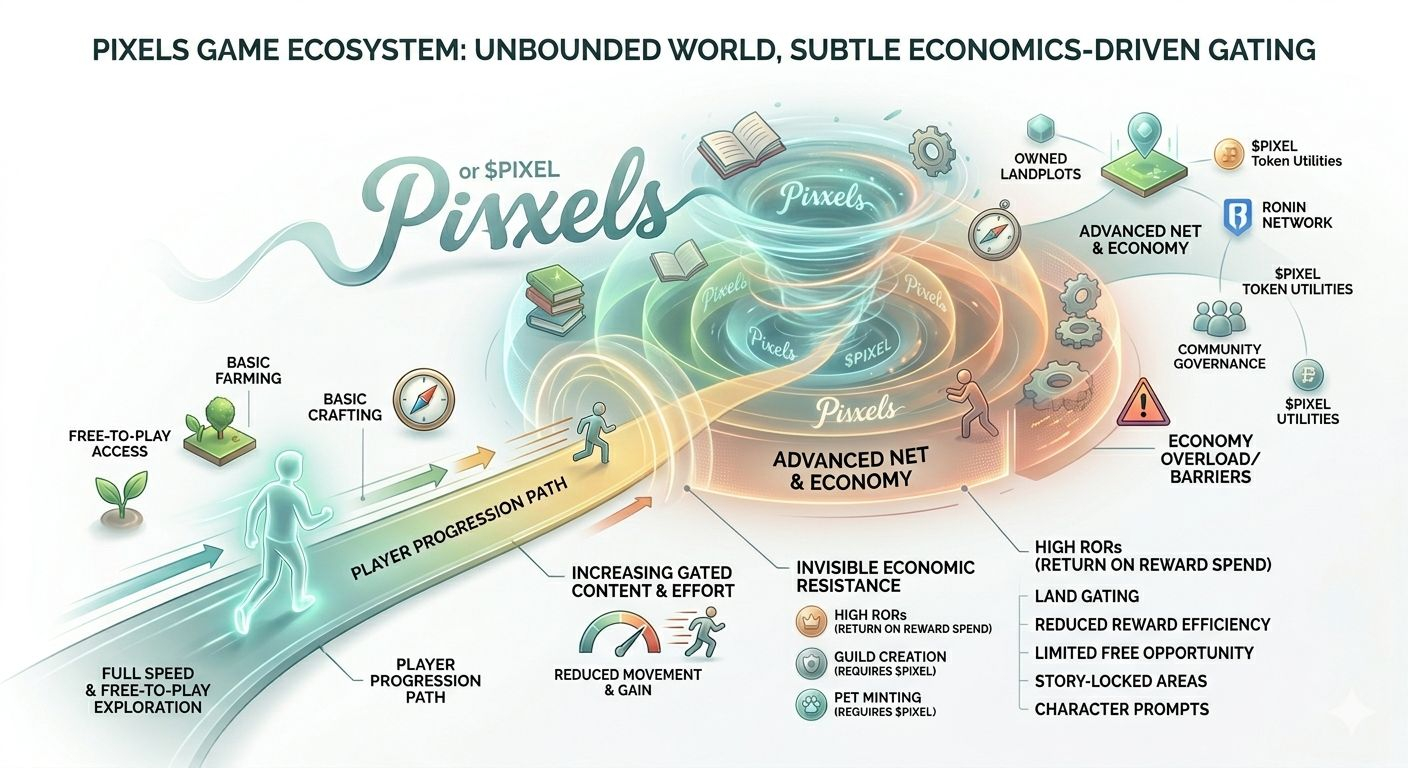
Like the system is allowing movement,
but not fully converting all of it into meaningful progress.
And that’s where $PIXEL, started to feel different to me.
At first, it looks like a standard layer.
Speed, access, small advantages.
But the more I paid attention,
the more it felt like it was sitting closer to something else.
Not where you start doing things,
but where the system decides
how far those things actually go.
There’s a difference between activity
and effective progression.
Pixels seems to separate those two,
but without making it obvious.
You can keep playing for hours,
keep producing,
keep interacting.
And still feel like certain parts of that progress
aren’t fully carrying forward.
Not lost.
Just… limited.
That’s where the system changes its shape.
Because the limits aren’t hard.
They’re soft.
You don’t hit a wall.
You just stop moving forward at the same speed.
And when that happens,
you start looking for what changes that.
That’s usually where $PIXEL comes in.
Not as something that unlocks everything,
but something that adjusts
how much of your activity actually translates into progress.
That’s a subtle role.
Easy to miss if you’re just playing casually.
But once you notice it,
it changes how the system feels.
Because now you’re not just thinking about
what you’re doing,
but how much of it actually matters.
And more importantly,
what controls that difference.
I caught myself slowing down at one point.
Not because I ran out of things to do.
But because I wasn’t sure
if what I was doing was still pushing me forward in a meaningful way.
That’s not a common feeling in open systems.
Usually, effort equals progress.
Here, it feels slightly filtered.
Not everything converts equally.
And that creates a kind of invisible boundary.
Not a restriction you can fight,
but one you gradually adjust to.
I’m not sure if that’s intentional design
or just how the system behaves over time.
But it changes the idea of “open.”
Because openness usually means
you can keep going without resistance.
Here, you can keep going…
but not everything scales with you.
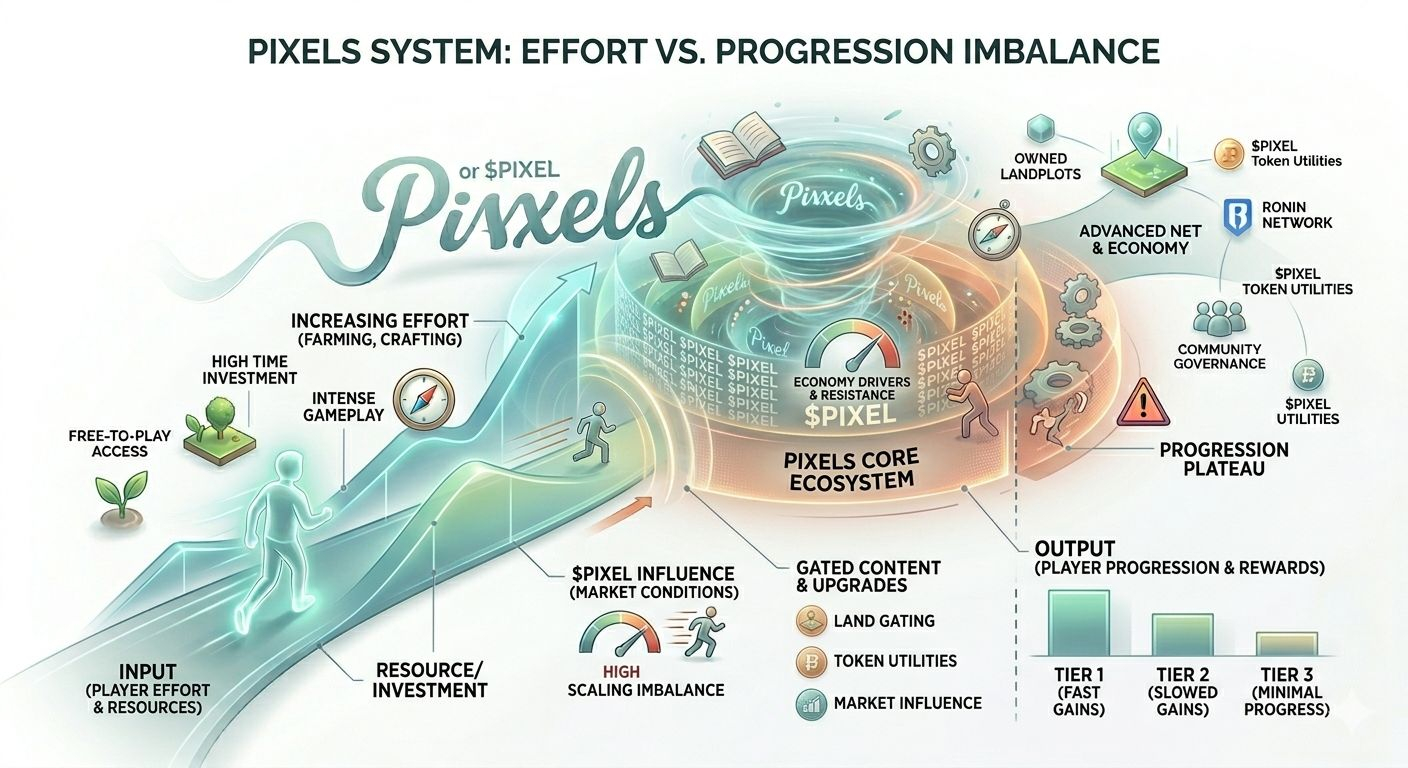
And $PIXEL seems to sit somewhere in that gap.
Not stopping you,
but quietly shaping
how far your actions actually reach.
I’m still not fully convinced
how stable that is long term.
Systems with invisible limits
tend to get tested in ways that aren’t obvious at first.
Players adapt.
They find edges.
They push against what isn’t clearly defined.
And that’s usually where things either hold
or start to break.
For now, it just feels… different.
Open on the surface.
But not entirely without boundaries.
And those boundaries aren’t something you see directly.
They’re something you slowly run into
without realizing exactly where they begin.