
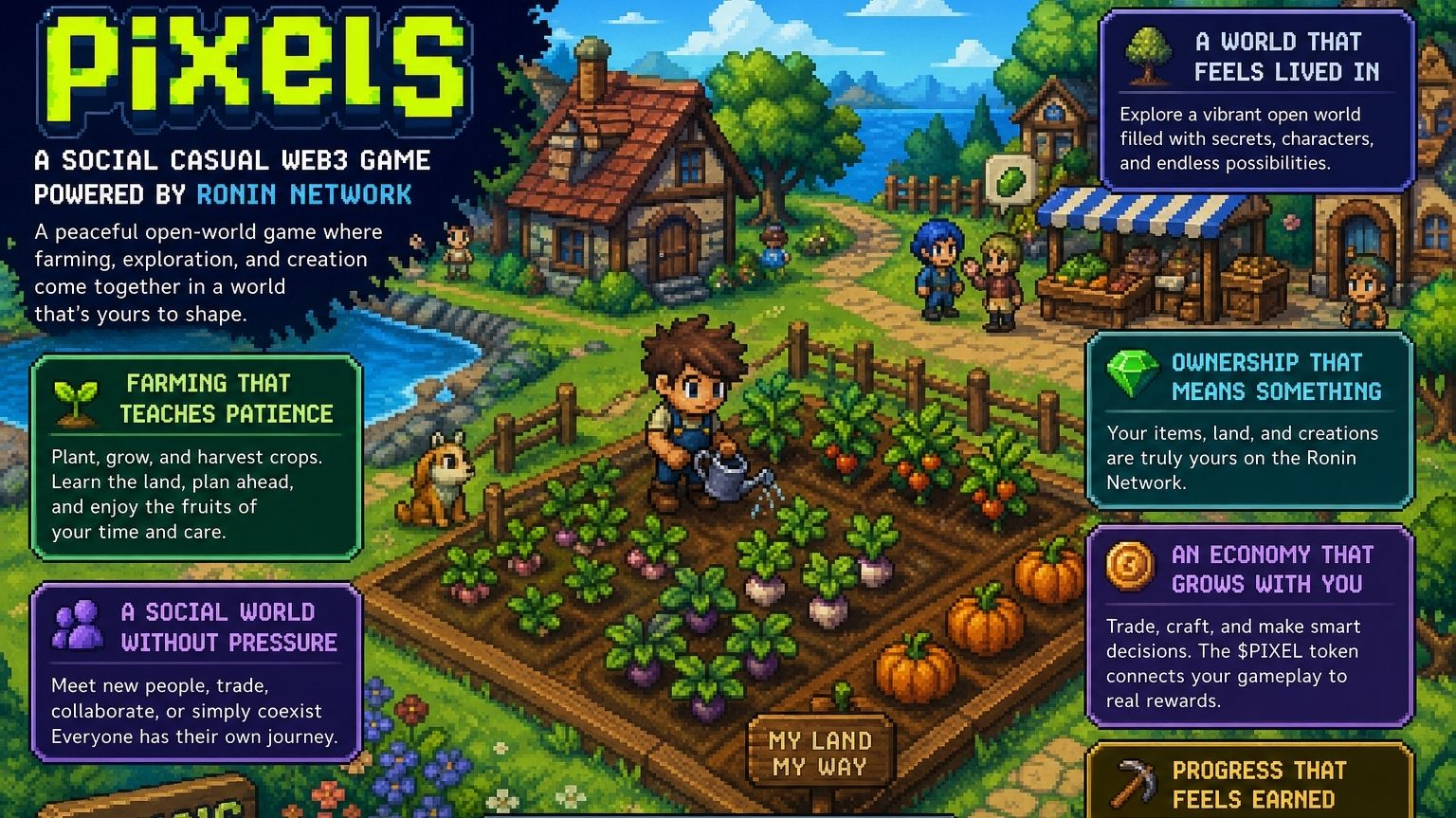
It’s easy to underestimate a game like this at first glance. Pixel art, farming, simple movement—nothing that screams “next big thing.” But Pixels has a way of changing that first impression slowly, almost without you noticing.
What starts as curiosity often turns into routine. And that shift is where the real experience begins.
A World That Doesn’t Shout for Attention
Pixels doesn’t throw you into chaos or overload you with instructions. You arrive, and the world is already moving at its own pace.
There’s soil to work on, paths to explore, and other players quietly doing their thing. Nothing demands urgency. Instead, the game gives you space to decide what matters to you.
Some players immediately start building farms. Others just walk around, learning the land. There’s no pressure to perform. That alone changes how it feels compared to most online games.
Not Just a Game, but a Layered Space
Under the surface, Pixels is connected to Ronin Network, but you don’t feel like you’re dealing with blockchain mechanics every second.
That’s intentional.
The Web3 side is there to support ownership and economy, not to interrupt gameplay. You don’t need to understand technical systems to enjoy it. You just play—and the deeper systems work quietly in the background.
That balance is rare. Many games either hide the tech completely or make it the center of attention. Pixels stays somewhere in between, and that’s what makes it approachable.
Farming That Teaches Patience Without Saying a Word
Farming in Pixels looks simple, but it changes how you think about time.
You plant something, leave it, come back later. Nothing flashy happens instantly. Instead, progress builds slowly.
At first, that might feel slow. But over time, it becomes the most satisfying part of the loop. You start planning your actions instead of reacting to them. You think ahead a little more. You notice patterns.
It’s not just gameplay—it becomes a rhythm.
A Quiet Social World That Feels Natural
There’s something refreshing about how people interact in Pixels.
You see others around you, but you’re not forced into constant communication. You can cooperate, trade, or simply share the same space without any pressure.
It feels closer to a living village than a competitive arena.
Some days you interact a lot. Other days you just focus on your own land. Both feel normal. Nothing is pushed.
That’s what makes the world feel alive without being overwhelming.
Progress That Feels Earned, Not Rushed
Everything in the game moves at a steady pace. Resources take time. Upgrades require planning. Nothing is handed out instantly.
This is where the in-game economy quietly becomes important. You start thinking about how to use what you have instead of just collecting endlessly.
Even rewards feel connected to effort rather than luck or speed. That makes decisions feel more meaningful. You’re not just accumulating items—you’re shaping your own small system inside the game.
Why Players End Up Staying Longer Than Expected
Pixels doesn’t rely on big moments to keep you hooked. It works differently.
It builds comfort through repetition. Checking your farm. Planning your next step. Seeing small improvements over time. Meeting familiar players again and again.
And slowly, without forcing it, the game becomes part of your routine.
Not because it demands attention—but because it fits into it naturally.
That’s where its strength really sits.
